Author Archives: melissahillman

I Wrote a Thing for TCG

The wonderful Edgardo de la Cruz, my undergrad directing teacher/cult leader

The wonderful Edgardo de la Cruz, my undergrad directing teacher/cult leader

I was asked by the wonderful Jacqueline E. Lawton to participate in the latest TCG blog salon, “Artistic Leadership: How Do We Change the Game?” She sent me a series of questions wickedly difficult to answer:

What was the most game-changing production you’ve seen or created, and why?

Who was the most game-changing theatre leader/artist you’ve met, and what do you carry forward from their example?

What is the most significant opportunity—or challenge—facing the theatre field, and how can we address it together?

My answers reference the late Edgardo de la Cruz, African American Shakespeare Company, Lauren Gunderson, Howard Sherman, Annoyance Theatre, and Lawton herself, along with issues of representation, money, and empathy.

Please check it out! You can find it here.

Tagged , , , , , , , , , ,

That Religious Person Next to You in Rehearsal

I looked for ages for a photo credit for this. If anyone knows this super-adorable kid, or the photographer, drop me a line. I found it onh beautyofhijabs.tumblr.com.

I looked for ages for a photo credit for this. If anyone knows this super-adorable kid, or the photographer, drop me a line. I found it on beautyofhijabs.tumblr.com.

Theatre has a certain . . . reputation, no? That professional theatremakers are an iconoclastic, irreverent community that ignores or even outright disrespects religion?

The reality is, as reality always tends to be, much more complex. It’s not uncommon, however, for religion to be invisible, or even denigrated, in some professional theatre circles.

People who grow up in Christian heritage families (and note that that isn’t the same as being Christian or practicing Christianity) have massive privilege in this country. Privilege creates a certain world view that, when left unexamined, deeply marginalizes people outside that privilege. Christian heritage privilege functions no differently than any other kind of privilege. It’s not that people with Christian heritage privilege overtly believe that Christianity is superior to all other faiths. Obviously, some do, but that’s not what I’m discussing here. What I’m talking about is unconscious bias.

Most people with Christian heritage privilege who have not examined that privilege have an unconscious bias that all religion functions like American Christianity (privilege believes “my experience = reality”); that all religion shares certain basic characteristics, beliefs, or principles with American Christianity (privilege believes “my understanding = truth”), and that Christianity is the dominant religion in the world (while Christians make up 70% of the US, they’re just 32% of the world).

Even people who have no real contact with religion apart from what they glean from popular culture, but who have unexamined Christian heritage privilege or have internalized its world view just from living in this culture often have this bias. Conservative Christianity is the most highly publicized religion in the nation. Every other type of Christianity is so completely overshadowed in popular culture as to be rendered invisible or tainted by association. Every other religion is either ignored or represented in wildly inaccurate or reductivist ways that are deeply colored by the world view of Christian heritage privilege. Conservative Christianity, the public face of religion in America, is taken by those with unexamined Christian heritage privilege and those who have internalized that world view as the basic definition of “religion.”

A certain kind of morality (anti-LGBT, anti-feminist, “pro-life”), certain political stances (anti-public assistance, pro-death penalty, anti-separation clause), certain practices (evangelizing, praying as wish fulfillment, tithing), and certain religious beliefs (male god in the sky, eternal hell for nonbelievers, original sin) are taken together as all the defining factors of “religion” rather than a certain type of Christianity.

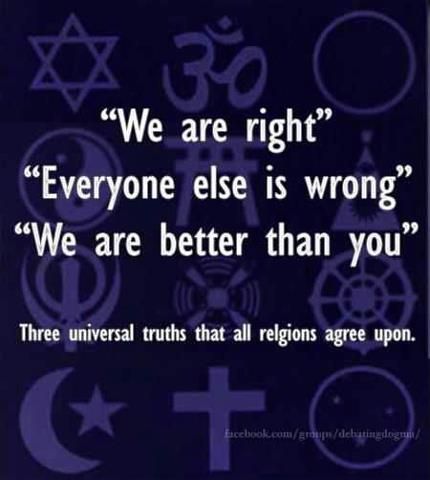
This could not possibly be more inaccurate. Not all religions are exclusive, and not even all of the tiny handful of the world's religions depicted on this meme are exclusive.

This is a great example. Not all religions are exclusive like conservative Christianity. Not even all the religions depicted on this meme are exclusive.

Therefore, it’s no surprise that some people who don’t come from observant families and aren’t observant themselves– an enormous, ever-increasing percentage of Americans– conflate this public, conservative Christianity with “religion” and conclude that “religion” is bad, whether they personally believe in a god (or gods) or not. And while most “nones,” (people who claim no religious affiliation) including atheists, are accepting of difference, a small but unfortunately vocal subset are actively hostile to all religion.

While there are certainly people who have come to an intolerantly anti-religion stance from non-Christian families, assuming all religions are like the ones they (or their forebears) left, the vast majority of anti-religious people in America, like the vast majority of people in America in general, come from Christian heritage privilege. Anyone who grew up in this country grew up surrounded by the erroneous concept that Christianity = “religion,” and that all religions function like Christianity in most ways. Some examine that world view and discover that it’s inaccurate, while others never examine it, some even expressing extreme fragility around the idea that Christian heritage privilege and its attendant world view exist at all. I’ve heard any number of people talk about all the “studying” they’ve done about “world religions,” yet claiming they’re “all alike,” a sure sign that their “studying” amounted to a Buzzfeed article on The Craft and half a documentary on Netflix about Orthodox Jews before they got bored and fired up Bloodborne.

Open hostility to religion and religious people is one of the few acceptable public bigotries left to liberals, so people will go to great lengths to protect it by crafting all sorts of justifications, asserting that religious people are all hateful of nonbelievers, “stupid,” “delusional,” and responsible for the majority of society’s ills, bolstered by unexamined Christian heritage privilege bias that unquestioningly sees “religion” as identical in form and function to conservative Christianity. This point of view highlights where that’s the case (as in fundamentalist Islam’s anti-LGBT stance) and minimizes or ignores where it’s not, rather than accepts that “religion” is a category so diverse that there’s not a single thing that could be said to define it across the board, not even a belief in a god or gods.

The impact in the theatre community is clear when you begin to look for it. More professional theatremakers than you think are religiously observant, and it’s no surprise that many hide that fact because they worry about their colleagues’ potential reactions.

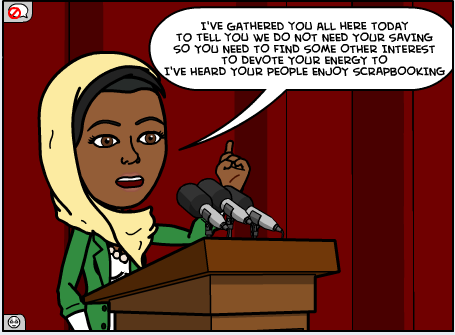
white-feminist-scrapbooking

I’ve been thinking about these issues for awhile. When you start to look for something, you see it everywhere, and it became clear to me that there is a large, but largely invisible, segment of our community that is religiously observant and, in many cases, hiding it, or hiding its full extent, anxious about their colleagues’ reactions. And while I’m not advocating for pushing this issue to the forefront past other issues of privilege and inclusion like race and gender, I am advocating for deeper thought around this issue, more kindness, and more acceptance, from everyone, on all sides, religious, atheist, and everyone in between.

A number of religiously observant theatre professionals volunteered to be part of this blog post. I wanted to give these people a voice, but allow them to retain their anonymity if they so chose, so some of the names below are real, and some are pseudonyms, but they are all real answers from real people. So here you go, theatre community. The religiously observant people with whom you’re already working, in their own words, discussing theatre and their faiths.

A Wiccan wedding, called a "handfasting." Photo cred: leavemetomyprojects.com

A Wiccan wedding, called a “handfasting.” Photo cred: leavemetomyprojects.com

What are the largest challenges you face as a religiously observant theatre professional?

Rowan, Wiccan director, Chicago:

Scheduling around events. Sometimes there are just unavoidable conflicts, and most of the time, I let my career come first. Discrimination against Wiccans is common, so most of us are in the broom closet, as we say. You can’t be open unless you know you’re in a safe space.

Larissa, Christian playwright, Santa Monica:

Scheduling during Christmas and Easter. I have performed shows on both holidays, but when it is a matter of rehearsal I let them know up front that I am one of two altos in our choir so if it is possible to give me an hour on Sundays to come in later if everyone isn’t always called, I would appreciate it. Sometime people are cool with it, often not, which is fine. I made the choice to accept the job so I don’t press it. However it is hard to hear the snide remarks about my being a Christian and missing church, which I never mention in the work place unless asked directly.

Nick, Quaker actor, San Francisco Bay Area:

I used to be really challenged whenever taking on roles. My concern was not so much about whether or not I am going to do something bad or sinful in a performance, but whether or not the piece of art as a whole that I am helping to create is creating goodness and beauty in the world. I am less concerned about that now, because my values have changed and I have more faith in the goodness of people than I used to. I was never super fundamentalist and felt like if it wasn’t a Christian message then it is evil, but I leaned more in that direction. However, this does still matter to me. I feel like my job as an artist is to create goodness and beauty in the world, to create the new heaven and new earth. For that reason I try to join artists who are doing that. The most important role I’ve been in was 8, a staged reading of the overturning of Proposition 8.

Linda, Buddhist stage manager, San Francisco Bay Area:

SCHEDULING. The best and the worst thing about being a Buddhist juggling production schedules is one and the same: how I practice is flexible. (The biggest challenge is not specific to theatre: the general public is very confused about Buddhism.) When a schedule conflict unexpectedly arises, I am more likely than not automatically expected to forego my commitment to my practice just because I can and just because ultimately I “only” answer to myself. Most productions have been good about keeping to a previously agreed upon schedule and being accommodating when schedules change. (Most, but not all.)

Andy, Christian playwright, Rhode Island:

I would probably say my biggest challenge is translating what are essentially religious themes into a modern idiom that is accessible to people from diverse backgrounds. This doesn’t mean watering down the religious content of my plays, but it does mean grounding them in real human emotions. What religion essentially is to me is a deep affirmation of the dignity and worthiness of each human, and as such is provides a very useful frame to examine long-standing conflicts of the human condition.

Alona, Jewish actor and director, New York:

I am a modern orthodox Jew. Every Friday night at sundown, until three stars appear on Saturday, I go into full-out Sabbath-mode: no using electricity, no driving or using public transportation, no cooking, no listening to or making music, no money, no writing, no carrying items outside of buildings. The list goes on and on, and it doesn’t mix with the world of professional theatre.

By acting in professional theatre, you are agreeing to a life of of Saturdays spent using microphones, being lit by stage lights, getting paid for working. You are also probably agreeing to work in theatres that are not a walkable distance from your home, and even if they are, you are agreeing to come to rehearsals prepared, which often means carrying your script (and food and a water bottle) outside. Usually you are expected to be ready to write down blocking or line changes, to be reachable by phone or email for last-minute schedule changes, and to listen to whatever music is included in the show or rehearsal or workshops. And while some theaters don’t perform on Sunday, I can name only one theater that never has Friday night/Saturday shows or rehearsals (shoutout to 24/6 in NYC). All of these things become extremely problematic very quickly.

In sixth grade, I moved to New Jersey and auditioned for Paper Mill Playhouse’s summer conservatory. At the time, my family and I were incredibly naive about all things theatre: my father answered the call and gave the casting director a grateful thanks-but-no-thanks. I wouldn’t be able to go to rehearsals or do shows on the Sabbath, he explained, and besides, opening night would be on Shavuot, a Jewish holiday. The casting director thanked my father and hung up. I was devastated. Fortunately, she called back, promising to work around any conflicts with Judaism. Looking back, I see how incredibly rare and accommodating that second phone call was; it’s a gesture I’m not going to forget. Paper Mill was wonderful about everything. They set up the double casting schedule so I’d have as few Sabbath performances as possible. That press opening coinciding with Shavuot was an unavoidable conflict, but they let me and my mother stay in an apartment just across the street from the theatre so I could walk over, and continued to let me do so for every Shabbat throughout the run.

I thought I’d solved the dilemma. But I was wrong. As I did more and more theatere, the conflict got harder and harder to deal with. Each show presented a new set of obstacles, a new set of decisions to navigate and compromises to make. Because where do you draw the line? If you’re signed on to a show and suddenly you have to eat onstage, do you ask the stage manager to buy (often more expensive) kosher food? What if painting or writing is written into a part? I can decide to listen to the orchestra playing, but what happens I’m asked to accompany myself with an instrument onstage? It’s a very tenuous balance to strike — and potentially destructive, too, because making too many compromises on either side has the potential to alienate you from either community. Taking on a high-profile role at a local theater could mean publicizing the fact that you’re breaking Shabbat, which could mean that some people in the Jewish community might stop trusting your standards of keeping kosher, and no longer feel comfortable eating at your house. Conversely, it’s easy to be “too difficult to work with” in the theater: being associated with a set of mysterious rules and conflicts could raise red flags for companies who don’t know what to expect. So there’s a balance between being up-front about potential conflicts and not scaring off theatre companies. If I anticipate any big problems or conflicts I’ll note it on the audition form — holidays like Rosh Hashana or Passover, for example. Sometimes I’ll even write something like: “talk to me about the Sabbath — some restrictions but shouldn’t be a big issue.” Being reassuring is important – people who are dealing with this situation for the first time might think it will be impossible. Part of my side of the bargain is letting them know that I’ve successfully struck a workable balance in the past, and that this can work out this time too. In fact, it will hopefully (probably?) be barely noticeable to them.

Jerry, Christian playwright and actor, San Francisco Bay Area:

I feel that I have been fortunate that my theater practice and Christianity have not been much in conflict, except the occasional timing issue between church letting out on Sunday morning and a tech rehearsal or performance. Belonging to a Lutheran church, there has been no onus about working in the theatre, and as a devout Christian, my writing is primarily focused on good and evil with good being an active verb rather than a responsive partner. Does that make sense? Based in my Christian faith, I believe that good is something one does, not merely something one is. As an actor, I have never been asked to do a part that was in conflict with my faith. Of course, I am not so sure it is the same for more dedicated actors. There are more of them than roles, and desperation can be a mighty powerful influence. I suppose it all comes down to values, and are we as artists true to them, whether they are faith-based or general personal ethics. I know what my values are, what kind of work I want to be a part of and what kind I don’t. For example, I don’t think I could be involved in a theater production of any kind where evil acts or evil people are glorified. Even for good money.

 Ariel, Muslim actor, San Francisco Bay Area:

I think as a woman who wears the hijab, and a convert who is also a theatre professional, the biggest challenge so far has been more internal, figuring out what MY line is. For me having graduated college and immediately jumping into work in the city while at the exact same time jumping in and embracing my newfound faith has really had my brain cooking as to where do I set the line. We as women are so hypersexualized that it is constantly in the back of my head. I ask myself questions like, Should I wear my hijab when I audition? Will they feel weird? Should I tell them no, I don’t feel comfortable doing this? Will that hurt my chances? How will my castmates react to me? Was taking my hijab off in the audition room a good idea or not? If I show my hair will that give me a better chance? The questions sound silly, even to me, but as a woman in theatre who used to think “I’m always going to be sexualized in this game, so why turn down roles just because I feel uncomfortable,” these questions are real.

Photographer: Kris Krüg

Photographer: Kris Krüg

Have you ever had to compromise either your faith or your art due to your commitment to living as a religiously observant theatremaker?

Rowan:

I turned down a show because it had a stereotypical caricature of a Wiccan in it, just there for laughs. Just mockery.  And I couldn’t say why. I faked a response about scheduling. I would have loved to do the show. I don’t know what their relationship with the playwright was. I didn’t feel like I could ask for changes to the script. I’d rather not stick my neck out about it and get labeled a problem or deal with bigotry.

Larissa:

I keep my mouth closed a lot when people are Christian bashing at work because I don’t want to become a target. I am often amazed that the same theatre people who are intolerant of hate speech toward Muslims or Jews will openly tear apart ALL Christians during work and think nothing of it. That kind of hate speech is completely tolerated at our theatre work places.

Nick: 

When I was less progressive, I used to believe that homosexuality was a sin. The first show I did with [company] was Merchant of Venice, and Antonio was directed to be openly gay. Even though I believed homosexuality in particular was a sin, that was such a small piece of the beautiful piece of work the director created. His Merchant was above forgiveness and terrifying consequences of rumors and prejudice. It didn’t matter what my beliefs about homosexuality were. It doesn’t matter that I may disagree with this director on one particular, because overall I know that he is making the world better. If there are scheduling conflicts between rehearsals and religious meetings or holidays, I will let rehearsal win. I view my art as a religious practice, so there is no compromise for me in creating art instead of going to church.

Linda: 

I rarely compromise in theatre, which means I do often compromise going to temple. Working in theatre also involves late nights, which makes getting to temple early the next day more a chore than the joyful chance to recharge it usually is. What this usually means is I compromise on recreation and keeping up with pop culture.

Andy:

I will refuse to do any theatre that conflicts with my religious beliefs, but in a very general sense. That is, I will refuse to do plays that do not affirm the basic dignity of human beings. This doesn’t feel like a compromise to me.

Alona:

The hardest thing for me was the realization that it was impossible to practice modern Orthodox Judaism and also do professional theatre. I would have to compromise one or both, and I think that’s the saddest thing. But in the world of inevitable-compromise-making, I have been incredibly lucky to work with amazingly understanding people: directors and SMs and castmates and techs who will go out of their way to print their notes instead of emailing them, to coordinate schedules so that I’m not called on Shabbat, to make sure I’m not walking home alone without a phone at night, to sign my name on the callboard.

But there are still trade-offs. The biggest compromise I’ve ever had: a role I’d been dreaming of playing for ages, a fantastic director, a great cast. There was just one problem — one of the performances was on Yom Kippur. By that point I’d come to terms with performing on Shabbat, but Yom Kippur, the Holiest of Holy Days — that was on another level entirely. So when I got the call that I’d been cast, the classic rush of excitement was tainted by apprehension. I tentatively brought up the subject of Yom Kippur: was there any conceivable way to work around my conflict for that single date? The answer was (understandably) no.

Reconciling Judaism and theater had always happened on fluid spectrum; the decisions I’d had to make were always how-much-how-little, never either-or. Suddenly they were pitted against each other. I imagined, for the first time in my life, not observing Yom Kippur: not being in synagogue to hear the shofar blow, not fasting, not being with my family. I also imagined the pang of regret I’d feel every time I looked back at the road not traveled, the role never played. I talked myself out of taking the part, and I talked myself back in. In the end, I took the role.

The show ended up being a lot of fun, and I don’t regret signing on. But I do regret performing the night of Yom Kippur. First of all, though I was there in body, as I’d agreed to be when I’d signed the contract, I wasn’t there in mind. Ironically, though, my performance wasn’t the only thing that was a disaster that night. At two minutes to curtain, paramedics rushed into the theatre to take an elderly audience member to the hospital (she ended up being fine). During the show, lights broke, props broke, cues were missed, lines were dropped. Disaster upon disaster. It was, objectively, the worst performance of the run. And all through the performance that night, I thought about the story of Jonah and the whale, which we read in the synagogue every Yom Kippur. In part of the story, Jonah tries to flee God by boarding a ship. God sees through Jonah’s plan and creates a storm to destroy the ship: the ship’s crew panics, and Jonah, realizing that the storm is his own fault, his own punishment, tells them to toss him into the sea. So they do, the storm stops, and they are saved. I’m not usually particularly spiritual or superstitious, and my agnosticism remained (and continues to remain) sound, but that night, as the show (sometimes literally) crumbled around me, the irony of the situation was overwhelming. I wanted to shout to my fellow actors: “It’s my fault! Toss me off the stage and you’ll be saved!” Now I know: no more performing on Yom Kippur for me.

Jerry:

Pardon me for being a bit obnoxious about this one, but life is full of compromises. Still, I have never given up my core faith or artistic bearing for the other. I have never been in the position where I actually had to turn down or refuse anything because of my faith, or take part in something that was contrary to my faith. Doing good is who I try to be. Writing/theatre is my vocation. Being Christian is who I am. At least for me, all of these are interconnected. I sometimes have remarked in serious jest that as a writer/theatre artist, I have a higher calling than a minister has. (My pastor doesn’t like when I say that.) Where the pastoral calling is generally (but not always) for a specific congregation, an artist’s calling is to spread goodness, and even the good news of God’s grace (in a variety of ways, some of them very subtle) to the world.

Ariel:

I have been very fortunate to not have come across a scenario where I had to compromise my art or faith. Despite my own internal anxieties, the Bay Area theatre community in which I have been blessed to work has been really awesome in not putting me in a situation where I feel uncomfortable. I’ve also done my homework to avoid anything that won’t mesh well. I’m honestly figuring it all out along with everyone else, what I do or do not want to do. I will say this, though– when prayer time is the same as performance it does get a little tricky.

A Yiddish theatre poster, New York, 1891.

A Yiddish theatre poster, New York, 1891.

Has your faith impacted your approach to your art?

Rowan: 

We get to truths through storytelling that we can’t get to any other way. Theatre is magic, I believe that. I think people who see it as entertainment or just a job are missing out. Wicca impacts the way I see the world. I feel like the social justice focus I bring to my work is a big part of my faith. Even when the play isn’t specifically about a social justice issue, who you cast and how you treat them are.

Larissa:

I believe in a God that has a plan for my life, so I am able to be fearless and walk though doors that many theatre people cannot because of the lack of a safety net, but I always have one, God. I love that I have a place I can go to every week to remember that there are bigger issues in the world than a light cue or line rewrite. I get to go to church and think about things that are bigger than my life and share that peace with people who have nothing to do with my job. I love that time to unplug and refocus. I don’t know how non-religious people do it. I pray for God’s will in my life and walk forward with every path that is put in front of me, knowing that He will make it work out. I’m also very aware of needing my art to do something positive in the world. I don’t convert people through my art, but I need it to make a real life difference to people. To change things. I think that’s part of what draws people to my work, the desire to do something more than entertain.

Nick:

I am really biblically literate and I also do a lot of Shakespeare. It’s always fun knowing all of the Biblical references that he makes. “O Jephtha, judge of Israel, what a treasure hadst thou!” Fucking Jephtha. Each Quaker meeting (“church”) has a book called “Faith and Practice” which outlines what they try to believe and how they try to live. Being a Quaker is so much about living and practicing your faith. Like I said before, I try to create beauty in the world, so my work in the theatre (and all the work) that I do, I see as a religious practice. Even though I am a Quaker, I was raised Catholic and still love the liturgical language of the Catholic and mainline churches. I often think of theatre artists working together as communion.

Linda:

Spirituality and art are integral parts of a benevolent cycle. By cultivating compassion, sympathy, and empathy I “hear” the resonance better and that can only make me a better storyteller.

Alona:

I’ve always thought of people’s warm-ups and pre-show rituals as a kind of religion. There’s lots of tradition and spirituality in doing a sequence of stretches and repeating certain phrases – and also in holding hands in a circle before opening night, in what you’re not allowed to say backstage, and how to respond to stage managers (at the risk of sounding irreverent – I mean it very reverently, in fact – is a “thank you, five” really so different from an “amen”?). And also both theatre and religion tend to be simultaneously very communal and very internal – they both rely very much on participating with a group, be it a cast or congregation, while at the same time eliciting (and sometimes requiring) a parallel inner experience.

I also have a lot of plays in my head about Judaism and Jewish identity that have yet to be written, and I’d love to start getting them on paper to see what sort of dialogue comes out of them in rehearsal rooms and in audiences. The few times I’ve gotten to be in spaces where theatre and Judaism overlap (watching shows like Body Awareness, for example, or parts of Fires in the Mirror, and yes, also Fiddler) have been really exciting for me: theatre is a medium that I feel very at home with, and Judaism is such a huge yet completely mysterious part of who I am, so it’s exciting to see theatre used to tackle some of the questions I still have about that whole side of life. Tradition, tradition.

Jerry:

As a Christian, I am a disciple, and part of being that disciple is to love my neighbor. Who is my neighbor? The great theologian Martin Luther defined the neighbor is anyone who needs what I have to give. So I get to give my storytelling, my love of stories, my love of my fellow human beings, my dedication to the marginalized, my love of the wonderfulness of life to the world—through making theatre. I get to truly be a Christian, and spread the good news that we are all valuable, beautiful human beings through live-action stories. I get to serve my sisters and brothers. Golly, I could go on and on.

I love the stories of my faith, and I love the parables of Jesus Christ. As an artist, I am dedicated to doing good in the world. In the theatre I get to do this by telling stories about how wonderful and beautiful human beings are.

Andy:

I have access to an incredibly rich store of images and stories that all deal with the most profound questions of human existence. Being religious puts me in contact with people I would otherwise rarely know. I have friends who are 80. I have friends who are homeless. I have friends who are special needs. These are people I probably would never have met if we weren’t united by our faith. But the history of Christianity is also a great inspiration. Being religious in the way I am forces me to understand our present moment in its historical context, which is still deeply Christian, so I think in a way being Christian helps me understand how we got where we are. It’s a great resource, my faith.

Ariel:

I’ve been able to meet people of other faiths who share their stories and it’s been really enlightening. The most important thing for me, especially at this time where Islam in particular is being portrayed in the media as evil, and Muslims are being associated with murder, terror, evil, and radicalism, is to be able to say, “no, that is not who we are,” and it’s nice to have met people who have said, “yeah, I know,” or are just willing to listen. To debunk even the smallest of things or explain why we believe this or that, especially as a woman where there are all these misconceptions about how we are treated in Islam. It’s been nice to be able to have discussions and answer questions.

My faith has impacted my art in that I have been able to be more aware of the human condition, being able to take a piece or a character and look at it more deeply. It’s inspired me to engage more in pieces that challenge government, examine the “roles” of women and men, embrace color, sexuality, all points of view. In a way my faith as made me pickier, more selective. Thinking less “me” and more “us.”
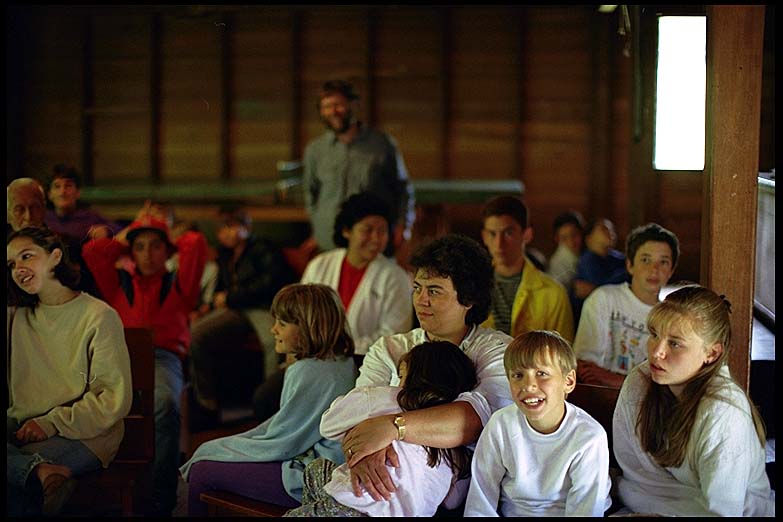
People gathered for a Quaker meeting. Photo cred: Philip Greenspun

People gathered for a Quaker meeting. Photo cred: Philip Greenspun

Has your art impacted your approach to your faith?

Rowan:

I love props and costumes and I use them in ritual all the time. Wicca can be very theatrical. It doesn’t have to be, but being a director, I think I have a visual, spatial approach to ritual, and how its theatrical aspects can impact people.

Larissa:

I’m definitely very aware that I work with non-Christians most of the time, and that makes me super aware of the bubble a lot of Christian live in. They really have no clue how the rest of the world thinks. That ignorance grows into intolerance. I see it happening all the time and it makes me so frustrated with being a Christian. It’s embarrassing.

Nick:

I think that Hamlet’s words to Horatio at the end of Hamlet have probably become as central of a religious text in my life as the Bible. “Not a whit. We defy augury. There’s a special providence in the fall of a sparrow. If it be now, tis not to come, if it be not to come it will be now, if it be not now yet it will come. Since no man knows aught he leaves what is’t to leave betimes? Let be.” Hamlet is also referencing Jesus in Matthew’s Gospel, so it’s fitting that I dig that.

Working in the theatre has also further instilled in me that idea that we live our faith in the world in our daily lives. Sometimes when I go to meeting (church), I see a bunch of people singing songs, pretending they feel a certain way, and listening to a very intellectual heady sermon, pretending they believe certain things (defining belief not as your practice in life or even what’s in your heart but intellectual assent to ideas), and I think what the fuck is the point? Then I go to the theatre and I see a group of people working together, supporting one another, to create beauty in the world, and I think, “This is the Church.”

Linda:

Deepening the understanding of humanity in all its many facets enlightens my understanding of my own foibles and what I might be able to do about them. A lot of Buddhism revolves around not giving one’s own ego free rein and one way to do that is putting yourself in someone else’s shoe, which is a skill storytelling can hone.

Alona:

Aside from helping me recognize that tradition can be dynamic on a personal level (as opposed to just societal), I don’t think it has….Hm, I’ve never really thought about this before! Maybe it’s something I’m still figuring out. I do know that I ironically hate “performing” in religious contexts – on the rare occasions that I go to an all-women’s minyan, I try to stay away from reading from the megillah and things like that.

Jerry:

I think they are intertwined; one impacts the other. But I believe I think more deeply about my faith because I am a writer. I apply (and when I teach Christian education relate) a basic premise I use in theater to the stories of my faith: What is it about? Not just what happens, but what is the story about. I also think a lot about truths – from my art to my faith, which is a different way of saying what I just did. Is this a true story? Do I believe it? Not do I believe it is factual, but does it tell me something important about human nature, or in the case of Christianity, God’s relationship to us and our relationships to each other?

The Thai Buddhist temple in my hometown of Fremont, CA. More info at watbuddha.org.

The Thai Buddhist temple in my hometown of Fremont, CA. More info at watbuddha.org.

What would you like the theatre community to know about your faith?

Rowan:

There are people out there who try to debunk Wicca by saying it’s less than 100 years old, which is both true and not true. The loosely organized theology of Wicca as an alternative faith has developed over the past 100 years, but the pagan traditions it’s based on are thousands of years old. My grandparents on my mom’s side came here from eastern Europe. They were Catholic. My grandmother taught us all kinds of things that she believed were Catholic traditions from the old country. House blessings, little rituals she said were for “good luck” or to ward off “bad luck.” But they weren’t Catholic at all. Hang this herb above the door, stuff like that. She claimed that this was our tradition as Catholics. I later read about the Christianizing of eastern Europe, and how Slavic peasants practiced their old religion and Christianity at the same time for centuries. Some of her traditions had to come from that. I wish people had more respect for Wicca. I’d love to be able to live more openly.

Larissa:

It’s the base of all the things you like about me. It’s why I’m such an optimistic person. It’s why I have real joy in my life. It’s why I take risks and fall and keep getting up. I approach every day with an intentional desire to show love and forgiveness to everyone, in the same way I believe Christ forgives everyone. We are all equal sinners in his eyes and all equally forgiven, so I don’t judge anyone. That intention is directly from my faith and, when I’m doing well at it, makes all of our days better.

Nick:

Not all Christians are homophobic. There is a huge growing number of Christians who believe that homosexuality is not sinful. I don’t want people to know that because the opinion of Christians matters at all. What Christians believe about people’s’ sex lives is completely irrelevant, and no one needs approval from Christians. I only say that because I want LGBTQ people to know that there are less people in the world that hate them and more and more who love and accept them. Also I kind of want people to know that I really really love to talk about religion and I have no interest at all in converting you, but I wouldn’t apply that as a rule to Christians. Don’t talk to them about religion. They totally want to convert you.

Linda:

Competing with other religion/faith/spirituality does not have to be part of all religions and in fact, it’s not part of Buddhism. This is inconceivable to most Americans. Buddhist services are not on the same day of the week every week. This is also inconceivable to most Americans. Gravity is not a bitch therefore neither is Karma.

Andy:

I would like the theatre community know that there is beauty, wisdom, and nuance in these traditions. Religious people are not crazy, we just have a different way of making sense of the world that secular people do. And I don’t think that’s because we ignore or denegrate anything about the secular world. I think it’s because we see the secular world as infinitely valuable because it is the creation of a loving God. This conception of the structure of the universe forms our mind in indelible ways, and asking us to translate these ideas into secular terms does them irrevocable violence. Theatre could do a better job understanding that, but then again we could do a better job explaining. They should all read Augustine’s Confessions and Teresa of Avila’s Life and then tell me what they think about Christians.

Alona:

There is no single set of rules for Judaism. Even just within Modern Orthodoxy, there are countless different traditions based on ancestry and family and what is available for you to practice where you currently live. And even within that, I’ve picked and chosen and molded what works for me – and even THEN, tradition itself isn’t static. So there’s no definitive set of rules I can point to and say “these are the rules I live by and this is exactly how they’ll affect this theatre-making process.” In practice I often have to decide ahead of time what rules I’ll keep and what I’ll let slide, since it can be confusing to change midway through, even if I see the change as being more accommodating by deciding that I’m okay with doing something I might normally feel iffy about. But most of the time the “…But last week you said you couldn’t do that!” and possible “Can you do this also then?” isn’t worth the confusion.

When I was a child doing theatre, most of the sacrifices were on my parent’s end. I just found an email my mother cc’d me on from years ago (sent to another mother asking about balancing Shabbat and theatre for her own child). The email said: “Your eyes would pop out if you knew some of the crazy things we have done to make things like this work. Worth it???? Overall, yes. And, it helps your kids see that it is okay to let people know (and how to talk about) what your boundaries and needs are – and most of the time a balance can be reached.” When I got older, they talked me through the tough decisions. They never said: “This is what you should do,” or even “This is what I would do” — not even when I begged them to give me an answer, any answer. There was no answer, they said, just finding out what I myself was comfortable with.

Jerry:

To me it is a great shame that so much of our media, which so many of us think is full of exaggeration and falsehoods in so many other areas, has become so “true” when it comes, in particular, to Christians. Golly, if I only thought of Christians as being those who pontificate about others’ “sins” and wrongnesses, or how God is full of hatred toward certain kinds of people who were not like they, I don’t think I’d want to be a Christian either. Really, folks, Christians, like gay people, are everywhere. We are your neighbors, your restaurant servers, your doctors, your bus drivers, your actors, your designers, your playwrights. We are frail human people who are trying to do some good in the world, trying to share the love that God has blessed us with—with others around us. We bicycle, install solar panels, eat healthy, clean our parks. We are trying to make our world a better place. We are not on television talking about our superiority or how we want to condemn our fellow human beings. We don’t separate the sinner from the sin, because we know we are all blessed human creations of a loving God. This is who we are.

Ariel:

Don’t believe what you see or hear about Islam. It’s not about hate or killing; it’s about love and respect for the human being, for oneself, for the plants, the earth, the animals. I think every faith reaches that same consensus, love, we just get there in different ways.

Are you a religiously observant theatremaker? Feel free to answer my questions in the comments!

My boys lighting the Chanukah menorah, 2006.

My boys lighting the Chanukah menorah at my parents’ house, 2006.

Tagged

I See White People (and I’m Sick of It)

crowe

About a month ago, I tweeted a little snark at Cameron Crowe about the poster for his upcoming film, Aloha. I was shocked to get a response. I wasn’t shocked, however, when the film turned out to be exactly what I thought it would be— a film about white people with some HAWAII used as, essentially, set dressing. Perhaps Crowe was assuming I might be pleasantly surprised by the inclusion of Hawaiian sovereignty activist Bumpy Kanahele (in a bit role as himself). But I think, most likely, he was assuming I’d be pleasantly surprised by the fact that one of the female lead characters is hapa, a Hawaiian term (now in common use, at least here in the Bay Area) meaning a mixed race person who is part-Asian/Pacific Islander, part-something else. The character is named “Allison Ng,” and is described as “one quarter Chinese, one-quarter Hawaiian, and one-quarter Swedish,” and one-quarter . . . ? It must be white, because white is the default position for all Hollywood casting. But still, half Asian/Pacific Islander, eh? That most certainly is a pleasant surprise!

Aloha_poster

The poster about which I snarked at Cameron Crowe. The hapa actress must have been left off the poster, right?

Wrong. I would have been pleasantly surprised if the character had been played by a hapa actress, from which there are many to choose if one cares to look. The role, however, is played by Caucasian actress Emma Stone. Cue sad trombone.

British actress Jessica Henwick. This is what a hapa actress looks like.

British actress Jessica Henwick. Henwick is one of many hapa actresses living and working in the world today.

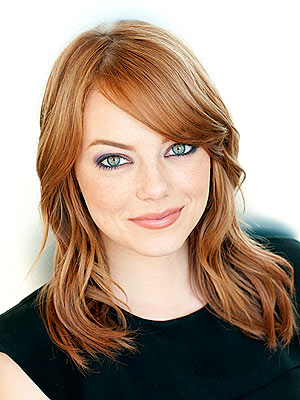
American actress Emma Stone. I pulled both these headshots from their imdb pages, and neither were credited. If anyone has photog info, let me know and I will update.

Emma Stone. I pulled both these headshots from their imdb pages, and neither were credited. If anyone has photog info, let me know and I will update.

There are many reasons this casting is shocking and unacceptable. Actors of color have had to fight for centuries for the right to play characters of color, first in theatre, now in film and television. Those roles historically went to white people in some kind of “ethnic” drag– blackface, yellowface, and the like. While many argue that our most egregious examples are far in our past (such as Mickey Rooney in Breakfast at Tiffany’s) we DO still cast white actors as characters of color all the time, sometimes using makeup, and sometimes, as in this case, just putting a white person on screen or on stage as is and calling it a day. We’re also notorious for whitewashing characters– taking a pre-existing property (like a novel or a fairy tale) or real-life story and remaking it as a film or a play, but changing the people of color in the narrative to white people. If you haven’t seen playwright Prince Gomolvilas’ “21 Reasons This Movie Sucks,” about the whitewashing in the film 21, you should.

It’s shocking that whitewashing still happens so frequently in Hollywood, particularly considering the massive controversies it causes much of the time–  the casting in Airbender created a firestorm back in 2010, and there have been many like controversies since (The Lone Ranger, Peter Pan, Exodus: Gods and Kings, and Ghost in the Shell are a few examples). What’s even more shocking to me personally is how often both whitewashing and yellowface (and brownface, and all permutations) happen in the theatre, even as we talk all the time about how much more progressive we are than Hollywood.

It’s depressingly common for white people to see the ability to play people of color as their due, and for white people to see their own ethnicity as a kind of “neutral.” It’s a bias (often an unconscious bias) that has enormous, far-reaching effects. A great example is how some white people react whenever a character of color is included in an otherwise very white context, or whenever a character of color is a lead in a story not specifically about their race or ethnicity. “Why does [insert name of character] have to be [insert ethnicity]?” is something I often hear, as if white is “normal” and “neutral” and anything apart from that is a particular, aggressive decision. And while it’s undeniable that race has meaning and cultural weight (which is precisely why you can cast a Black man as Hamlet but you can’t cast a white man as Othello), white people too often ONLY apply that to people of color, seeing their own race as a universally accepted neutral instead of something just as particular, but currently in a culturally dominant position.

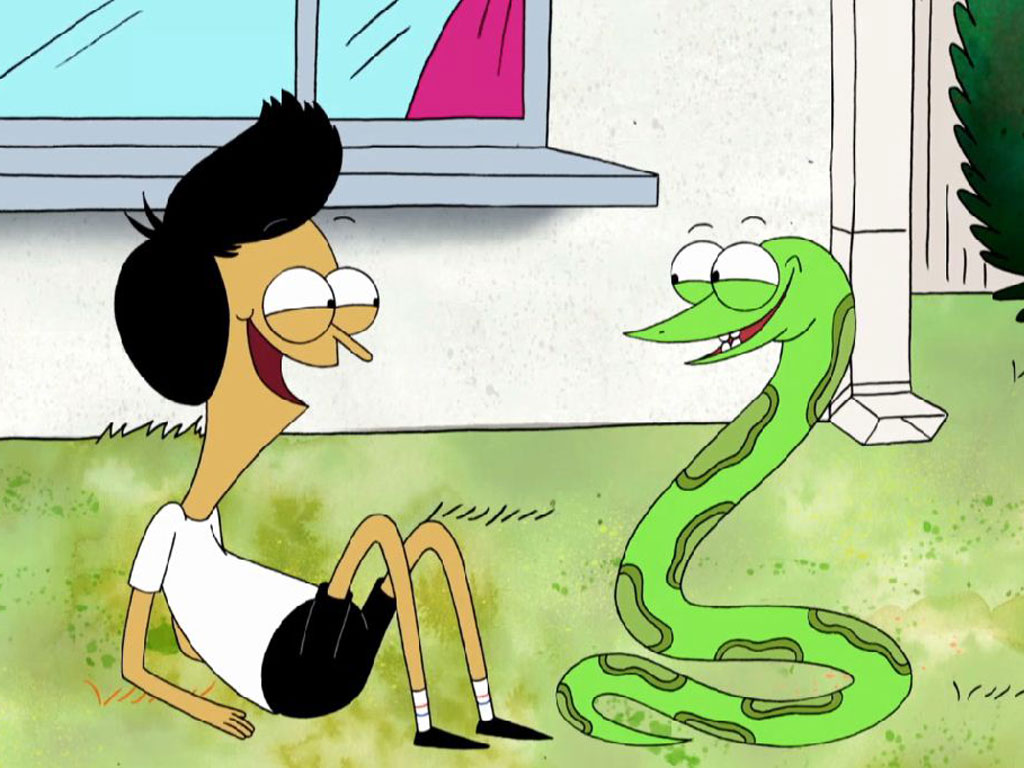
One famous example is SLIMED! An Oral History of Nickelodeon’s Golden Age author Mathew Klickstein’s comment about current Nickelodeon show Sanjay and Craig: “That show is awkward because there’s actually no reason for that character to be Indian,” as if a character needs a particular reason to justify a lack of whiteness. Klickstein goes on to state that characters should only deviate from whiteness if the show is about ethnicity: “I think that it does the culture a disservice. If I were Indian or Jewish, for example, and watched something where the characters are Jewish or supposed to be, and if it’s not specific to that, then I start to wonder, ‘Why are they doing this?’ It becomes blackface.” Because, obviously, everything Indian or Jewish people do relates specifically to that identity. I don’t blog: I JEWBLOG. I don’t sleep: I JEWSLEEP. I don’t have adventures: I have JEWVENTURES. And if your work includes Indian or Jewish people, but is not specifically about being Indian or Jewish, it’s racist. Yeah, OK. ::eyeroll::

sanjay-and-craig-silly-quotes-01

Sanjay and Craig.

Anyone who doesn’t conform to straight white able-bodied average weight cisgendered Christian-heritage male (and I’m probably leaving a few out) are defined by their deviation from that “standard.” While “straight white able-bodied average weight cisgendered Christian-heritage male” refers to approximately 15% of the population (at best), we are constantly positing it as neutral– as “normal”– and anything apart from that is so wildly different, so enormously specific, we must provide a justification for its very existence.

When the culture sees white as “neutral,” is it any wonder that a white woman can be cast to play a woman of color and (almost) no one bats an eye? Emma Stone can be just “an actor” while Jessica Henwick is an “Asian actor.” I’m willing to wager Crowe didn’t even read any hapa actresses for the role of Allison Ng, and that the casting call went out asking for “Caucasian actresses, 18-24.”

It’s depressingly common for white people to brush this off with things like, “She’s half white! Why can’t a white person play her?!” as if mixed people in America are somehow fully represented by a white person; as if mixed people in America are not struggling with racism, bigotry, and other issues PARTICULAR TO THEM; as if mixed people are fair game to ERASE COMPLETELY. As if white actors are truly neutral, the universal donors of casting.

I think the thing that’s the most depressing about this is that Cameron Crowe evidently felt so confident about this hapa character that he would personally tell me that my concerns about race in his film were unfounded, and that I would be “pleasantly surprised.” He seems to actually believe that casting Emma Stone as hapa Allison Ng quells concerns about the lack of diversity in his film, rather than creates more concerns.

Why are we still making films (and theatre) where both people of color and mixed race people are erased and replaced by white people? Ridley Scott, too old and rich to pretend otherwise, flatly stated that he cast white actors instead of Middle Eastern actors as Middle Eastern characters in Exodus: Gods and Kings because otherwise, no one would fund his film. Hollywood is notoriously risk-averse, and Scott’s statement is indicative of our cultural positioning of white as “normal” and everything else as “different,” considering a white star a certain box office draw despite constant evidence to the contrary, where the same poor decision was made and the film still tanked. There’s no question racially insensitive casting can take a bite out of sales– #boycottexodus burned up my feed before the film was released. And yet the idea that white = normal = safe is so thick in Hollywood you can walk on it.

The other excuses are no better. It’s nonsense that people “don’t see race” and are just looking for “the best actors for the role.” You’ll never see a Hollywood film with Black actors as the Continental Congress– it’s not historically accurate, right? But it’s perfectly acceptable to cast a Hollywood film with all Caucasian actors as the Egyptians and Hebrews in the book of Exodus, despite the fact that those actual, historical people were Middle Eastern, not white. And of course you never see a person of color randomly cast in a film written for white actors unless that person of color is a powerful star, but you’ll see white actors who could barely be called any kind of box office draw (Mena Suvari?) cast in roles that were either meant for a person of color, or were a person of color in the original material.

Egyptian actor Asser Yassin, from his imdb page.

Egyptian actor Asser Yassin, from his imdb page. You’re welcome.

Joel Edgerton, who played Pharaoh Ramses II in Exodus: Gods and Kings. Photo by Frazier Harrison/ Getty Images

Joel Edgerton, who played Pharaoh Ramses II in Exodus: Gods and Kings. Photo by Frazier Harrison/ Getty Images

As long as we continue to see white as “neutral,” we’re going to see directors casting white actors as people of color and feeling perfectly justified. We’ll continue to see white people getting huffy about their right to play these roles. We’ll continue to see white people try out deflection techniques like, There are so many more IMPORTANT things in the world! (If that’s the criteria, we’ll never get to talk about anything except literal genocide. And of course every person who makes that statement has just finished posting a dozen pictures of their kid, or three paragraphs about their diet. Because IMPORTANT.) As long as we continue to see white as “neutral” and “normal,” we’ll continue to see people of color ignored and erased.

So, Cameron Crowe, I’m not at all surprised, pleasantly or otherwise.

UPDATE 6/3/15:

Cameron Crowe posted a semi-apology on his blog for casting Emma Stone as Allison Ng. Tl;dr: “Sorry if you thought I effed it up; I based it on a real, redheaded 1/4 Hawaiian person; I added another 1/4 API ancestry because diversity; Emma Stone did lots of research.” So basically: “Sorry if you objected, but I’m still right.”

Evidently he never stopped to consider that he had created a character who was 1/2 API, making it unrealistic that she be played by a white actress. I understand that “unrealistic” isn’t a major concern for Hollywood, but race and representation matter in ways that shitty narrative do not.

It’s a very typical kind of half-apology issued when people in power are caught with their pants down. BUT. It’s heartening that he understands that he WAS caught with his pants down, at least. Baby steps.

Tagged , , ,

Having Kids: Worst Idea, or Worst Idea Ever?

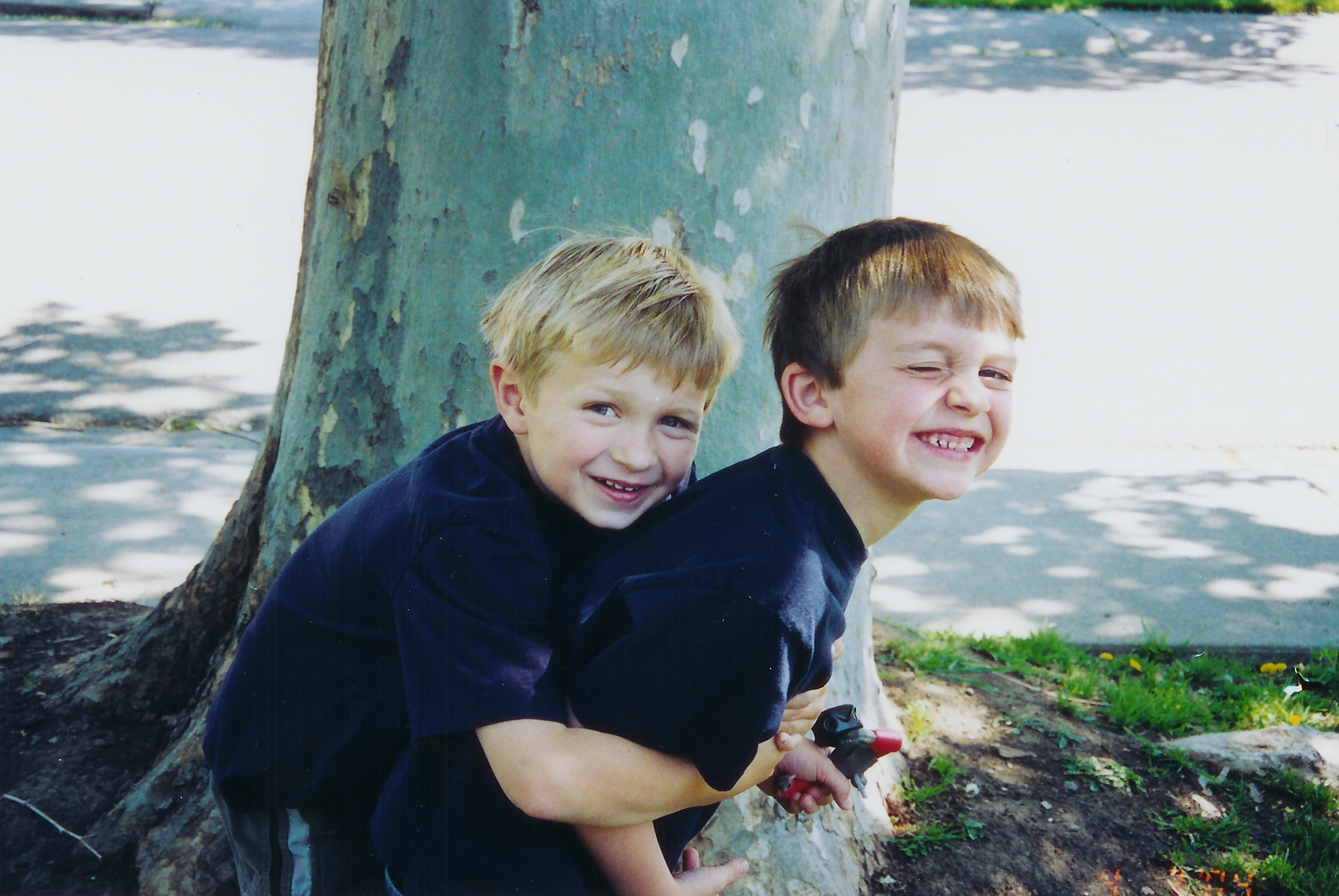
Jonah and Jacob, 2003

Jonah and Jacob, 2003

I have two kids, one I made myself and one I got free in a marital acquisition merger. So of course the title of this article is a joke, but the kind of joke that feels like the comedy equivalent of a right cross.

The truth is, it’s really, really, really difficult to have kids while you’re working in the theatre, most of us do it anyway, and most (all?) of us who decided to have kids while in this madness of a “lifestyle” believe it was totally worth it.

I’ve been asked many times about how I made parenting and a life in the theatre work. The sad truth is, there’s no magic formula that will make those early parenting years less difficult, but the happy truth is, it goes by in a blink. Your life as an artist will last decades, and your kids will only need direct supervision for 15ish years. It’s over before you know it. I know that’s not much consolation to people with a screaming baby who somehow have to teach three classes and rehearse for four hours on 37 minutes of sleep, but believe me, it’s true. Your screaming baby will be 15 and able to come home, do his homework, make his dinner, take a shower, and get himself to bed at a reasonable hour sooner than you think. It will be bittersweet, but it will happen.

Jonah and Jacob, goofing off on a road trip, 2014

Jonah and Jacob, goofing off on a road trip, 2014

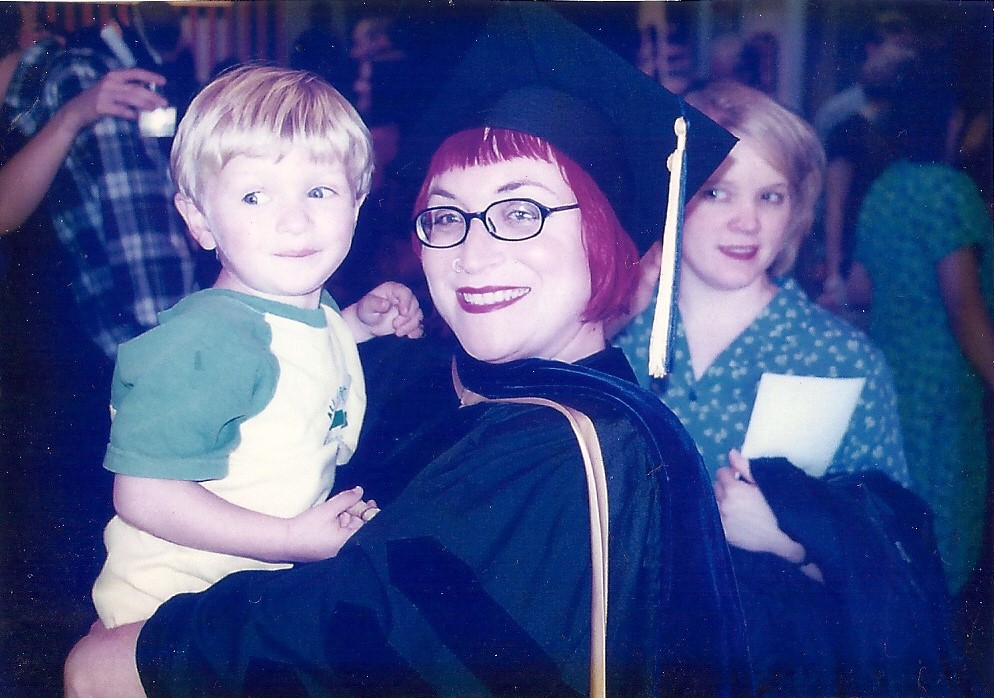
How to make it to that point is the trick. When the kids are little, you’re living your life day-by-day. Just getting through each day with everyone fed, clothed, and alive is a minor triumph. On some days, a major one. My kids are now 16 and 17. I taught university classes and a high school summer intensive their entire lives. I finished my PhD when my son was three– one of my favorite pictures of myself is carrying him the day I was hooded. I went through four surgeries on my hips and pelvis. And I was doing theatre the entire time. Impact Theatre was founded in 1996, and my son was born in 1998. In 2003, my stepson, also born in 1998, came into my life. So I’ve been there, and I know how difficult it is.

Jonah and I, 2001.

Jonah and Mommy, May 2001.

Here’s my best advice about how to survive as a theatre parent.

1. Make sure your partner is wealthy, unemployed, and uninterested in doing theatre. The people I know with this set-up have a significantly easier time as a theatre parent. It’s even better when your partner has wealthy parents with an apartment or house you can live in rent-free. Did you already mess this one up, like I did, and marry someone awesome but lacking a vast, personal fortune? Or are you going it alone and made the mistake of being born into a family without a vast fortune? Read on.

My handsome husband on rehearsal break with fellow actor Ariel Irula, May 2015.

My handsome husband on rehearsal break with fellow actor Ariel Irula, May 2015. Stolen from his instagram. ❤

2. Do fewer shows, and stagger them. My husband and I each did one show a year, and staggered them so there would always be someone home with the boys while the other one was in rehearsals and performances. The fact that I’m the artistic director of the theatre and control the scheduling (to a certain extent) and the casting (to an enormous extent) made this significantly easier for us, but I do know other theatre parents who use this method, even parents who are separated. If you’re not controlling your own scheduling, however, there may be nights of overlap, even when you’re staggering, when you’re both called somewhere. And of course, some of you are raising kids on your own. Here’s where your network comes in handy.

3. Make connections with young actors who like kids. These babysitters are lifesavers. In the Bay Area, pro babysitters are charging a mint, sometimes with surcharges for more than one kid, so you could be looking at an extra $100 for someone to watch little Shaw, Wycherly, and Dekker for one evening while you’re at rehearsal. A friend who loves kids but otherwise has a day job isn’t going to charge you $100 to watch your kids. On the contrary, a young actor will often do it for a few bucks and a bottle of wine, or even for free if you’re exchanging other types of favors– rides to and from the airport, monologue coaching, writing letters of recommendation, recommending them for roles, paying for the occasional dinner– the usual kinds of things we do for the younger actors in our lives. A major plus to this set-up is seeing adorable pictures of your kids pop up on the actor’s facebook or instagram while you’re at rehearsal. Young designers, directors, and playwrights are in shorter supply and usually busy– in rehearsal, feverishly completing a design or a script edit, or drunk. Sometimes all three, lucky bastards. But hey, if you can set that up, your kid might know how to use a sawzall by the time you get home. Score!

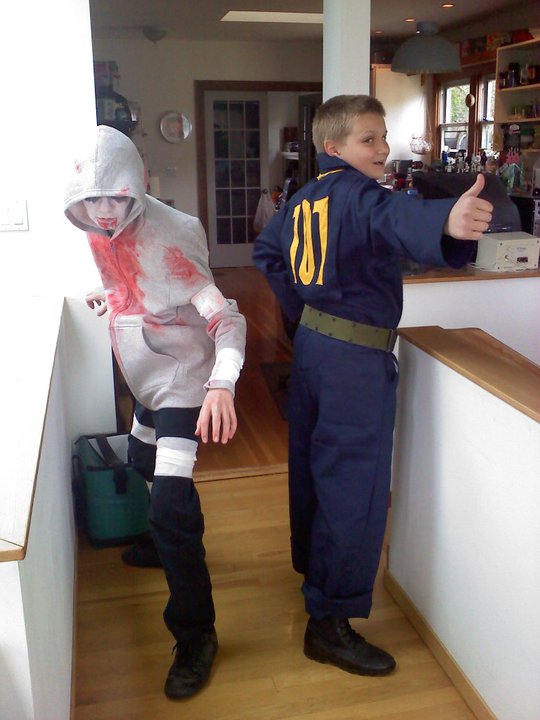
Jacob and Jonah in their WonderCon costumes, 2011.

Jacob and Jonah in their WonderCon costumes, April 2011.

4. Make connections with other theatre parents. Childcare exchanges with these families can be lifesavers, sometimes for both families. When the kids are old enough to entertain themselves for a bit, a playdate can keep little Kazan, Wolfe, and Malina busy while you sit down and answer some emails.

5. Moving closer to family isn’t a solution. I see people take this option all the time, and while it seems like it would be easier to be closer to the free babysitting that a grandparent or aunt can provide, in reality, those people have their own lives and problems, and aren’t always available on your schedule. Now you’re in a new location with no contacts, no network, and no one to watch Albee and McCraney while your parents are in the Catskills. And remember that you’re also on tap to help with their problems, issues, and kids as well, so not only do you have no babysitter for this weekend’s performances, but you’re also feeding your parents’ cat and committed to making treat bags for your nephew’s 3rd birthday party Saturday at a park 20 miles away with no bathroom the week after little Gotanda decided she would only wear princess underpants and no pull-ups, ever again, no, no, NO. Move closer to family because you want to be closer to family, not because you think they will be a big help to you.

6. Remember that it’s good for your kids to see you pursuing your passion. You’re not neglecting them if you’re showing them that Mommy is living her dream– you’re teaching them that it’s possible. Yes, they will sometimes guilt-trip you about leaving them and beg you to stay, but showing them that sometimes it’s Mommy’s turn to pursue Mommy’s interests is a valuable life lesson. It teaches them that their desires are not paramount every time (something some adults have yet to learn) and that taking time to pursue dreams and goals is a good thing. Sure, you could take it too far and actually neglect them if you’re doing back-to-back shows and out of the house every evening and weekend for six months. But if you’re doing one show a year, or some other reasonable schedule, they’ll be fine. Honest. One day they’ll be old enough to see your work, and that, I promise you, is an irreplaceable joy.
Jacob and Jonah, December 2012

Jacob and Jonah, December 2012

7. Don’t compare yourself to other parents. It’s undeniably true that a theatre family likely won’t have the resources (money or time) to schedule their kids into 57 extracurricular activities, have a leisurely homecooked family dinner every single night, or take little Rylance and Redgrave on European or tropical vacations every summer. And so what? Stop worrying about the fact that you don’t have the money other parents have. Stop worrying about the fact that you have a life and aren’t devoting every second of your free time to your kids. For one thing, there are children living all over the world in extreme poverty, so intense self-recrimination because, for example, your boys had to share a room in a safe and warm Bay Area house filled with food and videogames until they were teenagers (ahem) is patently ridiculous. For another, remember that very soon your kids will be teenagers, then adults and out of your house. If your entire life was devoted to those kids, when they’re gone, you’re screwed. Raising kids is a temporary gig, but your lifelong dreams and goals will always be there. While you’re in that temporary gig, make room for both– don’t devote yourself wholly to one or the other.

Jacob and Jon, September 2014.

Jacob and Jon, September 2014

8. Don’t compare yourself to childless friends, don’t criticize their choices, and just nod and smile when they say their pets are their children. Having kids is not for everyone. I don’t understand the pressure we put on people to have kids. The environment is stretched to the breaking point, maybe past it. Kids are demanding of your time, money, and energy. There are plenty of great reasons not to have kids, but some people will make it sound like a life is not complete without them. That’s bullshit. I wanted kids, and I had them, and I do not regret it for one moment, but I don’t see my voluntarily childless friends as some invalidation of my life choices, or as missing out on something necessary. Yes, having children is a unique experience. Having pets or nieces and nephews compares to it in the same way that jumping off a curb compares to flying a jet. There are joys and pains and mysteries and magic that only people with children experience. But living a childless life is ALSO a unique experience that I will never have, with its own joys and pains and mysteries and magic. Sending the kids to Grandma’s for the weekend probably compares to living a childless life like jumping off a curb compares to flying a jet– unlike my first example, I don’t have the experience to know, but I can guess from seeing the spontaneity and freedom my childless friends have. I would love it if we could all stop pretending that one experience is more valid or “real” than the other. Own your choice, love your choice, and be cool about people who make different choices.

Having pets is nothing like having children, and I know it’s annoying as hell when people say that it is. I know it’s irritating when people use that study that shows brain scans revealing that people love their pets like they love their children as proof, when they never read far enough to find out the differences discovered. They’re looking for confirmation about the way they feel, and they have no idea what the differences are between kids and pets because they haven’t experienced them. They don’t know, they can’t know, and I swear you will be happier if you don’t try to force the issue. Telling them they’re wrong does nothing in the world but annoy you both. Smile and nod and move on. If childless people with pets could stop telling people with seriously ill or lost children that they totally understand because they lost a pet, though, that would be cool. In those circumstances, raging at someone may be more of a sanity saver than letting it pass. I sincerely hope you never have to find out.

Jonah, May 2015

Jonah, May 2015

9. Always remember: THIS TOO SHALL PASS. I know I keep saying it, but it’s so true– it goes by in a blink. Do your best. Show your kids that you don’t have to trash your dreams to have kids. Love your kids lavishly, but never stop loving yourself or your art. It’s one of the most valuable things you can teach them.

Tagged , ,

Adam Sandler, Charlie Hebdo, and “Freedom of Expression”

America has been exploding with issues surrounding the concept of “freedom of expression.” Like many freedoms, “freedom of expression” sounds great in the abstract. In the abstract, pretty much everyone outside of political and religious extremists are for “freedom of expression,” and the very fact that political and religious extremists are most decidedly not in favor of freedom of expression makes a certain kind of person even MORE in favor of it.

In the concrete, the issue of “freedom of expression,” like everything else in the world, is much more complex and nuanced, and if there’s one thing political and religious extremists– and the people who love to piss off political and religious extremists– hate, it’s complexity and nuance.

loren-anthony-adam-sandler-640x400

Adam Sandler on the set of The Ridiculous Six. Photo courtesy of actor Loren Anthony’s Instagram, which you can follow at @lorenanthony


When Native American actors walked off the set in protest over the racism in Adam Sandler’s latest film, the ensuing controversy was unsurprising. The internet exploded with the coverage, and the backlash was instantaneous and fierce. Those who supported the actors were accused of suppressing freedom of expression, and misunderstanding the boundary-crossing nature of comedy. When PEN announced that Charlie Hebdo would be receiving its Toni and James C Goodale Freedom of Expression Courage Award, the ensuing controversy was also unsurprising. When 145 PEN members formally protested (that number has now grown to over 200), they were met with another predictable backlash that included a wealth of BUT FREEDOM OF EXPRESSION scolding. A lesser-known, but equally important, controversy happened earlier this year when stand-up comic Ari Shaffir viciously attacked fellow, lesser-known stand-up Damienne Merlina both for her disability (Merlina lost an arm in a car accident) and her weight, in his Comedy Central special. When Merlina posted a YouTube video calling Shaffir out for the attack, she was met with a barrage of criticism– and even mockery– for daring to speak out against her own attacker. A major part of the backlash Merlina received was centered around the fact that comedy was meant to cross boundaries, and that those attacked should understand that, shut up, and take it.

Damienne Merlina, photographed by Jeff Forney.

Damienne Merlina, photographed by Jeff Forney.

“Freedom of expression” is an emotional issue. It’s difficult to have productive conversations about its complexities. People have knee-jerk emotional reactions around protecting it in the abstract that prevent them from considering its complexities in the concrete. But it’s well worth the effort to at least try.

You may have heard the expression “punching up” and/or “punching down.” It’s fairly easy to understand. “Punching up” means comedy that makes fun of people or groups in power. This is the kind of humor most often used throughout history by progressive political and social movements. Imagine a cartoon making fun of a political figure, or Christianity’s active oppression of LGBT rights. “Punching down” means comedy that makes fun of people or groups who are marginalized, oppressed, and targeted by bigotry. Imagine a film mocking Native Americans. Imagine a cartoon mocking the girls kidnapped by Boko Haram just to make an unrelated political point. Imagine a comedian with a national spotlight attacking a young woman by name– a woman who wasn’t even there and had nothing to do with the event– for her disability and weight.

Comedy that “punches up” has long been a tool for political and social change. Punching holes in the cultural and political power of dominant groups is what people do when they want to call that power and dominance into question, when they want the culture to begin considering how that power and dominance is wielded, and whether such consolidation of power and dominance is, actually, a good idea. “Punching up” requires extreme bravery. “Punching up” is more than speaking truth to power– it’s speaking truth to power while telling power its fly is open. Punching up is dangerous because it challenges power, and power retaliates brutally. Thousands of people have been jailed and executed for punching up. There are people sitting in jail right this moment in many areas of the world for punching up, and they will not be the last.

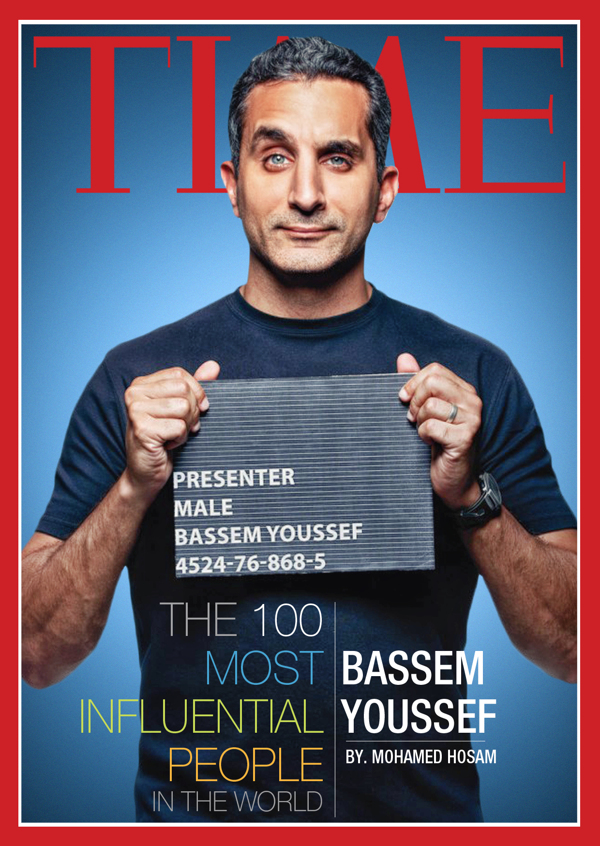
Bassem Yussef, an Egyptian satirist often compared to Jon Stewart, was arrested in March, 2013 for allegedly insulting President Mohammed Morsi and Islam. He was released on bail. In April 2013, he was named one of Time's 100 most influential people.

Bassem Yussef, an Egyptian satirist often compared to Jon Stewart, was arrested in March, 2013 for allegedly insulting President Mohammed Morsi and Islam. He was released on bail. In April 2013, he was named one of Time’s 100 most influential people.

Comedy that “punches down” has long been a tool for political and social oppression. Mocking groups that suffer bigotry and oppression is what people do when they want to solidify that bigotry and oppression, when they want to solidify their own cultural and political power and dominance over that marginalized group. Punching down requires no bravery whatsoever, because it’s done from a place of cultural primacy. Occasionally extremist members of a marginalized group will retaliate in reprehensible ways. Murder is never an acceptable response to comedy, period. But that kind of retaliation is rare. No one in their right mind believes that murdering people who work at Charlie Hebdo is an acceptable response to the content they publish, no matter what it may be. But no one in their right mind believes– or should believe– that Charlie Hebdo’s mockery of Islam in a nation where Muslims are common targets of bigotry puts it in the same position as a North Korean drawing cartoons mocking Kim Jung Un.

Many people are quick to point out that Adam Sandler, Charlie Hebdo, and Ari Shaffir punch both up and down. Charlie Hebdo, apologists are quick to point out, mocks Christianity as often as it mocks Judaism or Islam, and mocks right-wing politics even more. But that argument is the height of intellectual laziness. Punching up does not inoculate you from the effects of punching down. Mocking the powerful is one thing; mocking people who are daily victims of bigotry is entirely another. Despite France’s humanist bent, Christianity still holds enormous cultural power there, while Jews and Muslims suffer routine bigotry and discrimination. (Attacks against Muslims since the Charlie Hebdo attacks have focused primarily on women.) Despite Adam Sandler’s willingness to mock himself and other people in power, Native Americans suffer routine, institutionalized, daily bigotry in America. Despite Comedy Central’s willingness to air comedy that mocks people in power, the disabled suffer enormous daily bigotry in our culture. Punching up is a completely different activity– culturally, politically, and morally– than punching down.

Graves desecrated by vandals with Nazi swastikas and anti-semitic slogans in the Jewish cemetery of Brumath close to Strasbourg, October 31, 2004. Jewish cemeteries have been, and continue to be, targeted as antisemitism rises in France. (photo: Reuters)

Graves desecrated by vandals with Nazi swastikas and anti-semitic slogans in the Jewish cemetery of Brumath close to Strasbourg, October 31, 2004. Jewish cemeteries have been, and continue to be, targeted as antisemitism rises in France. (photo: Reuters)


Muslim cemeteries are similarly vandalized. Notre Dame de Lorette cemetery near Arras, northern France, April 7, 2008.  Photo: Reuters/Sadouki

Muslim cemeteries are similarly vandalized. Although anti-Muslim attacks have skyrocketed in France since the Charlie Hebdo shooting, anti-Muslim bigotry and attacks were well underway beforehand. Notre Dame de Lorette cemetery near Arras, northern France, was vandalized in April, 2008. (Photo: Reuters/Sadouki)

And yet, because power rewards power, PEN granted an award for courage to Charlie Hebdo. Because power rewards power, Netflix continues to give Adam Sandler millions of dollars to make his crappy movie. Because power rewards power, entertainment corporations continue to shower Ari Shaffir with money. And so it goes.

I believe in freedom of expression, both in the abstract and in the concrete. I don’t think we should be censoring bigotry. I am adamantly opposed to censorship. But I also think– because this issue is complex– that we need to be thinking hard about the difference between tolerating the expression of bigotry and rewarding it.

We need to stop pretending that speaking out against the expression of bigotry is “anti-freedom of expression,” when in fact it is the exact opposite– it’s exercising one’s own freedom of expression. Being told your opinion is nonsense is not the same as being denied the right to express your opinion. Being told that your employer is not interested in paying you for expressions of bigotry is not the same as being denied the right to express bigotry at all. And speaking out against giving an award for courage to a magazine that routinely mocks marginalized groups is not equivalent to speaking out against that magazine’s right to print whatever the hell it wants. Supporting your right to freedom of expression need not include rewarding you for that expression, nor need it include freedom from criticism.

I think Adam Sandler, Charlie Hebdo, Ari Shaffir, and anyone else should be allowed to punch down as often and as viciously as they like. And I think those with the power to dole out awards– whether literal awards or financial awards– should stop and think for a moment about whether they actually wish to reward punching down.

We spend millions of dollars on anti-bullying campaigns, initiatives, and education in schools. We’re fooling ourselves that kids can’t see through the hypocrisy of adults telling them bullying is always wrong and then turning right around and rewarding bullying done by adults. What’s the difference between a playground bully mocking a Muslim kid, a disabled kid, an overweight kid, or a Native American kid, and what Adam Sandler, Charlie Hebdo, and Ari Shaffir have done? If the bully says, “But I make fun of everyone,” does that excuse the rest of his bullying? Of course not. So why is that used to excuse adult behavior?

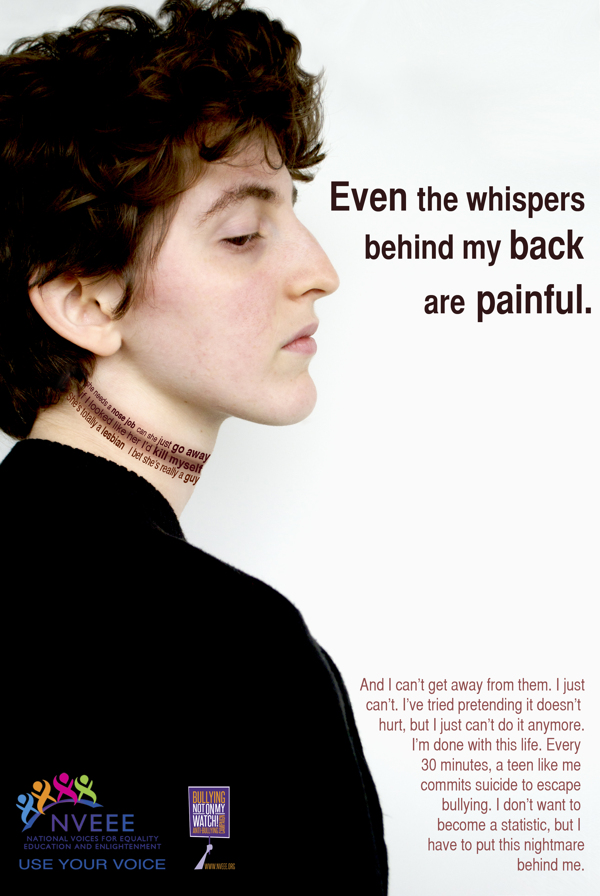
An anti-bullying poster from National Voices for Equality, Education, and Enlightenment. Learn more about them and their anti-bullying initiatives, at nveee.org.

An anti-bullying poster from National Voices for Equality, Education, and Enlightenment. Learn more about them and their anti-bullying initiatives at nveee.org.

And before you even bother posting comments defending any or all of the three I’ve discussed, the principle remains whether I’m right in my analysis of those particular three or not. We punch down in this culture all the time. We reward that kind of bullying with accolades, money, and power. We defend it with “it’s just a joke,” “you’re too sensitive,” and a barrage of like nonsense from privilege stomping its feet and throwing tantrums because their bigoted fun is being spoiled with our dissent. “It’s just a joke” is perhaps the most intellectually lazy argument of them all, as if the presence of humor evacuates its long history of keeping marginalized people “in their place.”

And while I will be the first one to defend your right to punch down– your right to freedom of expression– I’m appalled at the fact that we reward that behavior. It’s long past the time we stopped confusing tolerance with appreciation and reward.

Tagged , , , ,

Handheld Technology Has Not Ruined Today’s Youth Any More Than Dig Dug Ruined You

If there’s one thing that grinds my gears, it’s the disingenuous concern trolling over the rising generation’s “addiction” to technology, and how it has impacted their ability to [fill in the blank] the way WE DID WHEN WE WERE KIDS AS GOD INTENDED !!11!

Because this is a blog about theatre, I’m going to limit myself to speaking specifically to the outrageous idea that technology prevents the rising generation from appreciating art.

This picture is blowing up my various feeds right now:

Photo by Alvaro Garnero

Photo by Gijsbert van der Wal

This is one brief snapshot. We have no idea what these kids were doing just before or just after. Yet there are approximately 17 shitloads of “tsk tsk” and “This is our future” in my feed. Speaking as someone who has personally witnessed hundreds of high school and college kids blown away by art, I implore you to think more deeply about this.

We’re unthinkingly and unfairly using this picture (and the entire concept of handheld tech) to condemn an entire generation. Think for a moment: were kids enthralled to go to museums in the 1950s? Were kids enraptured by Mozart in the 1960s? Were kids stampeding Joan Didion lectures en masse in the 1970s? What pretend past are we mourning here? Sure, there have always been kids who were enthralled by classical art at an early age (and I was one of them), but the vast majority of kids– and adults– are not. Why are we condemning kids for looking at their phones instead of Rembrandt when most of you would be doing the exact same thing? How long have these kids been on this field trip? How tired are they? How many paintings of white men standing around have they been dragged past? And we dare to use this snapshot to condemn not just them, but their entire generation?

And has anyone bothered to note that this painting is hanging in a museum with an app-guided tour?

Elvis Presley was shot from the waist up when he appeared on the Ed Sullivan show in 1957 to protect teenage girls watching at home from his hip-shaking and its perceived sexuality.

Elvis Presley was shot from the waist up when he appeared on the Ed Sullivan show in 1957 to protect teenage girls watching at home from his hip-shaking and its perceived sexuality.

We talk a lot about wanting to engage the rising generation in theatre, and I’m seeing a lot of “what can we do about this?” commentary on this picture. Listen: If you want to engage the rising generation, the first thing you need to do is stop lying to yourself about them. You’ll fail to engage them if you don’t approach them with honesty. You can start by dropping the lie that our generation was any better in any way. Kids can smell dishonesty, and self-congratulation masked as concern is about the most dishonest approach you can take.

This is exactly why 99.999% of “audience engagement strategies” fail miserably to bring in young, diverse audiences. This is why “tweet seats” failed. We’re not looking at this generation honestly. Instead we look at studies designed from the outset to confirm our hypotheses. We make assumptions about how the rising generation thinks and feels based on how they make us think and feel. We refuse to engage them on their own terms, instead dictating the terms to them and then blaming them for boorishness when they fail to meet them.

Gorgeous young Franz Liszt, seen here in an 1839 portrait by Henri Lehmann, inspired a  frenzy in his young, usually female, fans, known at the time as

Gorgeous young Franz Liszt, seen here in an 1839 portrait by Henri Lehmann, inspired a frenzy in his young, usually female, fans, known at the time as “Lisztomania.” Women would wear vials containing his discarded coffee dregs and bracelets made of his broken piano strings. He was chased through the streets by young women attempting to grab a lock of his hair. The older generations were horrified and believed it to be a literal psychological disease.

Young people are no different now than they ever were, and the current pearl-clutching over tech is no different than the worry that comic books would ruin childrens’ minds, reading would make young women hysterical, jazz (and then rock and roll) would turn teens into sex-mad beasts, and television would “rot” children’s minds.

“Badly drawn, badly written, and badly printed – a strain on the young eyes and young nervous systems – the effects of these pulp-paper nightmares is that of a violent stimulant. Their crude blacks and reds spoils a child’s natural sense of colour; their hypodermic injection of sex and murder make the child impatient with better, though quieter, stories. Unless we want a coming generation even more ferocious than the present one, parents and teachers throughout America must band together to break the `comic’ magazine.” – Sterling North, Chicago Daily News, May 8, 1940

There’s no need to fight a battle we’re creating in our own minds. If we don’t look at the rising generation honestly, but instead seek to confirm our own biases about them, we are only going to speak to them in ways they know are dishonest, and get nowhere. Remember how lame older people sounded to us when we were teenagers, and how little they understood about our lives? That’s how we look to kids today when we post stuff like the museum photo above as proof of their lack of worth and how they are, essentially, a problem for older generations to solve.

The rising generation? They are wonderful. They are more politically active than your generation was at the same age. They are more supportive of equality than previous generations. They are brilliant, creative, funny, bold, and bright. And most importantly: They create and consume TONS of art. Whether or not it’s art you like is entirely irrelevant.

Are they perfect? Of course not. But approaching them as a problem to be solved is not going to create the kind of engagement we want. Give them room to speak. It gets us nowhere to tell them what they should be interested in, and then condemn them for their lack of interest. When Ms. Nelson made you read Keats in the 6th grade, and you hated it; when Ms. Sciambi made you look at all those Goya paintings, and you hated it; when Mr. Rodriguez made you listen to Wagner, and you hated it, what did that say about you? When you went home from school and read your D&D Player’s Handbook, listened to Run DMC, and played Dig Dug, what did that say about you? Right, nothing, apart from the fact that you were a normal kid who liked normal kid things.

Yes, we need to expose kids to the arts. We need much much more arts education than we have now. Art saves lives– I believe that. BUT. I was that nerd kid grooving on Keats, Goya, and Wagner in class, and everyone (apart from my nerd clique) gave me no end of shit about it. So now, while the rising generation behaves exactly as you did, you’re talking about how they need to be saved from themselves?

You were fine. They’ll be fine. Keep making art and inviting them. Keep trying– always keep trying. But appreciate them on their own terms. Do not ignore their art, or dismiss it as worthless. And please keep your judgypants in the closet or I will start publishing those pictures of you all from that middle school museum field trip where you were wearing sunglasses and Hammer pants and refusing to look at the paintings that didn’t have naked ladies in them.

Le Sommeil, Gustave Courbet, 1866. Turning middle schoolers into art lovers for 150 years.

Le Sommeil, Gustave Courbet, 1866. Turning middle schoolers into art lovers for 150 years.

Tagged , ,

How To Rock Your Musical Theatre Audition

I understand that there are something like 47,000 books on this topic, but I’m going to give you some succinct, usable advice right now for free.

In addition to running Impact Theatre, I’m also the casting director at a TYA company, Bay Area Children’s Theatre, which is a blast. For one, it’s incredibly relaxing to be in a space where the final decision isn’t mine (Me: “Wow, what a tough choice– all three of those actors are great. Welp, I’m headed home– lemme know what you want to do!”) Secondly, it’s been fun to learn more about TYA and casting musicals, two things I knew very little about before I started. A long time ago, in a galaxy far, far away, I was an opera singer, so I have a solid working knowledge of singing and singers. By the time I got to BACT, I had been casting shows for over 20 years, so I had a solid working knowledge of what makes a good audition and what should be avoided. I was bringing years of experience to the table, which helped me learn very quickly what makes an excellent musical theatre audition and what amounts to self-sabotage.

The original 1966 Broadway production of Cabaret

The original 1966 Broadway production of Cabaret

An audition is a fact-finding mission. We’re looking for answers to specific questions, and everything else is pretty much irrelevant. I’m not going to get into general audition tips– I’ve already written about that quite a bit (here, here, here). I want to speak specifically about your song.

1. I’m surprised how many people choose songs that tell us pretty much nothing about their voices. So many songs from the past 10 or so years of musical theatre writing are very poor choices for audition pieces– they’re conversational, almost recitative-like in places (if you know opera) and it’s impossible to tell what your voice can really do. You want a song that shows off your vocal quality and capabilities. It doesn’t impress us if the song is from a new musical or if it’s a song we’ve never heard before. That kind of thing is more relevant with monologues. We’re looking for answers to specific questions, like– What is her vocal type? Does she have a belt or is she more of a “legit” singer? What’s her legato like? How accurate is her pitch? What kind of volume can she attain, and is she showing the kind of throat tension that will cause her to lose her voice by the end of opening weekend? There are so many more, some dictated by the type of musical we’re casting (more on that below). If you’re interested in new musicals, there are so many great choices out there. Choose a song that shows off your vocal chops. Choose a song you love to sing because it’s right in your sweet spot. Don’t choose a song that’s cool, and has a lot of depth, but has a five-note vocal range. It just doesn’t tell us what we need to know. We’re not looking for someone to choose material– we’re looking for someone who can perform it.

Zero Mostel in the original 1964 Broadway production of Fiddler on the Roof, © Photofest, Inc., courtesy of Gret Performances, Broadway Musicals: A Jewish Legacy

Zero Mostel in the original 1964 Broadway production of Fiddler on the Roof, © Photofest, Inc., courtesy of Great Performances, Broadway Musicals: A Jewish Legacy

2. Don’t choose a song that’s overly ambitious. Every role has its own, specific needs. Some roles require a great deal of virtuosity, some require the ability to navigate tight harmonies without pushing your way to the front of the group, and some can be Rex Harrisoned through. Take realistic stock of your abilities and show us what they are. No matter where you are, there’s a role for you somewhere in the world of musical theatre. If you assume you need to reach for something you can’t actually do, all we know is that you can’t do something– we never got to see what you CAN do.

3. You are not Kristin Chenoweth. Unless you’re Kristin Chenoweth, who I assume, doesn’t read Bitter Gertrude. ANYWAY. Are you singing with your natural voice? Or are you pushing it out your nose to try to get that signature Kristin Chenoweth nasally sound? She has a very distinctive, fun quality to her voice, and that’s just how her voice sounds. You honestly don’t need to imitate her to get roles. Be yourself. When you push your voice out your nose, we can hear it, and we wonder what your voice really sounds like. BECAUSE WE DON’T KNOW. Let Kristin do Kristin. You do you. Nothing against KC, but I’ll be happy when women stop imitating her.

Kristin Chenoweth as Glinda in Wicked. Photo by Joan Marcus.

Kristin Chenoweth as Glinda in Wicked. Photo by Joan Marcus.

4. We tell you it’s OK when you don’t bring sheet music, but it’s actually not. I mean, it kind of is? We still want to see you. But a large part of performing a musical is being able to match pitch with the accompaniment. Can you hear the piano (or the guitar, or the orchestra) as you’re singing and match pitch? When you sing a capella, we’re left with partial information. This is why we’ll often asking you to sing scales, or Happy Birthday, or something along those lines with the piano if you come in with an a capella audition. Better to sing the song you’ve practiced than suddenly be asked to bust out the Star Spangled Banner on the spot, no? Bring your music.

5. Choose a song that’s contextually appropriate. If you’re not familiar with the musical, or if it’s a new musical in development, find out what kind of singing the role requires. There’s a world of difference between Dreamgirls, Into the Woods, American Idiot, and The Sound of MusicBringing a song that’s appropriate for one won’t necessarily give us the knowledge we need if we’re casting one of the others. If we ask for an “uptempo musical theatre song,” don’t bring in a rock song, a ballad, or a nine-minute Sondheim extravaganza. (In fact, avoid Sondheim completely, which of course is the advice you get everywhere, and you’re not going to find any disagreement here.) If you need clarification about the music in the show, or what’s expected at the audition, ask!

Nell Carter and Ken Page in the original Broadway production of Ain't Misbehaving, 1978. Photo by Bill Evans.

Nell Carter and Ken Page in the original Broadway production of Ain’t Misbehaving, 1978. Photo by Bill Evans.

6. Act your song. I’m sure you’ve heard this one million times, and here it is again. Your song is like a monologue. It has a narrative– a beginning, a middle, and an end. When something’s repeated (such as the chorus) find a reason why your character is repeating herself. “She’s happy” or “she loves him” or “she likes to sing” are pretty much the least interesting choices you can make. You can be happy, in love, or possess a predilection for something in silence, in words, or through (God help us) interpretive dance. There’s a reason your character is singing, and it’s not because “this is how it’s written.” Make clear, bold acting choices about your intro, every line you sing, the bridges, and the outro. Think, plan, rehearse.

7. REHEARSE. Prep a variety of songs you can use for the various types of musicals in which you’re interested. Then you’ll have a few songs from which you can choose, always ready to go, for most auditions. When you come in under-rehearsed, we can tell, and we wonder if you will be similarly unprepared in rehearsals. I’d honestly rather see an inappropriate song than an under-rehearsed one.

Nia Holloway as Nala and Jelani Remy as Simba in the Lion King national tour. Photo by Joan Marcus.

Nia Holloway as Nala and Jelani Remy as Simba in the Lion King national tour. Photo by Joan Marcus.

8. Do it, enjoy it, and forget it. It’s just an audition. You will do eleventy billion of them. Coming in tense will jack your voice. I’ve seen plenty of people miss a high note or squeak instead of belt due to nerves. Try not to stress. Do whatever you need to do to come in relaxed– within reason. I know sometimes people will tell you to have a glass of wine before you go in, but the last thing you want is the casting assistant scooting in a few steps ahead of you to inform us that you smell like you’ve been drinking. Never lose sight of the fact that an audition is a job interview. But also never lose sight of the fact that, like a job interview, we’re auditioning for you as much as you’re auditioning for us. You want to work for a company that respects you, and for which you enjoy working. I think sometimes that focus can help with nerves. When it’s done, walk away. Try not to obsess about it. There are so many reasons people don’t get cast, and talent is only one of many. If you don’t get cast, don’t take it as a sign of your worth as a performer, because it’s not, at all.

I hope this was helpful! Now go rock it out.

Neil Patrick Harris in Hedwig and the Angry Inch. Photo by Joan Marcus.

Neil Patrick Harris in Hedwig and the Angry Inch. Photo by Joan Marcus.

Tagged , , ,

The Lies We Tell About Audience Engagement

TCG is holding a multiyear inquiry about audiences called “Audience (R)evolution.”

The piece I wrote for it is called “The Lies We Tell About Audience Engagement.” It’s a little . . . rabblerousy. Are you surprised?

luke.no

Check it out, leave a comment, share it on twitfacetagram. I’m thrilled that I was asked to contribute!

UPDATE: Please take a look at Jonathan Mandell’s excellent response to my piece in his blog, New York Theater. He takes me to task for adding to the culture of ageism we have in the theatre industry, and he could not be more right.

Tagged , , , , , , , ,

Why Is Race the Line?

Lord Capulet (Jon Nagel) and his nephew Tybalt (Reggie D. White) in Impact's production of Romeo and Juliet. Photo by Cheshire Isaacs.

Lord Capulet (Jon Nagel) and his nephew Tybalt (Reggie D. White) in Impact’s production of Romeo and Juliet. Photo by Cheshire Isaacs.

I had an interesting conversation with a theatremaker recently about casting. The discussion centered around multiethnic casting, particularly whether casting actors of different races as members of the same family would make the storytelling in the play unclear. The concern was that audience members would have trouble reading the actors as related and therefore have trouble following the play’s narrative.

If you’ve followed my blog for more than 12 seconds you already know what I think (diverse casting is GO), but I gave this particular aspect of diverse casting some serious thought, as this is nowhere near the first time I’ve had this discussion. Here’s where I landed:

Why is race the line?

That’s a serious question, btw, not a facetious construction meant to elicit a WOMP WOMP from my fellow SJWs. We take it for granted that we put our disbelief in suspension when we go to the theatre, but that suspension has limits. When we see something inaccurate onstage, for example, it pulls us out of the narrative. When an actor playing a medical professional pronounces the word “larynx” as “larnyx,”or says the blood type B+ as “B plus” (both of which I’ve heard), I have trouble maintaining the belief that that person is a medical professional.

In casting, however, we make enormous allowances. We take it for granted that the storytelling remains intact in a production of As You Like It although the actress playing Rosalind is married to the actress playing Celia, the actor playing Orlando is married to the costume designer, and the actor playing Charles the Wrestler has never wrestled a day in his life. We take it for granted that the storytelling remains intact in a production of Romeo and Juliet although we know Lord Capulet, Lady Capulet, Juliet, and Tybalt are not related and, in fact, look nothing alike. We lauded Peter Dinklage as Richard III although his disability is nothing like what Richard’s was, and we lauded both Sir Ian McKellen and Kevin Spacey as Richard III, although neither has any disability at all.

Kevin Spacey as Richard III at the Old Vic in London. Photo by Nigel Norrington.

Kevin Spacey as Richard III at the Old Vic in London. Photo by Nigel Norrington.

It goes even further than that. People think nothing of casting a woman as Juliet’s nurse who is far too old to have plausibly given birth 13 years prior, although her entire relationship with Juliet hangs on that fact. People think nothing of casting a woman as Juliet who is visibly more than twice Juliet’s repeatedly stated age. We rarely expect an actor playing Iago to have military bearing although his years-long military experience and current military rank are central to the character and the narrative of the play. Hell, we live in a world where a major company can hire an all-white cast to do a show as vague “Native Americans” and almost no one bats an eye apart from Native American theatremakers and a few bloggers (also this).

So why is it so common for theatremakers to hesitate considering– or even refuse to consider– an actor of color to play the daughter of a white man, a Puritan farmer, the grandmother of a white woman, or a founding father (all examples taken from personal experience or discussions I’ve had with other theatremakers)? When we already are well aware that the actor isn’t the character, the characters’ relationships are (almost always) feigned, and the locations and actions are (almost always) pretend, why is that one factor– race– the line in the sand?

I don’t mean to discount the importance of race in our culture, or in the lived experience of people of color. What I mean is: Why is race so often THE most important consideration in casting, even when the production is not specifically about race? Why is race considered so much more important than other factors, such as age, suitability for the role, or skillset?

If you’re producing A Raisin in the Sun, M Butterfly, or Othello, the race of the characters is of primary importance, but most plays are not specifically about race. There’s no reason Tybalt cannot be Black in an otherwise all-Caucasian Capulet family. There’s no reason Eurydice cannot be Asian and her father cannot be white in Sarah Ruhl’s play. There’s no reason Joe Pitt cannot be Latino while Hannah Pitt is white in Angels. My own cousin is Black, and there are literally millions of other multiracial families in the US.

Julie Eccles as Gertrude and LeRoy McClain as Hamlet in California Shakespeare Theater's Hamlet. Photo by Kevin Berne.

Julie Eccles as Gertrude and LeRoy McClain as Hamlet in California Shakespeare Theater’s Hamlet. Photo by Kevin Berne.

The three main arguments I hear about this go as follows:

1. But they WERE all white in that time and place. For one thing, are you certain? Because you’re probably wrong, even when you’re talking about Puritan Massachusetts or Colonial America. And also: So? There are lots of things we’re choosing not to depict accurately (some of which I’ve listed above), either because we have made a choice to believe they aren’t important, or because we don’t have the capability to. Think about this: 130 years ago, the difference between an Italian person and a white person would have been apparent to any American. To cast an obviously Italian woman as Juliet would have appeared absurd to an American audience in 1885, even though Juliet IS Italian, due to the enormous racial prejudice against Italian immigrants at the time.

2. Well, how about white people playing Black characters? Huh? Why can’t THAT happen? HUH? REVERSE RACISM. Well, it actually DOES happen, especially in Hollywood. Google “whitewashing.” I’ve already covered why this is problematic in this very space a bunch of times. Here, read this. Don’t believe me? Check out Racebending.

3. It will make the narrative hard to follow. This is the argument that arguably has the most (any) merit. A friend of mine has a daughter who looks exactly like her in every way but skin color, and did so even as a toddler. Although they looked so much alike, she was constantly asked, “Where did you get her?” I told my friend she should reply, “Out of my uterus.” People often unthinkingly assume all familial relationships are biological, and then use racial similarity as a marker for familial relationship, even though they know, if they pause to consider, that adoption, stepchildren, and biracial people exist. Stories like these underlie that. However, we can’t necessarily apply that to theatre. We don’t know the relationships of any of the characters onstage until they are revealed to us, and we already know we’re in the world of pretend. If you tell an audience that, for example, two men of different races are brothers, almost everyone in the audience will accept that. It’s not uncommon, especially in indie theatre and in areas with diverse populations, to see diverse families onstage. Yet some theatremakers still hesitate to cast people of color for reasons of narrative clarity, yet will discount literally every other physical marker as unimportant.

Sean Mirkovich as Richard, Duke of Gloucester, and Kelvyn Mitchell as his brother, George, Duke of Clarence, in Impact Theatre's Richard III. Photo by Cheshire Isaacs.

Sean Mirkovich as Richard, Duke of Gloucester, and Kelvyn Mitchell as his brother, George, Duke of Clarence, in Impact Theatre’s Richard III. Photo by Cheshire Isaacs.

I think what’s going on here is simple. We see “white” as “normal,” the baseline: neutral. We see people of color as a deviation from that– particular,  different, “other.” Race has narrative, of course, and we must consider that narrative while casting. If you have an all-white cast apart from one Black actor who’s playing the bad guy, you’re saying something specific. But often diversity in a play that’s not about race doesn’t change the narrative at all. How much difference would it make to the narrative of As You Like It if cousins Rosalind and Celia were of different races?

Sarah Dandridge as Rosalind and Francesca Choy-Kee as Celia in the Cincinnati Playhouse in the Park’s production of As You Like It. Photo by Sandy Underwood.

Sarah Dandridge as Rosalind and Francesca Choy-Kee as Celia in the Cincinnati Playhouse in the Park’s production of As You Like It. Photo by Sandy Underwood.

But because we see whiteness as “neutral,” when we look at white actors, we imagine a palette of possibilities, a narrative polyvalence, that we do not afford to people of color. A white person can be anything; a person of color is primarily and foremost “of color,” and therefore is relegated in most cases to inhabiting spaces already designated as such. A white person is read as “person”; a Black person is read as “Black person.” There are casting directors who still separate their files into “ingenue,” “leading man,” “Asian,” “Black.” White people are divided into types; people of color are their race alone. Thankfully, this is becoming less and less common, but we’re still far behind full inclusion of people of color. However, even small gains by people of color in casting are seen as a threat to white actors. We have a long way to go.

Years ago I made a personal commitment to include people of color in lists of actors I was recommending for roles wherein race wasn’t specified. Whether that had any impact on the eventual casting of the role or not, it was one way I felt like I could personally challenge the idea of whiteness as neutral in my day-to-day life. I get these all the time– people ask me for recommendations for roles like “woman, 20s, good comic timing, excellent physicality” or “man, 30s, sophisticated, witty, elegant.” All too often the implication is that a role is white if not otherwise specified, and I refuse to accept that. We’re getting better at diverse casting, certainly, but we’re still struggling with it, particularly on larger stages, where some directors can be enormously resistant.

While we take it for granted that an audience can see past a 30-year-old woman playing a 13-year-old girl (“come Lammas-eve at night shall she be fourteen”), or a 70-year old woman playing that 13-year-old girl’s wet nurse; while we take it for granted that people will accept Kevin Spacey as disabled; we all too often refuse to take it for granted that an audience will accept a diverse family or a Black Puritan.

It’s time to rethink this. We need to slow down and recognize when we’re positing whiteness as neutral and color as a deviation from that, and we need to stop imagining that the only places audiences can tolerate actors of color are in spaces clearly designated for them. We need those ethnic-specific roles (and plays), certainly, but we also need to open our minds to making our onstage families look more like our offstage families; to giving our audiences credit for being willing and able to play pretend with us wherever we take them; and to giving actors of color consideration for their types, talents, and abilities apart from– and in addition to– their ethnicities.

Bay Area Children's Theatre's production of Five Little Monkeys. Mama Monkey and her five little monkeys as one happy (and busy!) family. Photo by Joshua Posamentier.

Bay Area Children’s Theatre’s production of Five Little Monkeys. Mama Monkey and her five little monkeys as one happy (and busy!) family. Photo by Joshua Posamentier.

Tagged , , , , ,

Go Ahead and Start Your New Company. But.

briefs1

One of the earliest flyers from my company. This was 1997. We did a series of 10 minute plays called “Impact Briefs” for 9 seasons. Pictured are Charlie Marenghi, Alex Pearlstein, Tonya Sutherland, and Christopher Morrison, all of whom were acting, writing, and/or directing.

So you want to start a theatre company. My first bit of advice: don’t. It’s insanely difficult. Undeterred? OK. Here are some things you need to know.

1. Vision and Mission. I know this sounds like the title of an insufferable U2 album, but actually, they’re the two most important things to have in place when starting a company. Why are you starting your own company? What do you want to say, and to whom do you want to say it? What kind of art do you want to make? What’s your aesthetic? These are the questions that will, I promise you, make or break your company. Companies without a clear vision and a clear mission are doomed to fail. I’ve been joking for over a decade that every new company destined to fail begins with either Danny and the Deep Blue Sea or The Marriage of Bette and Boo. For some reason I’ve never entirely figured out, I’ve seen dozens of companies begin with one of these two. Literally dozens. If you’re starting your company with such a well-worn play, it says to me that you have nothing interesting to say, let alone any idea to whom you want to say it. If you have an interesting new take on one of these plays, commenting on its position in the canon or using the play to make a larger point, that changes everything. If you’re just doing the play because it’s cheap (small cast, small set) and you want to act in it, then you need to have a long chat with yourself and all your stakeholders about what your company is all about, because I guarantee you, you don’t know. If you figure it out, clarify your mission, your vision, and your voice, you can succeed. If you don’t, you’re not going to make it. It’s tough enough to make it with a clear vision; it’s impossible to make it without.

One of the most successful plays we've ever done, both artistically and financially, 2005. Our lesbian Othello. Pictured is Desdemona, played by Marissa Keltie, and Othello, played by Skyler Cooper.

One of the most successful plays we’ve ever done, both artistically and financially. Our 2005 lesbian Othello. I was blindsided by how popular this production was. I never expected it to be such a runaway hit. Pictured is Desdemona, played by Marissa Keltie, and Othello, played by Skyler Cooper. Picture by Cheshire Isaacs.

2. Money. You have two choices: incorporate as a for-profit, which means you cannot qualify for grants and donations you receive aren’t tax-deductible, or go nonprofit, which means you will eventually qualify for grants and all donations you receive are tax-deductible. For-profit companies pay income taxes on their income; nonprofit companies do not. For-profit companies exist for one reason: to return profits to owners and investors. A successful for-profit company puts moneymaking at the center of most decisions. A nonprofit company exists as a public entity, governed by a board of directors, owned by no one, with profits going directly back into the business, ostensibly putting the public good at the center of most decisions. A for-profit company exists to make money. A nonprofit company exists to make art. A for-profit company makes money with their art, which dramatically impacts the art they choose to do– they’re only going to choose the kinds of shows they are reasonably sure will be popular and profitable. A nonprofit company, in theory, is supposed to be wholly divorced from the need to make a profit through their ability to receive grants and donations, making productions that may not be popular but further the art form, foster new voices, create a space for experimentation, and serve as a space for exploration of new ideas both in the art form and in the culture. In theory. In practice, the larger a company gets, the more money it needs, and the more blurred those lines become. Not legally, of course– legally, they are entirely separate entities– but in practice, particularly in season planning, the lines can get blurry.

A few years ago, Rebecca Novick wrote a fantastic article called “Please, Don’t Start a Theatre Company.” Provocatively (and somewhat misleadingly) titled, the article is a brilliant examination of the instability of the nonprofit model. I recommend that you read it, no matter where you are in your process, as it contains a great deal of hard, necessary truths. But if you’re feeling tl;dr today: There’s not enough funding to go around, so let’s think up different models than the traditional nonprofit one. The big theatres have sucked up all the grant money so fund your company differently, and worry less about structure and more about supporting the artists.

Of course it begs the question– how do you support your artists without structure? Your only two choices are selling stuff (show tickets, classes, merchandise) or getting stuff (grants and donations), both of which require structure in practice and by law. She advises new companies to make a “new model.” Her examples include a company that funds their personnel through a hit late night show (as if one could plan for that); a company that got money from somewhere unstated (but certainly traditional– grants, sales, donations) and uses it to pay artists, then uses those artists as admin staff as needed (which of course is the model most small theatres already use); and companies that fund their work through selling non-production-related things such as classes and CDs. While many companies offer classes, selling merchandise is a commercial enterprise that requires a great deal of support, both legal and practical (not to mention the fact that no one on earth is going to buy your CD). Here’s my point: When such a brilliant and experienced theatremaker elucidates the problems perfectly but presents solutions that are so deeply flawed, it exemplifies the difficulty of the situation we’re in. Whether or not her solutions are flawed, her analysis of the funding problems we all face are absolutely, undeniably true, and something you should take into serious consideration.

The takeaway here for someone starting a new company is that the nonprofit funding model is broken because there are too many companies competing for funding already, and your new company will only survive if you can produce on a shoestring, if you’re lucky enough to have a long-running hit show (and a place to house it), and/or if you have an extraordinary amount of free time to manage whatever non-production-related thing you’re selling to support your theatre, plus the enormous good luck to capture enough market share to make that profitable in an economy where small businesses go under every day.

Personally, I’d love to see funders stop giving almost all their money to a handful of behemoths and start peeling off a more meaningful percentage to smaller companies. Novick does chastise funders for requiring a minimum budget– the most common is 100K minimum annual budget for grants for “small companies”– and she goes on to say, “requiring a minimum budget size prioritizes growth over caliber of the work.” I could not agree more. But at present, that’s the reality we’re facing. (Novick also advises artists who are thinking of starting a company to consider forgoing permanent status and band together temporarily to produce shows here and there, as desired. This is possible if you have a funding source with which to pay production costs and no absolute need to make a profit on that money, as most shows, especially one-off shows, lose money. You could also run into some problems with finances, insurance, and taxes as an unincorporated non-company unless you’re working under the umbrella of a larger producing org. While one-offs aren’t what we’re discussing here, I would be remiss in not at least mentioning it. If you have access to an umbrella company and/or money to burn, you might want to consider a temporary, limited production run to see if you’re interested in continuing as a permanent, producing company.)

So choose which devil you sell your soul to, for-profit or nonprofit, as they both suck at present. I think nonprofit sucks slightly less vigorously, and if you agree with me, get the Nolo Press handbook for becoming nonprofit in your area and follow the steps. Make sure to check the law in your area about incorporating as a business (such as getting a business license), and take your paperwork down to a bank and create a business bank account. DO NOT– and I cannot stress this enough– commingle your company’s funds in your personal bank account. For one reason, you become personally liable for income tax on that money, and for another, it’s technically embezzlement.

The Year of the Rooster, 2014. This show was a hit off-Broadway. We got excellent reviews, but the play never found its audience in the Bay Area.  Did I overestimate how turned off audiences would be by the idea of a play about cockfighting? Was I blinded by the excellence of the script and the fact that the heart of the play is the rooster himself to the way potential audiences here would be turned off by the stigma? Who knows. All I know is we lost a ton of money on this show, and you can never predict what will sell and what won't. Pictured: Caleb Cabrera as the rooster, Odysseus Rex, and Sango Tajima as Lucky Lady, his mate. Photo by Cheshire Isaacs.

The Year of the Rooster, 2014. This show was a hit off-Broadway. Even though our Berkeley production got excellent reviews, the play never found its audience. Did I overestimate how turned off Bay Area audiences would be by the idea of a play about cockfighting? Was I blinded by the excellence of the script and the fact that the heart of the play is the rooster himself to the potential consequences of the stigma? Who knows. All I know is that even though press was great and the audiences who did come raved about it, we didn’t come close to meeting sales goals and lost a ton of money on this show. You can never predict what will sell and what won’t. Pictured: Caleb Cabrera as the rooster, Odysseus Rex, and Sango Tajima as Lucky Lady, his mate. Photo by Cheshire Isaacs.

3. Board of Directors. If you’re a nonprofit company, you are legally obligated to have a Board of Directors. Most small companies have an “artist-driven board,” meaning the people in the company are on the board. Eventually you’ll want to decide what kind of board you want. My recommendation is to get a board focused on fundraising, and put a lawyer on it. This is much easier said than done. Whoever you put on the board, they need to truly believe in your mission and vision, because the board has the power to fire the Artistic Director. If you’re a for-profit company, investors are going to want to see some experience on your team. Surround yourself with people who have already created success elsewhere. Call them an “advisory board” if you can’t afford to put them on staff. Get big names on there if you can. And then listen to them.

4. Ethics. I know you’re new and tiny, but the world is watching you. The internet makes everything public. If your company does nothing but plays by white guys, if all your casts are all white, if you hire directors who scream at actors and designers, if you violate contracts, if you do not immediately fire people who sexually harass your personnel, then A. you WILL get called out for it eventually and B-Z. What the hell are you doing? If you fuck up, own it, and genuinely strive to be better. When someone in your company comes to you and says she’s being harassed by someone working for you, take that seriously. If you’re not taking those issues as seriously as you would discovering that someone is stealing from the till, you probably shouldn’t be the head of anything, let alone an arts org. There are about eleventy kajillion ethical considerations to running an arts org, and they can all be summed up in: Treat your people like gold, create a culture where people are valued, and make sure everyone you hire is on board with that.

5. Don’t reinvent the wheel. No matter what you’re trying to do, someone has already tried it and fucked it up, and someone else has tried it and succeeded. The advice of the person who fucked it up is going to be golden– listen to people when they tell you what they did wrong. It’s relatively easy to avoid many types of failures– “We forgot to buy insurance,” “We didn’t have a written contract,” “I kept my mouth shut when the director violated contract by rewriting the play,” “I didn’t check his references,” etc. The advice of people who succeeded is going to be valuable as well, but success can be much harder to replicate, especially if the market has changed significantly, your circumstances are different, or if (and this is incredibly common) luck played an enormous role in that success. Often you’ll hear Boomers talk about how much better they were than the rising generation at (fill in the blank), and how much more successful they are in comparison, completely ignoring that the cost of living and producing was miniscule by comparison in real dollars, donations and grants were free-flowing, and competition was minimal. Don’t look at a company started in 1980 and wonder why you can’t replicate their success– they had it so, so, so much easier than you do, in every possible way. But you can look at a company’s failures and avoid them. If someone is willing to tell you the mistakes they made along the way, take notes. Decide what you can replicate and what you need to adjust (or abandon outright) when looking at other companies’ successes.

If you’re wondering how to X, or where to get Y, or why so many companies do Z, just ask. Email someone at a longer-standing company and ask. Chances are they will be happy to help. If they don’t have the time, they’ll let you know. Don’t be offended if they don’t answer you– they’re just as busy as you are. Ask several people until you get the answer you need. Then remember, when your company is the longer-standing one, to pay it forward. If there’s a theatre service org in your area, JOIN IT. Here in the Bay Area, we have Theatre Bay Area. Whatever your equivalent is, it’s well worth joining. If you ever get big enough to join TCG, or if they make their membership less dependent on financials, it’s worth joining as well.

The show we closed in December, The Dragon Play by Jenny Connell Davis. I knew I wanted to produce this play by the time I was 15 pages into the script. It was so satisfying to see audiences fall in love with the show night after night. This was a deeply satisfying artistic experience for me personally and, I hope, our artists. Lindsey Schmeltzer as Dragon Girl and Jed Parsario as Boy, photo by Cheshire Isaacs.

The Dragon Play by Jenny Connell Davis, 2014. I knew I wanted to produce this play by the time I was 15 pages into the script. It was so satisfying to see audiences fall in love with the show night after night. Lindsey Schmeltzer as Dragon Girl and Jed Parsario as Boy, photo by Cheshire Isaacs.

I could write a book about starting your own theatre company. There are so many issues to consider– legal, ethical, artistic, practical. So many skills to acquire. So many decisions to make with enormous consequences down the road. So many things I’ve left out of this one short article. Maybe one day I will, since clearly publishers are scrambling to come out with books about us, right? A TED talk? Web series? ::crickets tumbleweed lonely gust of wind::

tumbleweed

Anyway. These are some of the most important points to consider when you’re thinking about starting your own company. Think long and hard about them, choose wisely, and make the art you need to make in the way you need to make it.

Tagged