That may be a slight exaggeration. BUT ONLY SLIGHT.
For some reason, the people whose children attend the preschool across the street from my house think it is perfectly acceptable to block my driveway during pick-up and drop-off. At first, we were irked but took it relatively in stride. However, after being blocked either in or out of my driveway dozens and dozens and dozens of times, I’ve reached my wit’s end, then passed my wit’s end, then reached BLINDING RAGE.
One thing you might not know about me is that I’ve had four surgeries on my hips and pelvis, and I have a degenerative condition in my back. Walking can be extremely painful for me. I can’t just park around the corner, as I can’t walk up the hill, even on a good day, without the pain of a thousand flaming suns. I need access to my driveway. But of course, for the parents of this children’s center, my ability to get into my house is insignificant compared to the CRUCIAL IMPORTANCE of them saving the 17 seconds it takes to drive one house down and around the corner, where there is always ample parking.
We’ve tried discussing it with the school director (repeatedly). We’ve tried talking nicely to parents. We’ve tried talking sternly to parents. We’ve tried yelling angrily at parents. We’ve tried calling the police to ticket the offending vehicles. We’ve contemplated taking sledgehammers to cars and/or laying down caltrops. (I still have not ruled these last two out.)
When confronted, they hand me one of two reactions:
EXCUSES. “It’s the very first time I’ve ever done this!” (Evidently 400 kids go to that one preschool.) “I was only there for a second!” (I’ve been sitting here for ten minutes waiting for you to get your ass out of the school, into your vehicle, and out of my life.)
BELLIGERENCE. “Fuck you, lady!” “Who do you think you are? I can park where I want!” or my absolute favorite, delivered to me by a man whose size and height dwarfs my own, “GET OUT OF THE CAR AND SAY THAT AND SEE WHAT HAPPENS.” It takes a special kind of horrible man to physically threaten a mom in front of her own house while blocking her driveway, but it takes epic balls to do so while you’re driving a car with personalized plates, doesn’t it, Mr. Calhoun?
I’ve finally taken to blocking my own damn driveway, which prevents them from blocking me IN, but I do have to leave the house occasionally, and if I return during drop off or pick up hours, it’s almost a certainty my driveway will be blocked by one of these fine, fine citizens.
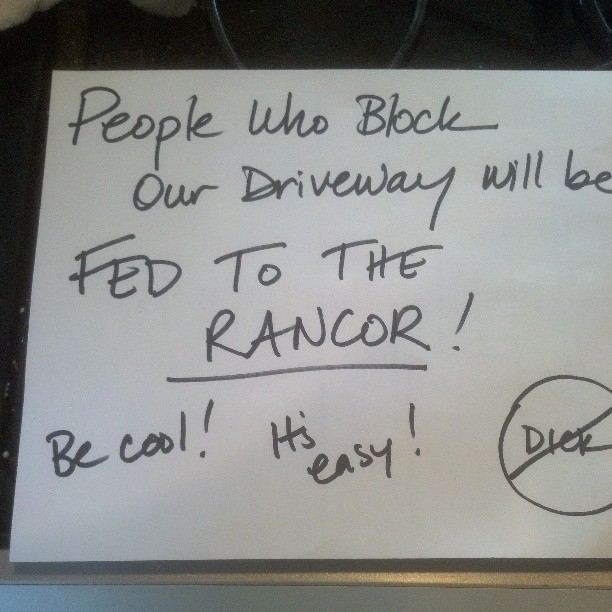
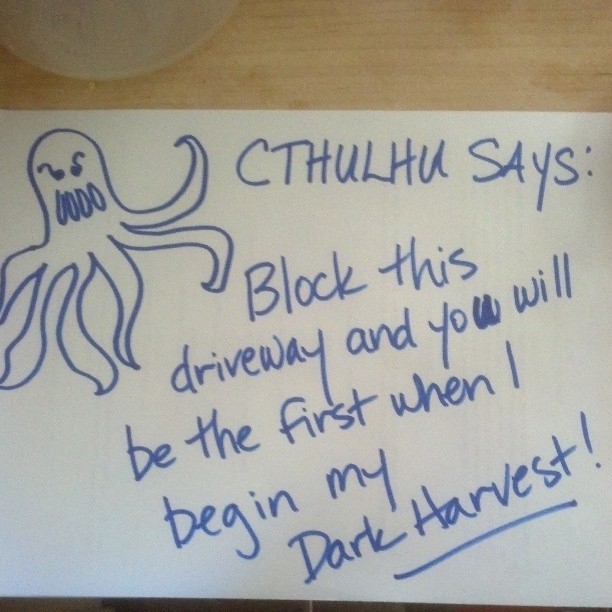
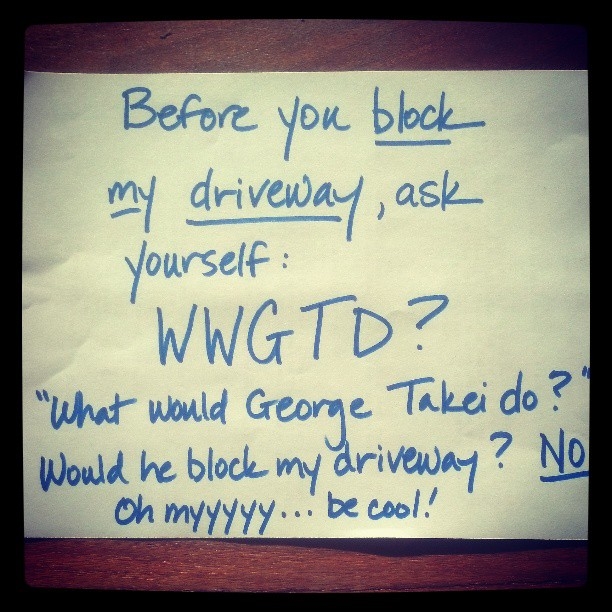
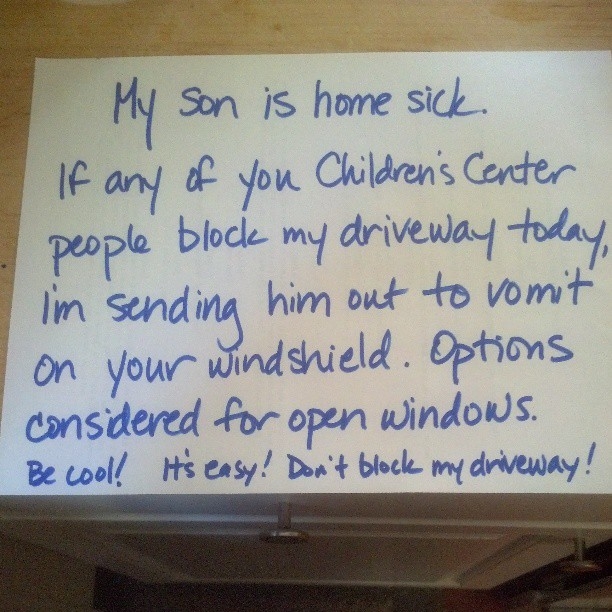
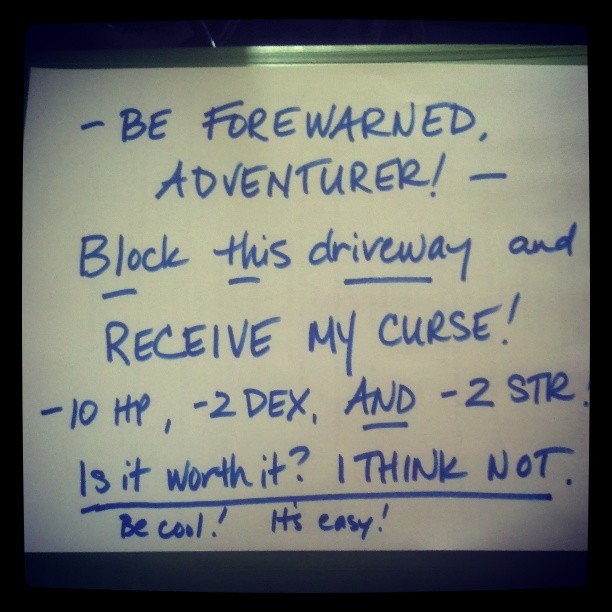
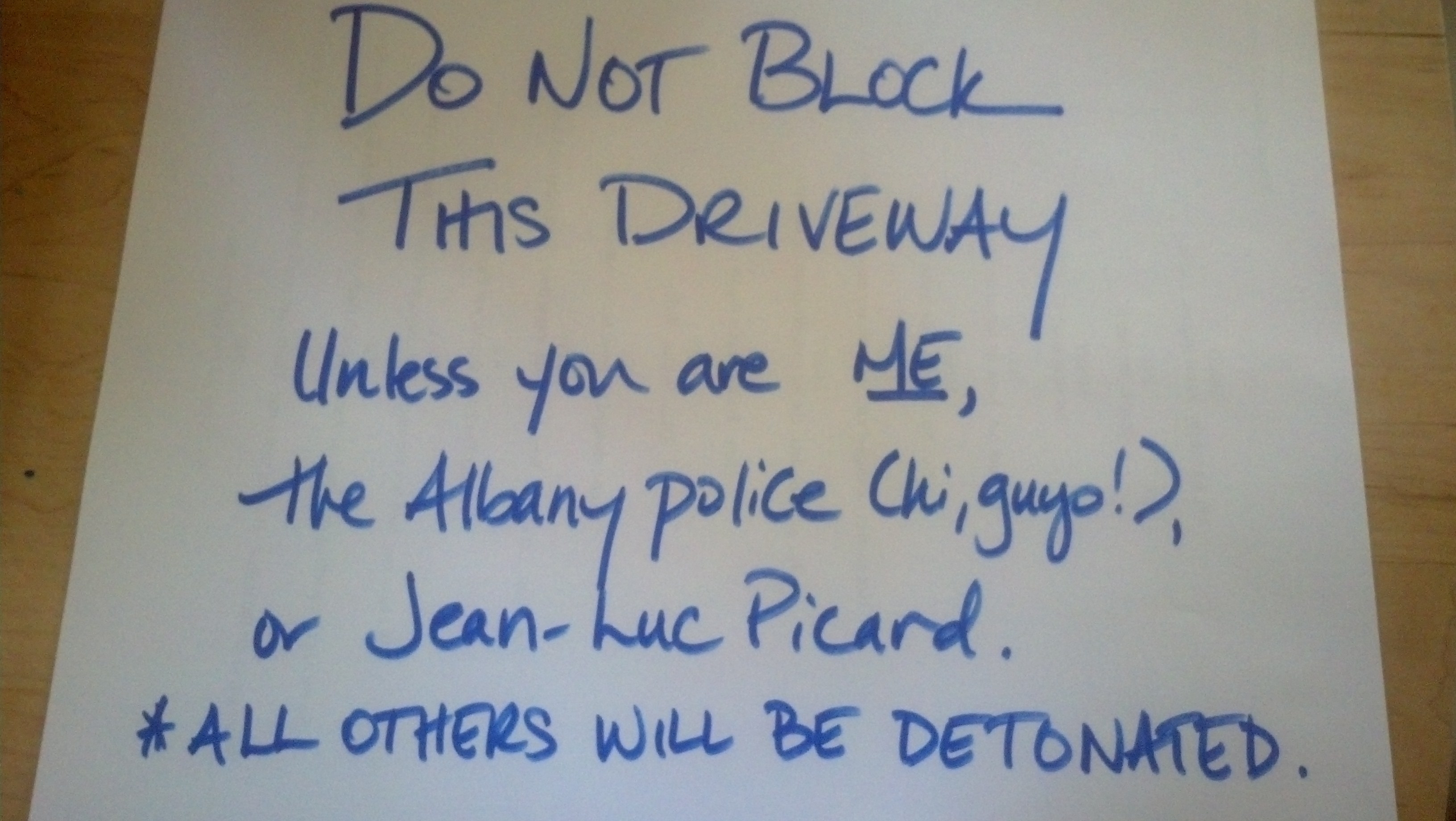
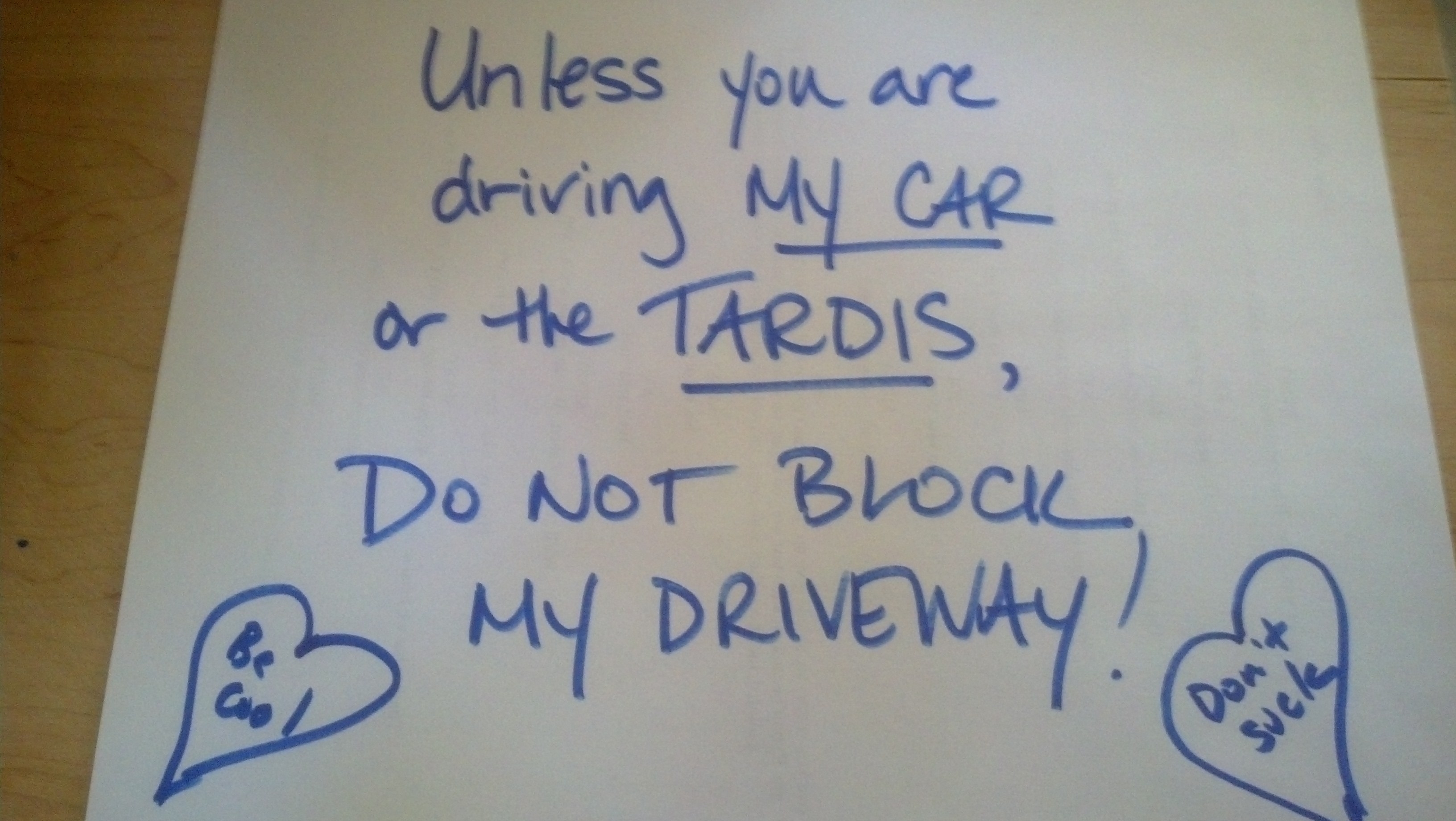
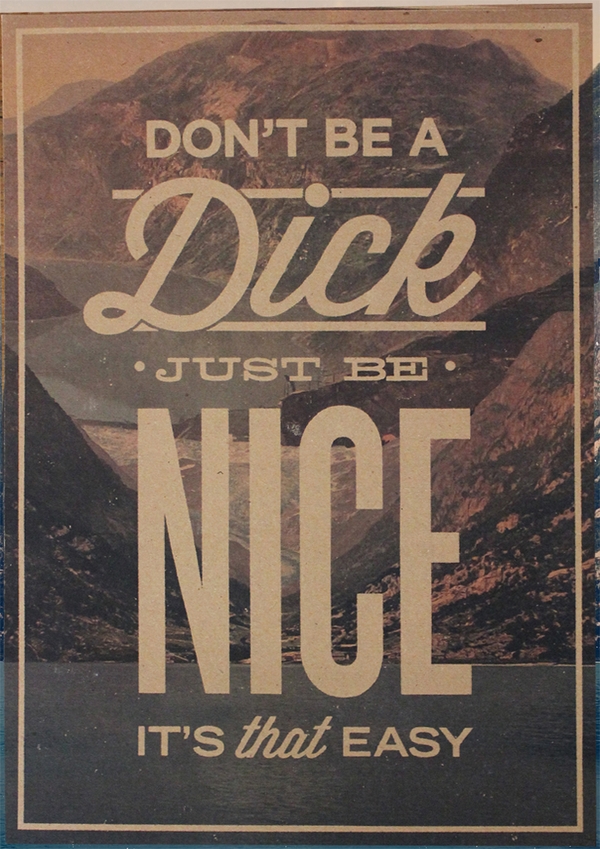
So this is my latest solution:
Every time I leave the house, I put up one of these signs. So far, it’s working! I’m SO glad, too, because I’m not entirely sure caltrops are legal.
My husband and I out in front of our theatre. Photo by Cheshire Isaacs.
This is something I wrote for Theatre Bay Area‘s Chatterbox blog in 2011. If you’re a Bay Area theatremaker or theatre company, you need to be a member of TBA!
You can see this post in its original setting here. I recommend going there to click around the blog. There are some really excellent articles there. Velina Brown‘s posts with advice for actors are particularly excellent.
THE ABSOLUTE CORE TRUTHS OF THEATRE PERSONNEL MANAGEMENT
This season marked my 10th anniversary as artistic director of Impact Theatre, and my 15th with the company as a founding member. When I became Impact’s AD, I quickly became aware of the fact that there’s no AD boot camp. There’s no Handbook for New ADs. Some local people were very helpful—Patrick Dooley at Shotgun Players was especially generous. Now that I’m more established, people who are planning to start their own theatre companies, or who are in their first few seasons, come to me for advice and I do my best to pay it forward.
I always give a lot of practical advice—how to handle auditions, how to get insurance, why you should join Theatre Bay Area, how to write a playwright contract, etc. One thing that’s struck me recently, however, is something I’ve never discussed in these situations: How much time we spend in the theatre finessing personnel management. I’m sure it’s the same in every field, but since theatre is where my managerial experience lies, I’m going to speak specifically to that.
Here’s what I’ve learned are the Absolute Core Truths of Theatre Personnel Management. These are probably all already printed in some management book, so feel free to tell me if I’m boring you by repeating something you had to read in business school, and I’ll go back to the ranting and inappropriate jokes you’ve come to expect from me. Here’s what I learned in the School of Hard Knocks™.
R-E-S-P-E-C-T
1. You don’t buy loyalty with a paycheck. You earn it by treating people with respect.
This doesn’t mean complimenting their work. “Great job!” or “You’re so good at this” only go so far with your staff if you treat their opinions dismissively and if you routinely override their expertise. Your marketing director, your lighting designer, and your box office manager all know more about their areas than you do. It’s their job to know more about it than you do. Listen to their opinions. Allow them to disagree with you. Take their opinions very, very seriously, because if they’re disagreeing with you about their area of expertise, it’s almost certain that they’re right and you’re wrong. Respect their knowledge and experience, and they will reward you in 100 ways.
2. Give your staff ownership of the company and the work. Allow your staff the freedom to make decisions. Don’t interfere with their decisions or their processes unless absolutely necessary. Does the set design violate fire code? Necessary. Does the rehearsal schedule violate the terms of your AEA contract? Necessary. Did no one tell the director the script is a comedy? Necessary. Do you think the backdrop should be light green instead of blue? Unnecessary. Do you think the sound designer should use “Bittersweet Symphony” instead of Sigur Ros? Unnecessary. Obviously you should make your opinions known, but putting your foot down and requiring a designer, development director, or stage manager to make unnecessary changes to their products or to their processes creates disgruntled, unhappy, underappreciated staff. Give your opinion or guidance, and back off unless the matter truly requires intervention.
Wearing authority with ease. Art by Michael Fleming.
3. Wear your authority with ease.
Nothing says “I’m insecure in positions of authority” like someone yelling at staff or refusing to allow staff to voice their opinions. A strong leader engages staff as equals, respecting their expertise. This doesn’t mean you should cede authority. Allowing your staff to make their own decisions and create their own processes doesn’t result in an authority drain. Step in when it’s necessary to step in. Put your foot down, respectfully, when it’s important. But have the strength to recognize when it’s important and when it’s not. And when mistakes happen or disaster strikes—because it will, trust me—blaming staff or yelling at people or otherwise losing your cool is the worst thing you can do.
4. Admit when you’re wrong. Because they all already know it. Bluffing makes you look foolish.
The error makes it delicious. Admit my wrong what, Uncle Sam?
5. Don’t be afraid to make the hard decisions. Sometimes people need to be let go. This is the hardest thing for me personally and something I’ve bitched out on doing a number of times, hoping for the best. Learn from my mistakes. Be gentle, be respectful, but get rid of the people who can’t do their jobs. Again, everyone else already knows, and they’re sick of covering for that person.
Keep your techs happy. You can’t see it, but he’s carrying a case of Newcastle.
6. Do whatever you have to do to keep your tech people happy. While all theatre personnel are equally important, too often techs get treated poorly, blamed for mishaps, and left out of the glory. Happy techs make a show sparkle with awesomeness, like a magical lighting and sound unicorn flew over the theatre. Happy techs can build a gorgeous set out of popsicle sticks and coffee filters. Happy techs call 427 cues without breaking a sweat. Unappreciated, yelled-at techs will still do their jobs perfectly—they’re professionals—but they will withhold the awesome and take someone else’s gig next time around. Or worse—continue taking your gigs and talk shit about you in the community.
7. Relax. It’s theatre.
This isn’t brain surgery. No one will die if the director casts Actor X instead of the actor you liked best at callbacks. No catastrophe will ensue if your lighting designer went with a different gobo. It’s not fuckpocalypse if your marketing director thought one show was on the weak side. Breathe. Creating art is about both process and product. Don’t beat your process to death with your image of the perfect product. Nothing is going to be perfect, but it’s within your power to make it awesome.
I’m a mom, but I’m not one who gets all demandy and weird about Mother’s Day. I don’t need cards and flowers. My kids and my husband are wonderful, and that’s truly enough for me. Although I *do* appreciate the Xbox Live points I get from them from time to time, not gonna lie. Once my daughter spent her allowance on Xbox Live points as a gift to me. I basically exploded with joy.
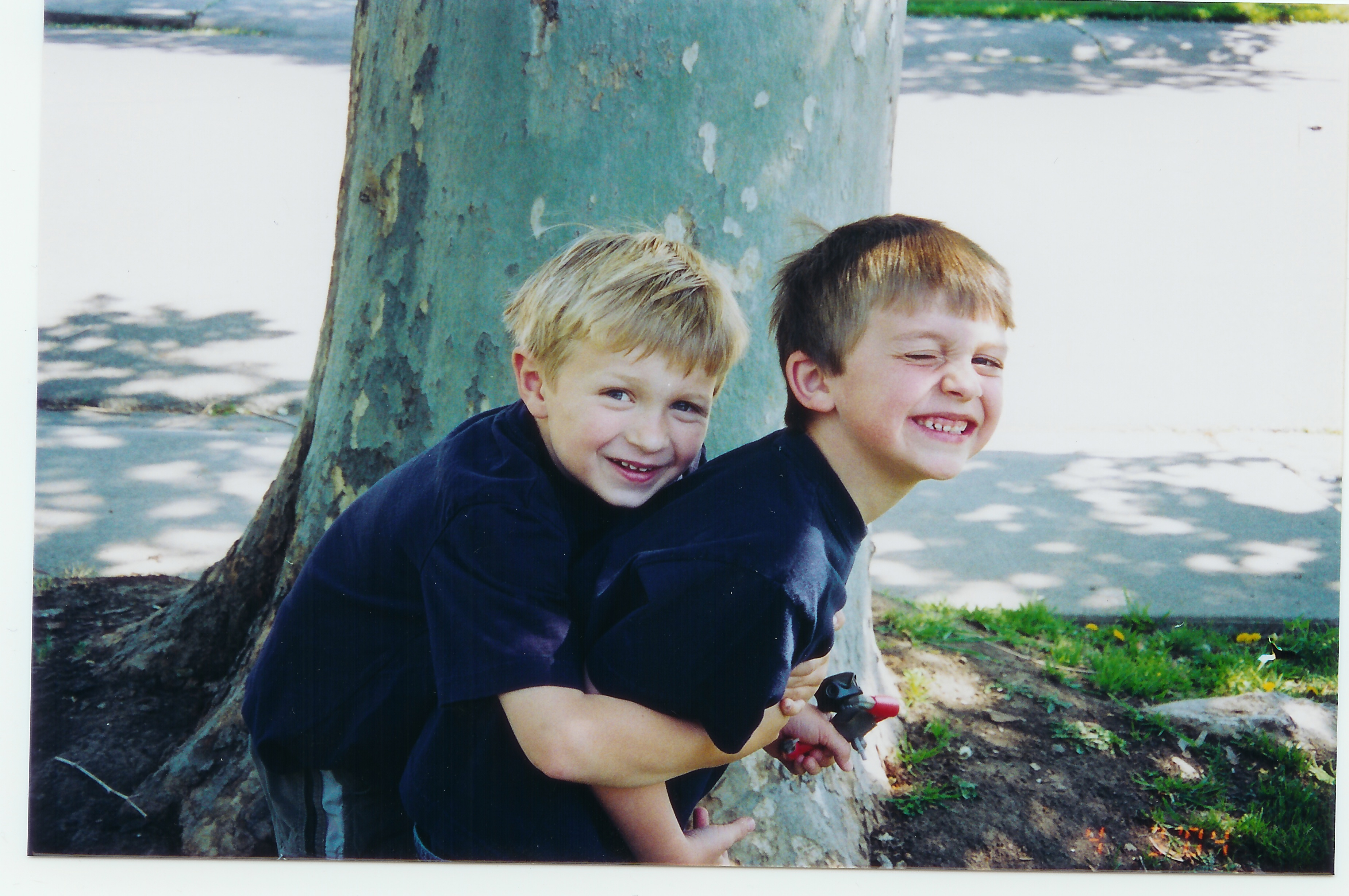
My favorite picture of my kids. 2004.
My own mother was . . . difficult. She had a complicated childhood, and struggled with depression her entire life. She would veer recklessly from extravagant affection to vicious lashing out without warning. She refused treatment every time it was brought up. By the time we were teenagers, she was so deep into her depression she was barely functioning. She kept up appearances in public, and with the rest of the family, but at home, things were rough for all of us. We begged her to get help and she refused. When my brother landed his first big job and was making piles of money, he told her he would come pick her up, drive her to therapy, pay for it, and drive her home, and she refused. She wasn’t interested in stepping out of her depression. She believed that leaving it behind would mean she was no longer honoring the difficulty of her life experience.
My mother.
She had stopped taking care of herself in every way that phrase has meaning, and would only take her blood pressure medication off and on. Eventually it caught up to her. Stroke, hospital, and a death that should have had the respect to come more quickly. She would have hated every second if she had known where she was.
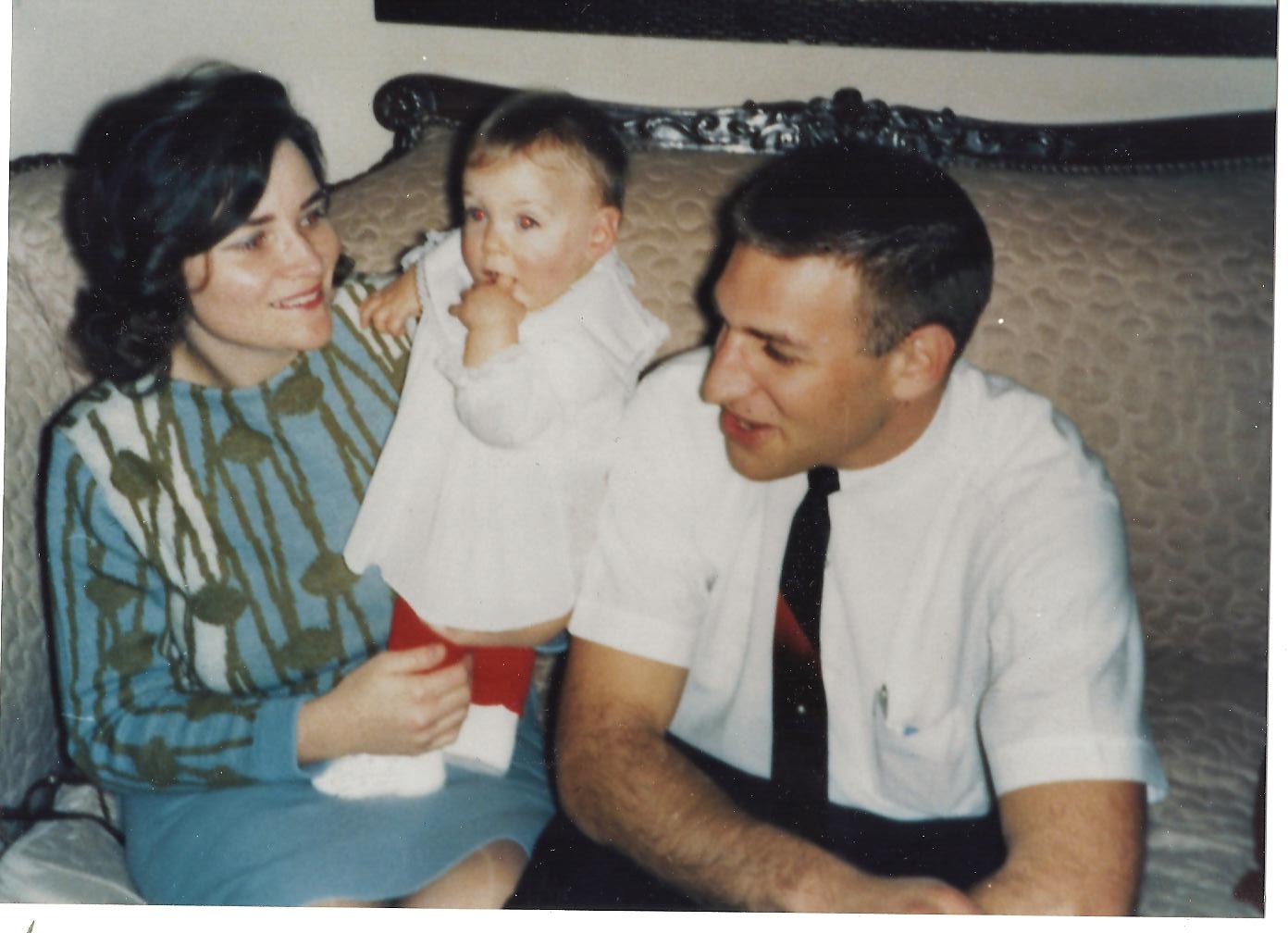
Me and my parents.
My father is a good man, in every way that phrase has meaning. He left my mother when I was 12 and I was devastated. My mother lavishly excoriated him in front of me, daily, and instructed me to hate him. I did my best to comply. I was too young to understand that my father was escaping an impossible situation. They were 34 and 35. Babies. My mother decided she was too old to start over and that her life had ended. She deteriorated from that day forward until her death at 62. SIXTY-TWO. At the time, a friend of mine was dating a man a year older than that (who would eventually become his husband). It’s a shockingly young age to die.
The tragedy is that my mother was brilliant and beautiful, with a razor-sharp, irreverent wit and a lavish warmth. The monster that was her depression took most of that away much of the time. She never fully disappeared– the monster could never conquer her completely– but she was clouded over far too often with the person who felt she was the victim of a world designed specifically to hurt her. And so it went.
My mother as a high school sophomore.
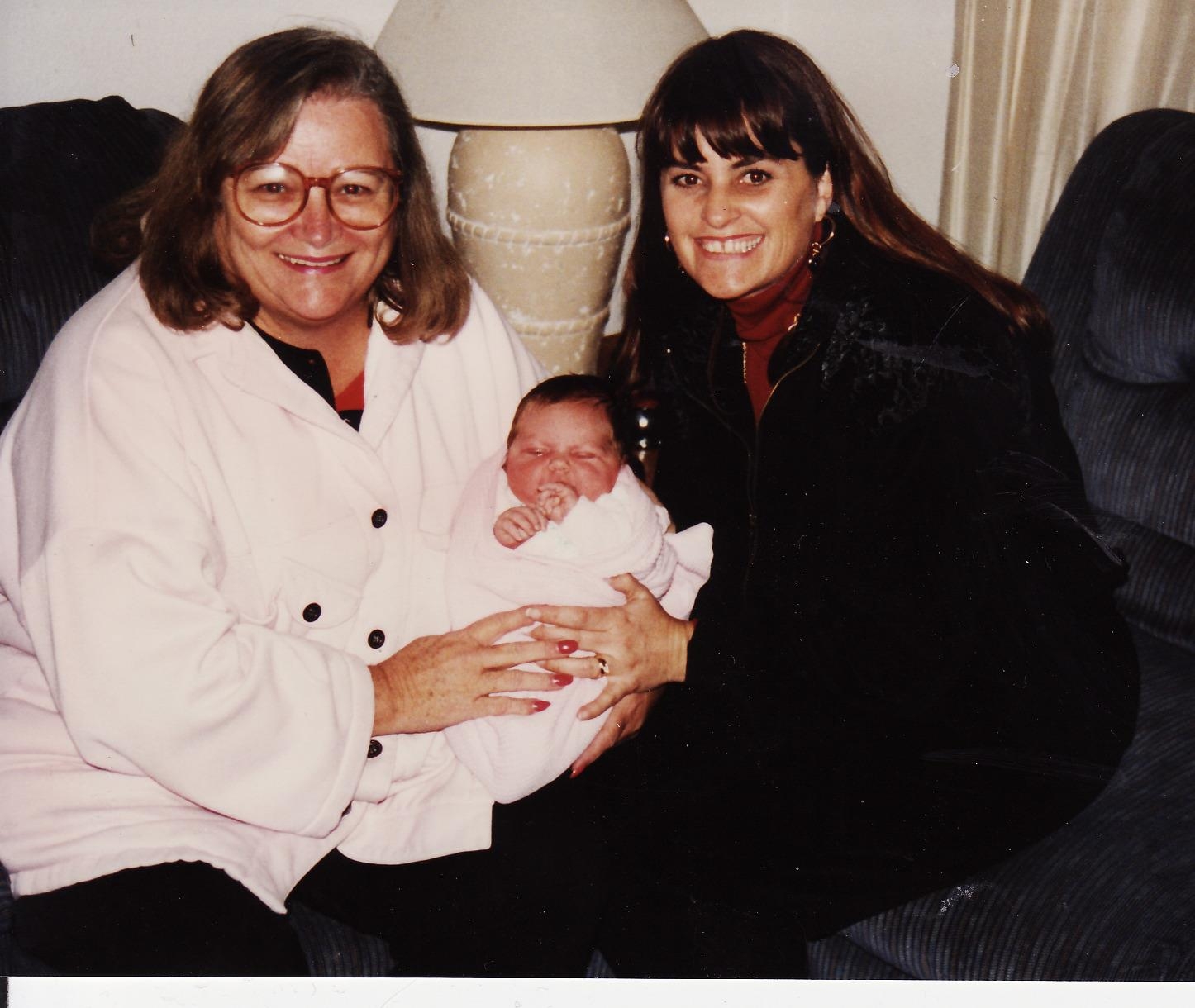
My mother, Charlene, and my newborn niece, Bayley, 1994.
My father went straight into a new life with a new woman. My mother instructed me to hate her, and I did. For years. And of all the selfish, horrible things I’ve ever done in my life (and there are plenty, I assure you), this one hurts the worst. I know I was a child under the influence of a strong but very troubled woman I adored, but I still feel that I should have somehow known better, and understood who this new woman was.
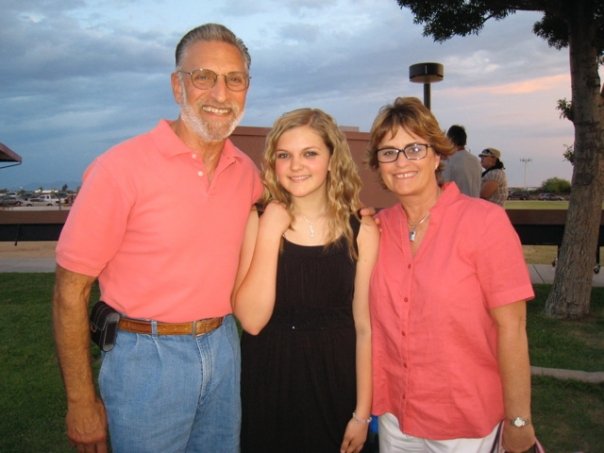
My father and Charlene at my niece Bayley’s 8th grade graduation, 2009.
My stepmother, Charlene, is– I’ve tried to type this sentence five times now, and I can’t get it out. I’m crying as I type this.
My stepmother, Charlene, is the best woman in the world, an enormous positive healing influence on me, a constant gift to my father, the linchpin of this entire family, and the most important woman in my life.
She sat patiently and waited until we figured it out on our own. She and my father never said a single negative word about my mother in my presence. My father to this day has not, and answers my direct questions evasively. Charlene is more forthcoming, but is still circumspect. But I know. Oh, man, I know.
Instead of giving up on us (a perfectly reasonable idea) and focusing on her own child (my awesome stepbrother who is awesome), she just . . . waited. She waited and she loved us. And that was all she did– loved us, and never stopped loving us, and waited for us to figure it out.
Me, my sister, my sister-in-law, and beautiful Charlene, 2006, goofing off in hats at high tea.
And we all did, eventually, one by one as we got into our 20s. As you do. My mother was wrong. She was trapped in a hellish fantasy of her own making. We had believed her. And we were WRONG.
The fact that it took me YEARS to figure this out is the worst thing I can say about myself. It feels like the worst kind of failure and stupidity. But I figured it out. It was like being struck by lightning. I remember the DAY, even, that it finally dawned on me as I sat, stretching out and talking to a friend before a dance class. Her mother was getting remarried, all three kids were flying out for the wedding, her parents had divorced when she was twelve, the new guy is such a sweetheart. And something about that conversation made everything finally click into place. It’s deeply humiliating to even talk about. I should have known years before, but the mythology I was taught at a young and vulnerable age was stronger than observation, stronger than logic. Still. I should have known.
My sister Becky and Charlene, 2013.
There’s no way for me to enumerate all the things Charlene is to me, has done for me, and means to me in this blog without it becoming tedious, because it would take all damn day to list them. All you need to know is that whenever I reached my hand out for her, she was there. She’s one of the few people I know loves me unconditionally, because I was a SHIT to her as a teenager, and her response was to love me. I deserved a swift kick in the ass, and instead, she gave me everything she had to give.
Now that I’m a stepmother, I am overwhelmingly grateful that Charlene taught me how to be a good one. My stepson Jacob came into my life when he was 5, and I went through many of the same things Charlene did when she married my father. Charlene handheld me through it, without ONCE MENTIONING, “Well, at least your stepson isn’t a shit to you like you guys were to me.” She’d have every right. But that’s not who she is.
Charlene with my niece, Maddy. 2013. I love her smile.
This is the paragraph where I should describe her in detail, right? And I can’t do her justice. She is wonderful. She is loving, and warm, and funny, and wise, and an AMAZING cook, and can fold a fitted sheet COMPLETELY FLAT (which is some kind of witchcraft, I think), and is everything I want to be. She can swear creatively and simultaneously make an elegant dinner party for 12 using nothing but an onion, a shoelace, and a Mr. Coffee. She was at Altamont, and my brother’s Bar Mitzvah, and the birth of my daughter. When my mother was dying, she and my father picked me up at the airport and shepherded me back and forth to the hospital, sitting for hours in that crappy hospital cafeteria waiting for me. Every single time I’ve ever reached out for her, she’s been there for me.
You learn how to love from your mother, I think. My mother taught me how to love lavishly, openly, and wholeheartedly. It’s a good way to love. But Charlene taught me how to love unconditionally, and what it means to love someone enough to know that sometimes you put their needs ahead of your own.
Hanging out at the pool with my dad, 2012.
Not that she neglected herself– she made time for herself and time for my father. She gave us an excellent example of what it means to take care of yourself and your marriage while still taking care of your family. To have balance. I had never heard of such a thing. I didn’t know what it looked like until she showed me.
She taught me how to be a mother, how to be a stepmother, how to be a strong woman. I’m still trying to live up to her example, every day.
So Happy Mother’s Day, Charlene. I can’t imagine what my life would be like without you. You came into my life and made EVERY SINGLE aspect of it better.
Cheshire’s basic poster image for the world premiere of The Fisherman’s Wife, by Steve Yockey.
You know what I hear ALL the time? “Your posters are amazing.” “Your production shots are incredible.” “Your flyers are gorgeous.” I KNOW. You know why?
Another Cheshire poster image. I directed this show, and he captured its feel perfectly with this image.
Apart from being Impact’s Managing Director, my partner in crime, and my theatre husband (you can ask Cheshire and my real life husband about how I can’t keep track of who I told what to. Magical), Cheshire is Impact’s Graphics Overlord. If you’ve ever seen an Impact poster, image, or photograph and loved it, you have Cheshire to thank.
So why am I telling you all this? Because, kittens, Cheshire is leaving his job as Art Director at Berkeley Rep and going freelance. Need an amazing poster? A kickass logo? Exceptional, attention-grabbing PR shots or production photos? New headshots? BAM. He’s your hookup, no question. (He’s San Francisco Bay Area-based, so photography will have to be within a reasonable distance unless you have a TARDIS.)
Cheshire’s basic image for Cameron McNary’s Of Dice and Men. My real life husband painted the mini to match the actor playing the paladin, Jonathon Brooks.
Cheshire has been making me look cooler than I am for years now, and now he can make YOU look cooler than YOU ARE. And if you’re already extremely cool, well, his work will make you EVEN COOLER.
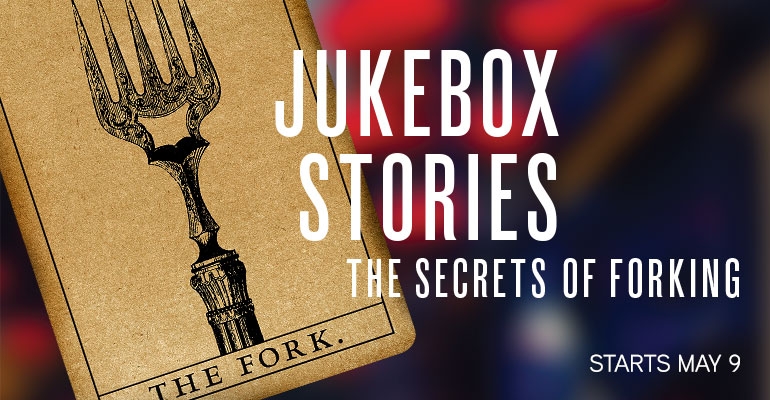
Cheshire’s image for Prince Gomolvilas and Brandon Patton’s last installment of Jukebox Stories
I have a lot of his poster images here, but fewer of his PR and production shots, because I have tons of his shots all over the blog. Click around and check it out. His shots are incredible.
So check out his stuff and drop him a line when you need some amazing art, OK?
One of Cheshire’s PR shots for Impact’s Titus Andronicus. Mark McDonald, Reggie White, Anna Ishida, Michael Garrett McDonald, and Joe Loper pictured.
One of the PR shots Cheshire took for my Romeo and Juliet. You can see how the poster and PR shot match in tone and feel. Joseph Mason, Mike Delaney, Reggie White, and Jonah McClellan, with Seth Thygesen as the corpse.
Stacz Sadowski in a production shot from Cameron McNary’s Of Dice and Men, of course by Cheshire.
Cheshire’s art for Impact’s production of Lauren Yee’s Ching Chong Chinaman is now the cover art for the published version, available from Samuel French. This isn’t the only Cheshire Isaacs theatre poster that eventually became the book cover.
As many of you know by now, I’ve been teaching at the Berkeley Digital Film Institute since its founding. Many film directors have passed through my classes, and exactly . . . um, carry the two, OK, FOUR PERCENT of them understand when they start my class that staged violence needs a fight director. And before you start congratulating yourself for being in theatre and therefore knowing better, easily half of all stage violence is blocked without a fight director. Maybe more. Here’s why you need to hire a fight director for your film or theatre violence.
Impact’s Romeo and Juliet. Seth Thygesen as Benvolio, Marilet Martinez as Mercutio, Michael Garrett McDonald as Romeo. Photo by Cheshire Isaacs. Violence by Dave Maier.
They’re better at it than you are. I know you totally think you can stage that fist fight based on your many viewings of Star Trek TOS, but believe me, you can’t. Or, rather, you CAN; it just won’t be safe or look anywhere near as good as if you had brought in a professional. Here’s the deal: Ideally, you know the look that you want. But the road to get there is not necessarily a straight line. You don’t, for example, set up a stage punch exactly in the same way you’d set up a real punch. It’s not as simple as just not landing your punch. Additionally, every fight has a narrative. Do you know what the story of your fight should be? Do you know how to tell that story clearly? A fight director does. Nothing is more annoying, or pulls you out of a moment faster, than watching badly done violence. It can take a beautifully acted scene and throw it straight down the toilet. You can have all the honesty you want, but if your violence looks cheap and crappy, it’s going to obliterate all that honesty immediately. So, for the same reason you hire any other designer whose entire job is to know more about their area of design than you do, hire a fight director. It’s the difference between a badass fight and this.
…….or you could just use your phaser. Still: KIRK RULES.
Fight Director Christopher Morrison:
“The fights are integral to the story. A fight happens when the characters run out of language to pursue their objectives and their choices become physical. Block/direct accordingly. Also understand a fight is a DESIGN element. As a director you should understand what KIND of violence you want, how that violence fits into the world of the play/spine of the story, and what tone the violence should be (i.e. cartoon, filmic, epic, comic book, intimate, ‘fake,’ dirty, etc.) and be prepared to speak to your fight lady as you would another designer on the team.”
Christopher Morrison getting thrown by Cara Gilson in Impact’s production of Zay Amsbury’s The Wake Up Crew. Violence by Christopher Morrison.
They’ll keep you, your actors, and your audience safe. Apart from the obvious first thought– you want the people around you to remain unharmed because you’re not a psychopath– I’m guessing that you, like me, are someone who enjoys staying out of prison and avoiding lawsuits. An excellent way to do that is to hire a professional to stage your fights safely. Fight Director and actor Carla Pantoja:
“I can’t tell you how many stories I have heard or been privy to of actors getting physically injured because someone didn’t use a respectable fight director. Now when I say ‘respectable fight director,’ I mean someone with reasonable and up-to-date training, or even hiring someone in the first place. [Name] shared a story awhile back of a nonunion (sadly, most of these horror stories are peopled with nonunion folk) actor who had her arm broken and dislocated because the director didn’t hire someone and wanted an arm lock that was ‘real’ (ugh, I hate that term used in relationship to theatrical violence– you want ‘real,’ start a fight club). This director demonstrated on her and snapped her arm. She required surgery.
Part of using a respectable and up-to-date fight director is getting the up-to-date knowledge. There are techniques that are outdated. Just like acting, techniques change. “
All fights, no matter how well-choreographed or rehearsed, carry some measure of risk, like everything in life, but the better choreographed and rehearsed they are, the lower that risk is. If you’ve ever lived through an actor getting injured on your stage, knowing you did everything in your power to prevent that is a world of difference from knowing your actor has a puncture wound because you couldn’t be arsed to hire a professional.
And please be prepared to trust that professional and follow his directives. A safe fight will not remain safe if you throw all the fight director’s instructions out the window. Fight Director and actor Andrew Rodgers:
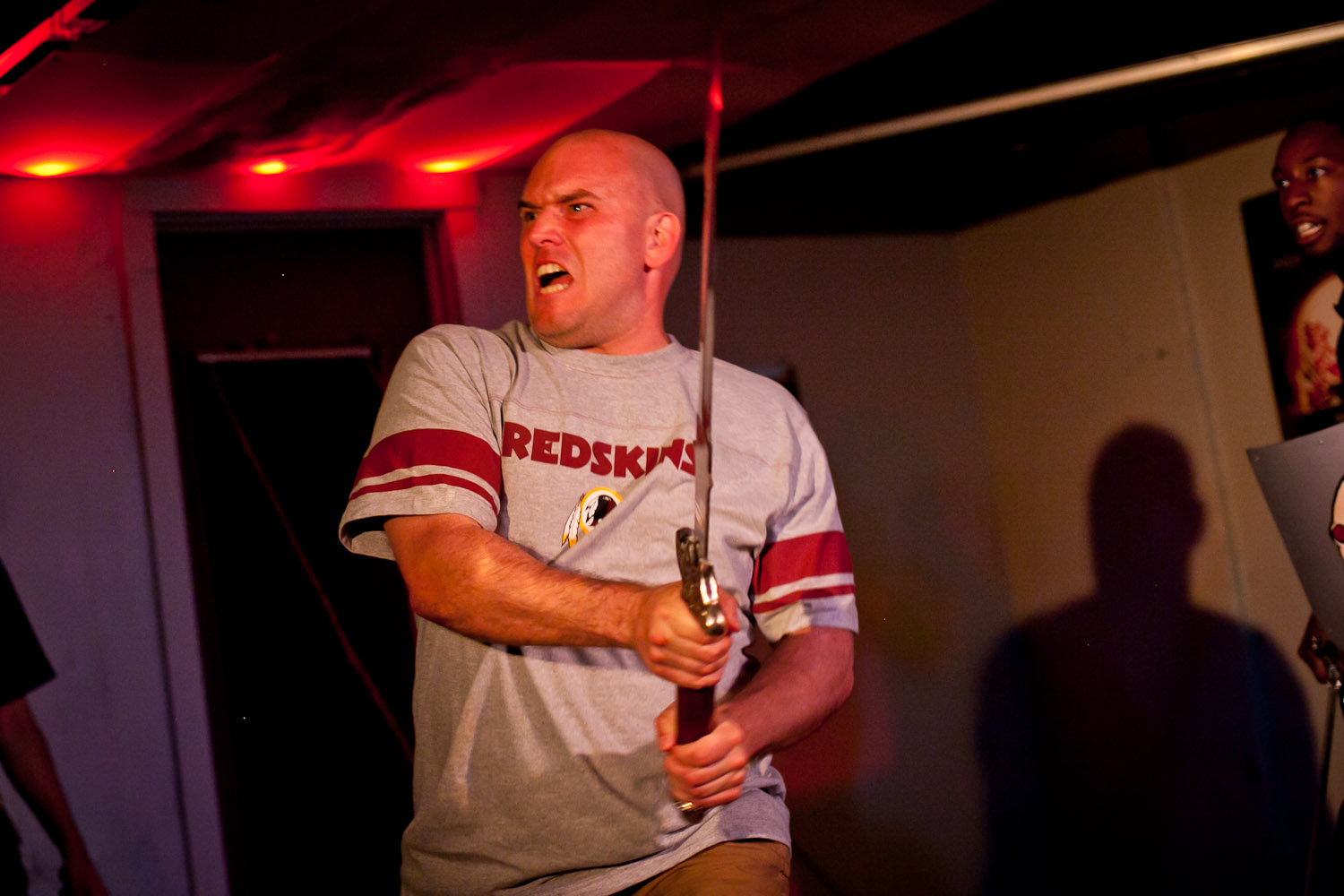
This show is about as bad as it can get for a fight director. The company called and asked if I’d choreograph the violence and the description of the play didn’t seem so bad. But then I saw the publicity photos– the sole actress of the production (let’s call her ‘Jenny’) had a knife in her hand in the pictures. I came to a rehearsal to see what was going on and I discovered that ‘Jenny’ had NO IDEA what safety meant. The knife she was using was a dulled-down butcher knife, and my heart stopped when she first brought it out. The blade was dull but it still had a point on it, and she was playing with it like it was a teddy bear– rubbing it on her face, putting it in her mouth, holding it by the blade or with two fingers. I nearly exploded. To complicate things, there was no structural, dramatic or narrative reason for the knife to be in the show– the playwright thought it’d be cool and edgy, and he refused to do rewrites until opening week. I had to explain to ‘Jenny’ that all weapons, dull or not, should be treated as though they are sharp, and that the knife that she was futzing with could actually kill her or another actor. I thought she had it, then my stage manager called to say she was doing it again.”
I’ve been lucky at my theatre to have worked with many wonderful actors who would never dream of ignoring a fight director’s instructions, but of course we always reinforce that with support from the director, fight captain, and stage manager. Everyone needs to be on board.
Stacz Sadowski and Anna Ishida in Impact’s Titus Andronicus. Photo by Cheshire Isaacs. Violence by Dave Maier.
Yes, you can afford it. Carla makes an excellent point that nonunion actors bear the brunt of the foolery of the producers and directors who don’t want to hire a fight director. Why is that? Because the small theatres who work with nonunion actors are always looking for ways to keep costs down. I’m right there with you in the trenches. My company is the smallest of the small. No one at my company draws a salary. But we wouldn’t dream of doing a show with fights without hiring a fight director. We build it into the budget from the start along with every other design element. If I can do it with my microbudget, so can you.
Obviously you want a trained, professional, certified fight director, but can you afford one? YES, dammit. A little research will show you who the big theatres in your area are using. While a small theatre is unlikely to be able to afford the kinds of rates paid by a LORT, perhaps that LORT fight director is willing to work with you on a sliding scale. If not, it’s almost certain she has a highly-trained associate or star student who’s qualified and talented but is early in his career and looking to build his professional resume. Is there an organization in your area that trains fight directors and actor combatants? Is there a university in your area that offers stage combat training? A little sleuthing will reveal who teaches those classes. Don’t just assume that these professionals are out of your price range, even if your price range is $100 and a sixer of Pyramid Hef. YOU NEVER KNOW. No asky, no gety. But don’t skimp. Pay your fight director what every other designer is getting, because that’s what a fight director is: part of your design team.
Carla Pantoja:
“For those who believe it is too expensive to hire a fight director, did you know that most of us are willing to talk about prices? Sure, there are price points I can’t go below due to commute, etc., however, I know people and I will point you in the direction of someone who may be in your price point.”
Bring your fight director into the process in preproduction, not during tech week. Again, a fight director is part of your design team. You should be meeting with your fight director before rehearsals even begin. Even if the violence is nothing but a single punch, talk to your fight director in advance, let her know who the actors are and what skills they have, discuss the fight narrative and style with her, and ask her how much rehearsal time she’ll need and where in the process she needs that time to be. Fight director Alaric Toy:
“The sooner you include the fight director in the show the better. If the fight director can be part of the audition process, even better. That way s/he can get a good idea of each actor’s true performing capability then and there. Listing ‘gymnastics’ and not being able to perform a cartwheel is just bad. I speak from personal experience looking at some actors’ supposed resumes and the reality of their movement capability doesn’t match when I have to choreograph the fight.”
Carla Pantoja:
“Producers, please call us in early to the rehearsal process. I can’t tell you how many calls I get to stage something like R & J two weeks before opening and none of the actors have ever held a weapon. I’m not kidding. You are setting us all up for failure. When you call me the first time INTO TECH! to help stage a fall or a hit and the actor can’t do it fluidly and it looks clunky, it isn’t the fight director or the actor’s fault. I am not a miracle worker; I can’t magically give that actor the time it takes to incorporate the moves into their body. BTW, falls are the hardest things to sell, I have found. They are the hardest thing to get right technically while visually looking convincing. I don’t do these last minute calls anymore, they hurt my soul.”
Reggie White and Cassie Rosenbrock in Titus Andronicus. Photo by Cheshire Isaacs. Violence by Dave Maier.
What the hell do you mean by a “fight narrative”? Isn’t it just a fight? Ow, even typing that hurt me. This kind of attitude is all too common, and makes as much sense as asking why you should hire a lighting designer, because can’t you just turn the lights on and off yourself?
Andrew Rodgers:
“That is the key to good choreography– thought. The actors MUST be thinking or the fight turns into empty steps. The fight MUST have a purpose, just like any other scene in the play, otherwise it’s an uncomfortable dance break (and I’m usually a fan of dance breaks.) The actors MUST be processing what the characters are thinking. It’s the simple things like this that make good combat– not speed or big shiny weapons– although those have their place. It’s about thought.”
Carla Pantoja:
“I remember one of my mentors, Richard Lane, tell someone: ‘Would you do Oklahoma and not hire a music director? Or would you hire actors to do a play, just give them a script and have them direct themselves?'”
Don’t avoid hiring a fight director because you think your actors don’t have the training to pull off a professional fight. A trained professional fight director will work with your actors’ capabilities.
Carla Pantoja:
“While actors are amazing, we need direction. We need an outside eye to tell us if what we are doing is working. Safety is also nice. Fear is detrimental to our work as actors, not only fear of ‘is this working?’ but fear of being hurt physically.
As a fight director, I am an actor advocate. My job is to help you portray violence in a convincing way in a safe manner, creating a fight with you and for you. A fight you will enjoy to do and can do well within your own abilities. It doesn’t behoove me to make you do a move you physically cannot do, a move you are fearful of, or hold you back if there is a special move you can do that can be highlighted in the fight.
I have sadly worked with too many actors who have been injured and left distrustful of theatrical violence.”
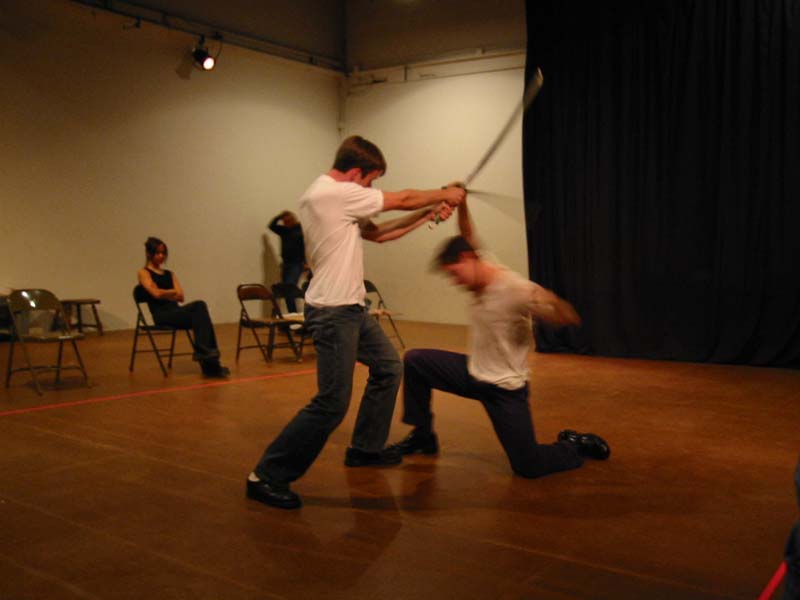
Rehearsing the Hotspur/Hal fight for Impact’s Henry IV: The Impact Remix. Violence by Christopher Morrison.
FOR THE LOVE OF GOD PLEASE TREAT YOUR WEAPONS LIKE WEAPONS. Never, ever, ever, ever, ever allow an actor to point a gun loaded with blanks at someone, or at himself, and pull the trigger. A blank is not a NOTHING. That noise is made by a violent discharge that can seriously hurt someone. Just because it’s not propelling a bullet through the air does not mean it is a fluffy puppy. (Personally, I use sound cues for gunshots. A sound cue will recreate the sound of the gun in the setting. Is your play set outdoors? In close quarters? Is that gun supposed to be a hunting rifle, a shotgun, a .22? A blank fired in your theatre will always sound like nothing other than a blank fired in your theatre, and yes, all blanks of all sizes and types sound like blanks fired in your theatre, not like a bullet fired in your setting. That is, IF the blank even goes off. I’ve been through far too much “click click click click POP” to rely on blanks. And again, they sound like crap. An excellent sound designer is worth every blank in the world put together.)
A dulled blade is not magically prevented from doing any harm to anyone. It’s still a hunk of metal that can penetrate a squishy human body rather easily.
MORBO LAUGHS AT SQUISHY HUMANS
And NEVER take your weapons out of the theatre unless they’re in some kind of case or containing device. Do you want three uniformed police officers and one plainclothesman charging downstairs into your theatre five minutes before curtain? Then make sure your actor leave his weapon on the prop table when he runs to the bathroom, not shoved down the back of his pants.
(I don’t need to tell you that an actor who plays with the prop weapons backstage is an actor you should NEVER HIRE AGAIN, right? If an actor can’t follow the simple directive of “don’t fuck with dangerous props (or any props, really)” then that lack of concern for professionalism and safety is bound to carry over into other areas of his work.)
All good troopers know to put their weapons back on the prop table when they’re off stage, and never touch anyone else’s props.
So please hire a fight director. You CAN afford it. A qualified fight director will enormously enhance the quality of your show, keep everyone in your building safe, and open your eyes to new perspectives on work that you may, in many cases, have been turning over in your mind for years. When you finally get your hands on Lear (and by “you,” I mean “me”), a fresh perspective on those scenes you’ve been dreaming about blocking for a decade will not only make the violence better, but will provide fresh insights into the entire piece– narrative, themes, and characters.
Stacz Sadowski and Miyaka Cochrane in Impact’s As You Like It. Photo by Cheshire Isaacs. Violence by Dave Maier.
This piece wouldn’t be complete without a shout out to the fight director Impact Theatre works with– Dave Maier. Dave is brilliant. He and I see eye-to-eye about violence and tend to exacerbate each other’s love for stage combat when we’re working together as director and fight director. We’ve been known to turn the simple direction “they fight” into scenes that say as much about the characters as the dialogue, maybe more, and that’s something I would never, ever be able to do on my own. Working with Dave is a joy. I learn something every time I work with him, and his ideas about character and narrative are always fantastic.
So hire a fight director. Be safe. Be a better artist. Be awesome.
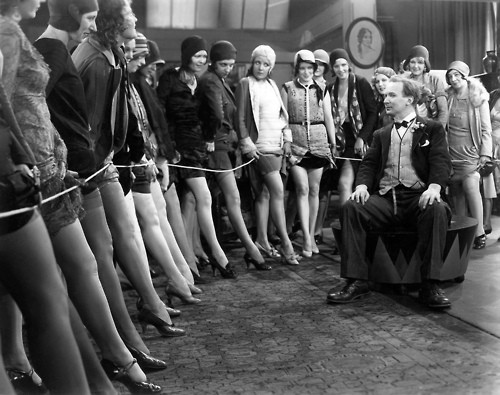
A casting call for showgirls, 1920s. This is exactly how I’m running callbacks for Troilus and Cressida.
I love auditions. I always have and I always will. I will happily sit through day-long auditions. I recognize, however, that auditioning is a deeply flawed process with huge limitations.
For that reason, I also hate auditions. Their artificiality makes it difficult to understand how an actor works in a rehearsal and performance process. There’s also a hierarchical feeling to auditions that makes me uncomfortable. I see actors as co-creators rather than as puppets who execute my vision. I think I’m auditioning for them as much as they’re auditioning for me. But the reality is: I have more actors in front of me than I have roles to fill. Some will hear “yes” and some will hear “no,” and I hate that. The fact remains that I must find a way to make decisions about who will populate the plays I direct or produce.
Taylor Mac wrote a great article about casting a couple of years ago, saying that we should completely do away with auditions and instead cast people we get to know through work in the community or working with them directly. This is, of course, a fantastic way to get to know actors– I’d even say the best way. But it’s not something that can replace auditions outright.
I use a combination of both techniques. I cast people without an audition (or bring them straight to callbacks) if they’re someone I’ve worked with before, or someone whose work I’m familiar with. But I just can’t envision completely giving up auditions, because I think, as flawed as they are, they offer something unique to theatremaking that we can’t do without.
One of the PR shots for my production of Othello at Impact Theatre. Skyler Cooper, my Othello, came in to audition for Macbeth the previous year and blew us away. I had never heard of her as she was new to acting after spending years in the Air Force. Impact’s lesbian Othello was one of the most successful shows we ever did, and I would never have found Skyler were it not for our open auditions. Pictured: Marissa Keltie and Skyler Cooper. Photo by Cheshire Isaacs.
The New Kid on the Block. Over and over again, I’ve had someone I’ve never heard of before walk into an audition and blow me away. They’re new to the area, recently graduated, or new to acting. Often an open audition is the only chance they have to break into a new market. This is especially true for actors who are traditionally marginalized. If you’re not getting cast, I have no way to get to know your work unless I hold an open audition. An open audition allows actors who have no other pathway access to directors, casting directors, and artistic directors. I think preserving that access is crucial.
Growth and development. Yesterday we had our first day of season auditions, and no less than three actors I’ve seen multiple times before gave auditions that almost knocked me out of my seat. Three actors showed up with auditions that were leaps and bounds better than anything I’d ever seen them do before. One did a piece outside of what one of my directors had considered her type, based on the pieces and shows he’d seen her do previously, and changed his entire conception of her abilities. There’s a special kind of joy in watching an actor develop over the years. I’ve seen actors go from green, timid, and wobbly recent graduates to powerhouses in just a few years. I’ve seen powerhouse recent graduates mature into wider and wider ranges and abilities. I’ve seen mid-career actors push through to new levels, mature into new types, discover new approaches. It’s deeply satisfying to see, and it’s something we might not see outside of auditions. If I “know” what your type, range, and abilities are, I might not prioritize coming to see your show in favor of seeing a show stacked with actors I don’t know. I can only see so many shows, so I have to pick and choose. Additionally, you might get cast consistently as a certain type, but have the ability to push out of that range into something new. An audition will give you the opportunity to show us that.
Impact resident actor Mike Delaney in the world premiere of Toil and Trouble by Lauren Gunderson, directed by Josh Costello. Mike auditioned for a show I was directing at CSU East Bay years ago. Now he’s a core member of my company. Photo by Cheshire Isaacs.
Actors as co-creators. When you do an audition monologue, theoretically, at least, this is material you’ve chosen for yourself, performed with choices you’ve made. The choices you make show me something about who you are. I want to work with people who bring something special to the table, who have interesting things to offer as co-creators of the work. When I go to see a show, often I have no way of knowing which choices you’ve made and which choices the director’s made, and that balance is going to differ depending on who the director is, how s/he works, what kind of relationship the director has with that particular actor, what kind of relationship that actor has with the director’s concept, etc. There are a huge number of variables that affect how deeply an actor is directed in any given production.
An actor came in to auditions yesterday doing a piece from a show he had performed, directed by someone I know very well. While he was a skilled performer, his piece looked, smelled, and tasted like the director. All I could see was the director. He came recommended by another actor whose opinion I trust, so I’ll call him back, specifically to see who he is as an actor. His audition just didn’t answer that question for me.
I’m not just looking for actors; I’m looking for collaborators. I don’t want minions; I want accomplices. I’m auditioning people so I can see both what their skills are and what kinds of choices they make.
Change Our Minds. Every so often, I think I know what I want for a certain character, and then an actor shows up who changes my concept completely. I had a short list of actors I was considering for a particular role in the show I’m directing this fall, and an actor I’d never seen before came to auditions yesterday and changed my mind. In the middle of his monologue I suddenly realized that I wanted something completely different for the character. I could see him as the character, and it brought a different context and more depth to the role than I had previously considered. Now he’s my frontrunner for the role. 24 hours ago, I had never heard of him.
Chris Quintos in Impact’s production of The Chalk Boy by Joshua Conkel, directed by Ben Randle. Photo by Cheshire Isaacs.
Despite their drawbacks, auditions are a very useful tool. I have a love/hate relationship with them, but I’ll continue to rely on them.
P.S. I have some articles about audition tips you can check out here and here, and some casting advice for actors here.
Impact Theatre’s production of Steve Yockey’s The Fisherman’s Wife. Pictured: Eliza Leoni and Maro Guevara. Photo by Cheshire Isaacs. I think this accurately represents my day.
OK, most of the people who read this blog are theatre people, so you already know that we don’t have birthdays. We have rehearsal. The most any theatre professional can hope for is a surprise cake at break before you get back to work blocking 21-36. WE KNOW THIS. It’s one of the hazards of the job, and that’s fine.
I decided to buck that hazard for one year out of my life (I started in theatre when I was 12) and have an actual birthday. I kept Monday, April 15 clear of rehearsals, meetings, coaching, auditions, readings, and performances. It was a challenge, but I did it. I was going to have a BIRTHDAY, DAMMIT. I was going to experience the magic of civilian life.
What I imagine happens to non-theatre people on their birthdays while we’re all at rehearsal
There was already a wrench in the works when the sink started leaking on Sunday. The garbage disposal had a screw stuck in it (WHERE THE HELL DID A SCREW COME FROM AS I DID NOT HANDWASH A BATTLEMECH) and was therefore refusing to work and leaking water all over the place. We tried calling the plumber but it was Sunday and we were out of luck. So I knew going in that part of my CIVILIAN NON-THEATRE BIRTHDAY EXTRAVAGANZA on Monday would be meeting the plumber. So maybe the mani-pedi (one of the very few girly things I do) can wait until another day.
We go to bed Sunday. Tomorrow is going to be AWESOME. I’m going to play way too much xbox, wait for the plumber (slightly less awesome but working sink = AWESOME, so OK), blog, thank everyone for the birthday wishes as they roll in on facebook, maybe still squeeze in a pedicure, maybe do a little work on the script WAIT NO I MEAN some work on the dramaturgy for my summer class WAIT. OK, this is harder than I thought. MORE XBOX and then a no-kids dinner date with my husband, whom I had planned to ravish afterwards. A perfect day. I get a midnight birthday kiss and we go to sleep.
Just a quick picture I took of myself before I went to sleep.
Fifteen minutes after the “go to sleep” commences, my husband sits up, yelling “I CAN’T BREATHE.”
This gets my attention.
I vault awake and ask him what’s going on. I’m fully into my “Calm In A Crisis” Mode, a mode I discovered I had during my mother’s many health odysseys. He tells me he’s having trouble breathing, he has a crushing pain in his chest, his left arm is tingling, and he feels like he’s going to faint. It’s 12:20 by now and I’m throwing my clothes on, ready to take him to the ER. I give him a choice: ambulance or car? By the time I have enough of my body covered to be able to make a public appearance, his symptoms are subsiding. He decides to call the Kaiser advice nurse first. I take nothing off, because I’m still certain we’re going to the hospital.
The advice nurse says to come in if any of the symptoms return, but otherwise come in the next day. He makes an appointment for my husband for 10:40AM. My husband gets up to file a lesson plan with his school and contact sub finder. I follow him and sit next to him the entire time he does this because I don’t want to let him out of my sight. My night owl Managing Director, the awesome Cheshire Isaacs, sees that I’m up and we chat for a bit on facebook. It’s a serendipitous moment of comfort while I’m in Handling It mode.
The next day, I get up early, pack a lunch for the son not on spring break, and check my email before we head off to Kaiser. Sitting in my inbox are two comments on this blog waiting for approval. One is from a dude mansplaining dramaturgy to me because my understanding of dramatic structure is ALL WRONG (I might approve his comment and just reply with a scan of my PhD diploma). The other is special, though: MY FIRST MRA TROLL! Every female blogger of note has them. I feel like I’ve arrived. He’s angry because I’ve used the word “dick” as a pejorative in the word “Dicklandia,” which he believes renders every comment I’ve ever made about sexism inoperable. He says it’s comparable to using “Pussylandia” or “Asianlandia.” I toy with approving his comment just to see what your responses would be, but I have bigger fish to fry. I leave my mansplainer and my MRA troll where they are.
We spend five hours in Kaiser, most of it in the ER. My poor husband has two EKGs, a chest xray, a bunch of blood work, and an ultrasound (I have now seen my husband’s actual beating heart). I read about Boston on my phone and my heart breaks. I put my phone down– I need to focus on the crisis in front of me. We wait for the test results to see if the doctor will let us go home or admit my husband.
Through it all, we are how we always are– joking with staff, not making a fuss, doing our best to ease their working day. We are Good Customers. When they wheel him out for the chest xray, I’m left in the room alone. For the five minutes I am unseen behind the closed door, I lose it. I cry and cry.
And then I realize, for the first time in two decades, I have left the house without a handkerchief. There are no tissues in this exam room. I tear off some 20-grit paper towels and attempt to wipe my face and blow my nose without scraping off half my face.
Not the look.
The tests are inconclusive and they send us home. The good news is that it wasn’t a heart attack; the bad news is they don’t know WHAT it was. He’s told to rest and follow up with his GP.
We go home, exhausted. We sleep for a bit. Too tired to put pants on, go out in public, or, you know, move more than 20 feet, I shuffle out to the kitchen and make popcorn for dinner (ON THE STOVETOP THE WAY GOD INTENDED). I always make too much popcorn, so I had leftover popcorn in the bowl, which I set near the tower of books by my bed. Ehhhhhhhhhhh. I’ll get it in the morning. What could possibly go wrong?
I’m afraid to go to sleep– I think if I’m not watching him nonstop something terrible will happen. Exhaustion finally wins out and I turn out the light around midnight.
AGAIN WITH THE 12:15. I hear suspicious sounds coming from the popcorn bowl. I grab my glasses, turn on the light, and
A FUCKING MOUSE leaps out of the bowl and makes a mad dash for the closet.
Whatever I said (possibly “HOLY SHIT A MOUSE”) wakes up my husband who gets out of bed, semi-excavates the closet, and sets a mousetrap. I sit up for way too long listening to the mouse scurrying around until it hits the trap (or maybe cleverly disarms the trap and makes off with the peanut butter; we haven’t checked it yet), and quiets down so I can finally get to sleep.
And that was my birthday.
Lesson learned, universe. Theatre people: DO NOT EVEN TRY. Giving up birthdays and anniversaries are just part of the darksided deal we made.
Why do some people want to make everything into a damn contest or a display of one-upmanship? The foolery alarm goes off the minute they start a sentence with “Try.”
1. “Teaching middle school is so damn hard!”
WRONG RESPONSE: “Try teaching second grade.”
RIGHT RESPONSE: “I bet! That sucks! I teach and it’s hard for me, too! Let’s be annoyed together! YEAH!”
2. “Wow, my day sucked because I’m sick.”
WRONG: “Try being sick for two weeks.”
RIGHT: “I KNOW! Been sick for two weeks and it blows and also sucks! Let’s complain together! BONDING MOMENT!”
You also know you’re on a ride through Dicklandia when their response starts with “Welcome.”
1. “I had a fourteen hour day today! Whew!”
WRONG: “Welcome to my every day”
RIGHT: “That’s rough! I had one, too. MILLER TIME!”
2. “Aw, damn, I didn’t get the job.”
WRONG: “Welcome to the real world.”
RIGHT: “I’m sorry. It’s been rough out there for a lot of us. MILLER TIME.”
It doesn’t actually have to be Miller
When you say say “Welcome” or “Try” in these contexts it belittles the other person’s experience. It implies that they’ve never had this hardship before and you go through it all the time. It implies that, no matter how difficult the person is finding their experience, yours is HARDER. It’s a dick move, EVEN IF IT’S TRUE. You can commiserate with someone without belittling them. You’ll get your chance to complain. You don’t need to bogart theirs.
And yes, sometimes people are complaining about shit they have no right to complain about. When I was selling my mother’s house (she was ill and towards the end of her life), the real estate agent bitched and moaned to me about how he used to go to cultural events in Oakland all the time, but now there are just “too many Black people.” The appropriate response to that may very well be “Welcome to 2003” with the addition, “YOU ARE A RACIST AND I AM GOING TO A DIFFERENT REAL ESTATE AGENT AT ONCE.” I’m not talking about people who are being awful, racist, selfish, or entitled. I’m talking about people complaining about their regular lives– you know, the kind of complaining we all do. Ow, my back; my kids are driving me nuts; I have no job; my job sucks; my mother-in-law is certifiably insane. You know, the usual.
The people who can’t let anyone else have a moment to do some basic human complaining are the same people who just can’t let anyone have the spotlight for even one minute to celebrate, either.
“I just did an awesome thing! Whee!”
WRONG: “My kid did that awesome thing when they were two, plus I did it seven times with Shatner on the back of a monkey-driven, rocket-powered donutmobile AND I WAS BORED.”
RIGHT: “Congratulations!”
If you find yourself responding to someone and the first word out of your mouth or keyboard is “Try,” YOU ARE NOT BEING COOL. Unless that person is saying, “OW I AM BLEEDING” and you’re saying “Try putting pressure on it,” in which case, carry on. If you find yourself responding to someone and the first word out of your mouth or keyboard is “Welcome,” YOU ARE NOT BEING COOL unless YOU ARE BEING SINCERE.
“Look at this picture of my new baby!”
SINCERE RESPONSE: “Welcome to parenthood! She’s beautiful!”
BULLSHIT RESPONSE: “Welcome to my world. Good luck getting any sleep until February.”
You really do not need to be the winner every single time. Let others have the spotlight from time to time. I promise you won’t disappear if it shines on someone else for a second. It actually feels great, and, as my wonderful former mother-in-law says, it earns stars for your crown in heaven. Not that we subscribe to the same religion. She’s a Christian and I’m a follower of Moradin, god of the dwarves.
The only god who will give you +2 STR and +10 HP just for asking.
When you’re just starting out as a playwright, a lot about the industry can seem mystifying. Here are some quick dos and don’ts for people out there trying to navigate the wild waters of playwriting.
DON’T send your play to playwrights, artistic directors, literary managers, or dramaturgs asking for feedback unless you’re related to and/or sleeping with them. Maybe not even then. We’re all very busy people, and we get dozens of people a month asking us for feedback on their plays. You’re asking us to do FOR FREE something we do for a living. It takes hours to read a script, evaluate it, and craft useful feedback. Those are hours we must reallocate from our paid work or our personal lives. Then, when we provide that feedback, if it’s not what the playwright wants to hear, all too often they react angrily, ignore our advice, or tell us we’re wrong. It’s almost always a no-win situation for us.
If a theatre, contest, or individual has already stated that feedback will be provided for free, have at it. Otherwise, don’t ask for feedback on your script from someone who isn’t one of the first ten people you’d call to bail you out of county.
DO invite these people to come to informal readings. Feed them snacks. Serve them beer. Have them read your play aloud, then open a dialogue about it. This can be an incredibly useful tool. There’s no substitute for hearing your work out loud. Feel free to invite all the playwrights, ADs, turgs, and LMs you like. If they show up, they’re agreeing to give you the feedback you seek. LISTEN TO THEM. Take their advice to heart. You don’t need to follow every piece of advice everyone gives you, of course, but don’t reject criticism out of hand. If all you want is praise, give the play to your mother, a call girl (tip well), or your imaginary friend. I’d advise against having a public reading of an early draft if you’re just starting out. There are a million reasons, but the most important is that professionals will give you advice about how to make your play do what YOU WANT it to do. It’s a specific skill. Save the public readings for a more solid draft or until you’ve found your footing as a writer.
DO consider hiring a dramaturg. Professional dramaturgs often specialize in helping playwrights develop new work. Another option is to find a director who understands your vision and will be on board throughout the development process. I understand (oh so intimately) that most people don’t have a lot of extra money, so this may not be an option for you. Perhaps you know a dramaturg who’d be into a barter agreement. I’d trade dramaturgy for massage therapy in a hot second. Now if I could just convince Karin Wertheim to start writing plays…. (If you’re located in the Bay Area, you really need to check her out. Her bodywork is INSANELY good.)
DON’T make rookie mistakes in your cover letter. Don’t tell me in your cover letter how “hilarious” or “moving” your play is. If it’s a comedy or a drama, it’s fine to say that. But don’t praise or otherwise evaluate your own work. Also, always proof read. I don’t mind when playwrights have the name of another AD or company at the top of the email due to a copy and paste error (it’s fine, really), but I do mind when the email is riddled with spelling and grammatical errors. I don’t think you need to be a Grammar Ninja to be a good playwright, but a cover letter riddled with errors shows a lack of care and attention. The squiggly red line is there for a reason, chaps. Finally, I’m very interested in your play. I am completely uninterested in the letter of recommendation you’ve attached to it from a famous playwright. I have nothing but respect for Theresa Rebeck, but she knows nothing about my theatre or its needs, so her recommendation is useless to me.
DO follow all the submission guidelines. They’re there for a reason.
DON’T expect a personal response. No, it’s not “just polite” for a company to respond with a personal note to a submission. We all get hundreds and hundreds of submissions, even theatres without paid staff. The workload is nuts, so most of us are barely keeping our heads above water. Many have stopped responding to submissions entirely. And please don’t come out with, as I’ve heard some people say, “Then don’t accept unsolicited submissions at all if you can’t respond to them.” There are an increasing number of theatres who have decided to do exactly that. I don’t have any plans to stop accepting submissions, but I understand why a company would make that decision. I think playwrights would want to encourage those avenues of access to stay open. So don’t always expect a response, don’t imagine that the reason you didn’t get one is because the theatre is impolite, and don’t tell us we should stop accepting submissions if we’re not sending out personal notes to all 412 playwrights who submit each season. I assure you, we’re all doing our best.
This week’s submissions
Another thing I hear frequently is “You should state in advance whether or not you respond to submissions and how long it takes.” While I agree that companies that don’t respond to submissions should state that in their guidelines, remember that even theatres that do not accept submissions at all get hundreds of them, and playwrights are often sending submissions based on a third-party post. (I’ve sent numerous emails to various playwriting sites attempting to correct errors about our submission process, to no avail.) There’s no reason why a theatre that does not accept submissions should respond to yours, and a theatre may have in their guidelines that they don’t respond to submissions unless they’re interested in producing, and yet that fact never made it onto the third-party website you’re reading. Again, don’t assume the reason a theatre isn’t responding to you is simple twattery.
No theatre can accurately predict how long it will take to respond. Generally speaking, the longer the better. We can turn a rejection around quickly, but when a play is being strongly considered, it takes much longer as it makes its way up the chain.
“Here, have some dynamite down your pants” is never a good response to rejection.
DO respond courteously, if at all, to rejection. While most playwrights are awesome, often literary departments and ADs are confronted with angry playwrights who are upset their play was rejected. I’ve personally received dozens of angry emails from rejected playwrights. Once we had a playwright resubmit a play, telling us that he had rewritten it to include a Black character “since that’s what you people seem to like over there.” I’ve been called an “asshole” more than once. I’ve been told I was an “idiot” who couldn’t recognize good writing. I was told once that I “require objects of condemnation.”
I’ve even received angry emails from playwrights who didn’t like the rejection letter itself. I’ve received emails complaining that the rejection was a form letter. I’ve received emails complaining that the rejection was NOT a form letter. I once received a lengthy email telling me I was “everything wrong” with theatre because our rejection letter had a formal greeting (Dear Mr. Malcolm Reynolds, etc).
I know rejection is hard, but I assure you it’s not personal. Since there’s no such thing as a rejection that every playwright thinks is “best” (they all want different things, vehemently at times), theatres must make a choice that works for them. So take a deep breath, and then call me an idiot who can’t recognize good writing when you’re at the bar with your friends, not in an email to me.
DO tell meanything practical you think I might need to know. Are you open to casting some of the male roles with women, or using different music than the music stated in the script? Are the difficult technical moments able to be done in a low-tech way? How do you envision that being accomplished? If the script calls for an actor to play the accordion, are you open to other instruments as well? Are you open to double casting?
bring it
DO watch your language. You can drop all the f-bombs on me you can muster. Creative swearing brings a smile to my lips and a song to my heart. However, be very careful about using words that are considered hurtful. I’ve seen in two scripts recently the usage of the word “retarded” in stage directions: “Staring at him like he’s retarded.” I’ve seen racism, anti-Semitism, homophobia. I’m not referring to characters’ points of view– of course people write all the time about characters with unsavory opinions– but language that reflects the point of view of the playwright. I’m going to trust that your statement that the right theatre could “jew you down” to a lower royalty rate comes from a place of ignorance rather than outright racism. So review your statements carefully.
That’s all for now. You know I’ll have more later, right? I can’t stop myself. I’m pathologically helpful. I know that starting out in theatre as a playwright can be confusing and overwhelming, but hang in there. It won’t take long for it all to seem like home.
There’s a lot of handwringing over the dismal stats released on a regular basis about audience diversity in the theatre. I’m not going to retrieve the stats for you– you’re already on the internet and can find the eleventy brazillion articles about it on your own– but suffice it to say, they are dismal, even in ethnically diverse communities like the Bay Area.
Scholars are insistent that theatre will “die” if the industry can’t diversify its audiences. Because the country’s ethnic makeup is getting more and more diverse, so the thinking goes, theatre will eventually die unless it can make its audiences more diverse.
It’s true that people of color do not attend THE THEATRES THAT WE MEASURE in numbers representative of their percentage of the population. But we only measure certain types of theatre. We measure Broadway. We measure large nonprofit theatres. We measure theatres that exist within the models we deem relevant.
We do not measure small theatres, indie theatres, or any theatremaking that exists outside of the mainstream models. For example, despite the fact that it’s a multimillion dollar industry, we do not measure gospel musicals.
I think what directs that thinking is that traditionally white-dominated artistic endeavors are labeled “high culture” and everything else is “popular culture.” Then, from there, we worry about why people of color aren’t participating in the art forms and styles we’ve decided are “best” or “important.” We laud the Latino who plays the violin in an orchestra and discount the Latino who plays the violin in a mariachi band. We see this within theatre all the time– what’s “serious” theatre “counts” and everything else exists in semi-visible strata beneath that.
My classes are extremely diverse, and you’d be surprised how many of my students have participated in performance-based activities. Those activities don’t always conform to what white America thinks they should. Many people have lives that are inundated with art, but mainstream culture very often believes that that art just doesn’t “count.” We put ballet dancers in a class above Polynesian or flamenco dancers. When I tell people I used to sing opera, they react as if I’d done something remarkable and worthy of respect. Tell someone you rap, and the reaction is completely different. I could be the worst opera singer in history standing next to the best rapper who ever lived, and I would still be accorded a measure of respect the rapper will not get. Someone who’s been to 20 church plays is not considered a theatre-goer.
We need to stop discounting performance forms that don’t conform to our expectations of “importance” or “high culture.” People of color are participating in enormous numbers in arts of all kinds, but we’re upset because not “enough” are attending the arts events we want them to attend.
In addition to opening our eyes to other theatre forms, we need to check ourselves, all of us. More than one person of color has mentioned to me that this desperation to get people of color into “our” theatres smacks of paternalism- that we’ve decided what people of color “should” be doing and we’re handwringing over the fact that they’re not choosing what we have to offer them in the numbers we want. (WE DID FENCES, WHAT MORE DO YOU WANT?)
Personally, I’ve become deeply uncomfortable with the fetishization of people of color in our audiences. It’s uncomfortable to me to hear people bragging about or complaining about their audience diversity, like people of color are pogs. And I get, deeply, that much of this anxiety comes from funders who are demanding to see an increase in the number of people of color in all theatre audiences, which is a whole different discussion.
My audience is diverse because we market to young people in the Bay Area, and that demo is diverse. I don’t feel like it’s some particular achievement that we staged world premieres by Enrique Urueta or Prince Gomolvilas. But I’m as susceptible as anyone else to this conversation, and I DO talk about these things as if they’re achievements, all the time. And it’s starting to make me feel awful.
I’m getting more and more uncomfortable with the way this dialogue goes. It always ends up with talking about people of color like they’re collectible lunch boxes. We need to start examining our underlying assumptions, starting with this idea that people of color “should” be attending “our” theatres.
I’m not saying we should ignore issues of diversity. Theatremakers of the future will be more diverse and include more women in part because we insist that it be so. We need to be vigilant about creating equal opportunity for people of color and for women at all levels of theatre. When theatremakers are more diverse, theatre audiences will be more diverse, partly because of the programming they will create and partly because the entire population will be more diverse.
What I’m saying is: Theatre’s never going to die. The multimillion dollar nonprofit model might die (and it might not), but there will always be people doing theatre, always. There always has been and there always will be. We need to step away from claiming so much definitional authority over its terms and processes. We need to step away from this desperation to “save theatre” by enticing more people of color into certain doors while ignoring other doors, and realize there’s more theatre in heaven and earth than in our philosophy.
UPDATE:
The brilliant Cindy Im, former Impact resident actor and current AEA actor whom you should hire for ALL THE SHOWS, had this to say:
“After my mostly white school took me to see a play, my parents told me I couldn’t be an actor because theatre was for white people. This was not because they had other cultural outlets, but because they felt excluded. Once I dragged them to the theatre so I could see plays, they felt more comfortable and started attending on their own. Who knows how many thousands of people there are who would love to attend the theatre but don’t feel comfortable or don’t know anything about it, who might love it if they had the exposure?”
I think the issues around access and diversity are incredibly complex. While it’s true that we’re just not measuring the cultural outlets that are dominated by people of color in the same way that we measure traditionally white-dominated activities, and while it’s true that we accord traditionally white-dominated activities a level of respect that we do not accord activities traditionally dominated by people of color, the fact remains that creating avenues of access for diverse audiences is still a crucial consideration for the theatre community.
Open dialogue about these issues is the key, I think. We need to listen to each other and find a way forward, together.





































 Bitter Gertrude