Tag Archives: producing

Theatre’s “Broken Business Model”: An Open Letter to Dwayne Clarke, CEO

Dear Mr. Clarke:

I read the Stranger article about your play at ACT in Seattle. As a millionaire (billionaire?) CEO, it’s honestly touching that you wrote a play about your life-changing experiences in group therapy. By all accounts, it was a decent first effort. Of course, it wasn’t staged on its own merits– you paid ACT for the privilege, taking on all the financial risks yourself, and filling the house by exhorting your CEO buddies to buy blocks of tickets at twice the ticket price to support the work, then give the tickets to their employees– a very nice touch. You could easily have paid someone to make this into a film. But you chose the theatre, and that’s actually, honestly, kind of sweet. You say you see yourself as a neo-Renaissance patron of the arts, a modern Medici. Either you’ve played a lot of Assassin’s Creed, or you know a little something about history, but either way, on its surface, it’s touching.

What’s less touching is your opinion that theatre is a “broken business model.” You see, Mr. Clarke, there are two basic kinds of theatre. Commercial theatre makes scads of money by staging splashy, fluffy shows, charging a mint for tickets, and selling tons of related merch. Think Disney’s Aladdin on Broadway, or the touring company of Book of Mormon. These would be the people operating on the for-profit business model with which you’re familiar, and they’re doing, for the most part, quite well.

The nonprofit theatre, however, works under the 501c3, meaning the model it works under is expected to make less in ticket sales, and is allowed to make up the difference in grants and donations, tax free. “Why would we do this,” you ask? Because the kind of new, risky work we want to do rarely sells scads of tickets. Sure, every so often you have a hit, but most of the time, risky new work doesn’t pack the house. It’s necessary, however, for the development of the art.

This is usually where patronage comes in. You see, we already have that as part of our model. It’s called “donating.” Millions of people make individual donations each year to nonprofit theatres, ranging from a buck tossed in a hat on the way out the door to a $100,000 major donation that underwrites a show to a multi-million dollar endowment. We could not do what we do without them, because you see, Mr. Clarke, the patronage model is the business model all nonprofit theatres already work under.

The difference between most donors and you, however, is that most donors don’t overtly dictate the plays the theatre they patronize chooses to produce. Donors are making an investment in a theatre they love– it’s a gift to ensure that the theatre can continue to do the work it already does. It’s an act of faith in the theatre and its leaders, and the art they produce. And it’s already an enormous part of our nonprofit business model, by design.

Most new playwrights, and a significant percentage of new plays, come up through the small theatre world– either smaller AEA theatres (what we used to call “midsize theatres”) or indie theatres working without AEA contracts. There are thriving indie scenes all over the country. The playwright who would have been slotted at ACT had you not purchased the slot and put your own play there, would most likely have begun their career toiling in obscurity for years in the indie scene, developing their work, and trying to break into the level you bought your way into.

You see yourself as a modern Medici, but the Medici didn’t make the art themselves. They paid artists to create art. Sure, they paid for art that flattered them, or that they wanted made for other reasons, but the artists they patronized were free to create in their own voices, in their own styles. You would have been a modern Medici if you have commissioned a play about your experiences, underwriting the playwright while s/he was working on it. You would have been a modern Medici if you had made a major donation to the theatre and gotten your name above the title of a hot new play as the producer. You’re not a modern Medici, sir, by displacing a playwright with your donation. It’s wonderful that you made money for the theatre. It’s wonderful that you wrote a play (and engaged a local writer to help you). It’s wonderful that you want to help the theatre. But it’s not wonderful that you co-opted that theatre’s voice as a condition of your patronage.

You see, we already struggle with this issue. Unfortunately, many large theatres have something akin to that in place called “Don’t upset the subscribers,” or a skittish, conservative board of directors, and those theatres’ work has suffered for it. Groundbreaking new work is passed over for something less risky, less groundbreaking, less likely to result in Mr. and Mrs. Cecil Moneybags pulling their annual $10K because never! in our lives! have we been so offended!

And here’s something else you might not know: We’ve long been in a national conversation about how to get more work by women and people of color onto our stages. Because the experiences of wealthy, straight, white men, while just as valid and important as anyone else’s, have dominated western theatre for a very, very, very long time. If you had gone to ACT, said, Give me the top ten plays you’re considering for next season by women and people of color, chosen one, and underwritten it, sold out the house, put your name above the title as producer, and called yourself a “modern Medici”– you would have been a fucking hero. Instead, you made replacing the theatre’s artistic voice with your own a condition of your patronage.

Mr. Clarke, I think you’re probably an awesome person, and that’s not at all sarcastic. Believe me, it’s not lost on me that you chose theatre as your vehicle of choice, nor is it lost on me that you took on the financial risk. I know you treat your employees well, and that goes a long way with me. But we don’t have a “broken business model”– we have a model that already incorporates patronage. You didn’t create anything new, you just used an old model and made creative control a condition of your patronage.

I hope you keep writing plays. I really do. But I hope you don’t continue to buy season slots for your work. I hope you get out to the small theatres in your area and the places you travel (there are so many), to see what the up-and-coming playwrights are doing. Find a playwright or theatre whose work you like. Sponsor the ever-living fuck out of them. Seriously– go drop a 50K donation on a small theatre and you will be a lifelong hero to those people, and, by proxy, us all. Create a grant for playwrights. Underwrite a season slot somewhere where you get to be part of the season selection process, rather than sole dictator of content. Because this is already what we do. Why do we do it, you ask? We love it. Come love it with us. We welcome you with open arms. Just . . . don’t buy any more LORT slots, OK?

Love,

Melissa

UPDATE: (Or should that be PS?):

I’m getting a lot of feedback like this: “It’s important to point out that this was not part of ACT’s Mainstage season, but was part of their ACTLab program; no playwrights were displaced in staging this show.” The ACTLab program is something like a co-production program, allowing smaller companies and self-producing artists to use ACT resources such as space, marketing, and ticketing to which they otherwise would not have access.

I’m not sure that makes a difference here. In ACT’s own words, it’s a “curated partnership program.” ACTLab’s own application states, “Due to the high number of applications received, ACT will only contact those applicants whose proposals are selected as candidates for the ACTLab.” They’re turning so many people away, they don’t have the resources to contact them all. Surely someone– many someones– were turned away while ACT resources were devoted to this project.

My intention with this post was never to fault ACT for their actions. If someone came to me with such a Faustian bargain, would I be able to say no? I don’t know. But I do find it difficult to believe, given the available information, that no playwrights were passed over in favor of this project.

The point here is not to scold another company for taking an offer that would be very, very difficult to refuse in this economy. It’s to discuss Mr. Clarke’s misunderstanding of patronage, and the widespread, completely untrue belief that the nonprofit business model is “broken” because it performs exactly as it was designed– it doesn’t cover its expenses through earned income. What’s “broken” is the amount of support vs the number of companies needing support. But that, imzadi, is a blog post for another day.

Tagged , , ,

Homing in on Home

I’m a fifth-generation East Bay resident. My family came here in 1900. My son makes six generations of my family in the beautiful East Bay. This is my home.

But lately, I’ve been thinking a lot about “home” and what that actually means. Recently, my husband and I received a letter evicting us from the house we’ve lived in for nine years– the place we had come to think of as “home.” It’s a typical Bay Area story: the owners want to sell. We had to scramble to find a new place in the same school district, and now we’re packing up nine years of our lives and two kids and vacating this space that has felt like home for so long. Renters can fool themselves that they have “homes,” but we don’t: we have housing. The rug can be pulled out from under you so quickly. In my parents’ generation, a teacher could afford a housewife and an East Bay house to put her in. In my generation, no two teachers combined can afford a house in the East Bay, the area in which my family has lived for over a hundred years. We’re priced out of the only area in the world I can call “home.” Unless something changes dramatically, we’ll never have a home, only housing. That was a startling, heartbreaking revelation.

The same can be said of our theatre space. We rent the space, like nearly every small company in the country. We overlook issues with the building out of fear of irritating the owner or calling attention to ourselves. We’ve put hundreds of hours into renovating the space over the years. We’ve overlooked the set pieces and audience seating ruined by workers the building owner sends in, unannounced, to, for example, open a wall onstage to access wiring. We don’t want to be evicted. We have no home, only housing. It’s a stressful way to live.

And the same could be said of my employment situation, one faced by millions of people. When my PhD was finally in hand, my plan was to run my little theatre company and teach. It was a simple enough, accessible dream, or so I thought. The bottom had just fallen out of the university teaching market and there were no jobs. I spent twenty years as an adjunct with no job security, being paid less than half what the tenured faculty made for the same work. When those tenured faculty couldn’t make enrollment quotas in their classes (a common occurrence), their classes would be cancelled and they would be given mine whether they were qualified to teach the subject or not, suddenly leaving me with no income, and often asking me to give them, free of charge, my notes and prep work so they could teach my class. I could be offered a full load and relative financial security, I could be offered nothing, or I could be offered something and have it yanked away from me, and everything, everything happened at the last minute. Eventually, like millions of people in every field, I was laid off. Finally, through a fluke, I landed a job teaching at a small private high school. It was something I had never planned on doing, but thank all the gods I did. The staff, students, and pedagogical approach are beyond my wildest expectations. I am in love. And every day, even after nearly two years there, I walk in that building in fear. Every day, I worry that this, too, will be yanked away from me. I would call this school “home.” But I’m not even sure such a thing exists anymore.

It once did, however. The right to “home” for everyone, something we used to call “The American Dream,” was last claimed by the Boomers, who quickly threw a fence around the idea, shutting everyone else out. The subsequent generations are dividing into two categories: the rich few who can still access that American Dream and everyone else. The idea that anyone who wished could land a Steady Job, which would be enough to buy a house and support a family– to create “home”– started with the Labor Movement and began its slow end with the Reagan Revolution. Now it’s over in most areas of the country.

And the idea that you can start a nonprofit theatre that uses grants and donations to grow continually, pay continually increasing rent and AEA wages while still supporting the staff who writes those grants and gets those donations, is over in most areas of the country. It had almost the same life span as The American Dream.

It’s a damaging thing, this denial of a Place to Belong. People are evicted from their “homes” and scramble to find a new place, a more expensive place, forced to shell out thousands of dollars in moving costs and deposits to pay for the privilege of being tossed out. Theatres are cutting budgets further and further and further, doing two-person shows, cutting salaries, postponing much-needed equipment upgrades, facing spiraling costs against dwindling grants, donations, and sales, and being told “I deserve money though” by everyone on all sides, all the while knowing that they could be the next closure, knowing they’re one big grant denial or missed sales goal from closing, and wondering, maybe we should just do a wheezy old standard guaranteed to sell instead of a new play that really deserves to be seen, or maybe we should do all public domain plays next season, saving thousands of dollars, so we can pay another grantwriter. Knowing that closure means yanking “home” away from everyone relying on us to keep the doors open.

The rising generation’s often chastised for their perceived lack of loyalty, but it’s a predictable response to a country that no longer has any loyalty to them, throwing up roadblock after roadblock (impossible tuition costs, impossible housing costs, lower and lower pay with fewer and fewer benefits) while scorning their inability to thrive. Older generations are constantly bragging, “At your age, I owned a house, had two kids, and was debt-free.” When you were her age, honey, you made 250% more in real dollars for the same job, the cost of living was half what it is now, and tuition was $300 a semester. That world is gone, and yet they blame the rising generation for living in the world they created for them.

But we do find “home,” we MAKE “home.” We have artistic homes in theatres that are nomadic or in nontraditional spaces, but rooted in unique, important voices. We have homes in friends and, yes, family. We go on living and try not to think about the instability of this new world, an America that’s become far, far more difficult and unforgiving than it’s ever been for any living generation. An America that’s focused primarily on personal gain rather than cultural benefit. An American as sharply divided between the rich and everyone else as we were in the days of the robber barons.

But I was at rehearsal last night, and my wickedly talented and brilliant and funny and warm theatre family felt like home. I came back to our soon-to-be-not-ours house, saw my sweet and loving and wonderful husband and son, and they felt like home. I’ll go to school soon, look at the inspiring and brilliant staff and students, and they will feel like home. And for that, for all of it, I am so, so thankful.

Tagged , ,

Oh, THAT Play

Here I am reading a cover letter . . . jk, I don't read cover letters.

Here I am reading a cover letter . . . jk, I don’t read cover letters.

So I’m in heavy season planning right now, and reading many many many plays a day.

Yesterday I cracked open four plays in a row that were all two-person plays with people in some kind of romance, all MALE PERSON, 30s; FEMALE PERSON, 20s and set in New York. This is something I see a lot.

I have questions.

Can we not at least IMAGINE that a man in his 30s would find a woman in her 30s potentially fuckable? That there is SOME POSSIBLE OTHER location than New York? That a white man in his 30s is not DEFAULT HUMANITY? That male ennui + banging younger women is not particularly interesting as such?

I’m exhausted by:

THE SPACE BETWEEN THE NIGHT AND THE STARS

“Quote I always just skip over.” – Søren Kierkegaard

MAN, 30s. Any race lol/jk I mean white. White privilege drips out of the character like warm mayo dripping out of a sandwich.
WOMAN, 20s. Boobs.

LOCATION: An apartment in New York City. The universe.

MAN sighs and rolls over.
WOMAN: What are you thinking about?
MAN: Man things and life. My life. I wish I could make you understand.
WOMAN: Tell me.
MAN: No. My broody mansecrets are in their 30s and you wouldn’t understand. Let’s fuck.
WOMAN: OK!
……………………….
WOMAN: I hope you like my blowjob stylings.
MAN sighs and rolls over. He lights a cigarette. He smokes.
WOMAN: Tell me something nonlinear about life.
MAN: [2 page monologue about stars, dreams, and Captain Crunch]
WOMAN: Let’s fuck.
………………………….
MAN: I see the future when I look at you.
WOMAN: Our future?
MAN sighs and rolls over.
WOMAN: I am leaving you for reasons I will not explain because my character was never developed far enough for anyone to care.
MAN: But I told you about stars and Captain Crunch! I was nonlinear and poetic!
WOMAN leaves.

MAN looks up as the entire theatre space explodes in a million stars. A marching band enters, playing “Hallelujah,” but they all turn into ants. The ants spell out “I ❤ New York.” MAN weeps.

~FIN~

Of course, having spent my entire life here, I understand that most plays don’t do this. As I dive back into my giant pile of scripts, I’m hoping I won’t encounter more of the above. But I probably will.

pouring a drink

Tagged , ,

The Most Important Thing in Theatre You’re Not Talking About

There’s a massive disconnect between theatre intelligentsia– bloggers like me– and what’s actually happening on the ground.

Theatre writers have been doing an excellent job drawing attention to issues of inclusion and diversity, issues of copyright and contract law and copyright/contract violation, issues of audience demographics, issues of access to arts education, issues of season selection, issues of censorship, especially in schools. Those are crucial, vital, important issues about which we need to continue to write. I have no plans to stop writing about any of those, nor do I expect (or want) anyone else to stop.

But we’re all avoiding the elephant in the room, probably because it’s simple, and boring, and all too painfully obvious.

THEATRES ARE CLOSING.

Nonprofit theatres all over the country are in trouble. While larger theatres are doing better than they were during the recession, a jaw-dropping amount of small, indie theatres and even midsize theatres are in trouble. Small theatres like mine actually did pretty well during the recession. People who wanted to get their theatre on in an economic fashion were packing our houses. But the past few seasons have been rough all over for us.

Sure, when a theatre closes, we can pretend it was mismanagement once or twice, but when it’s over and over and over and over? We have a problem. Over the past few weeks, I’ve had conversations with key people in several companies across the country who have all told me that their small theatres are in immediate danger of going under. While not LORTs, these theatres are still important contributers to the national theatre landscape. Small companies create the playwrights, directors, actors, designers, tech, and adminstrators who populate large companies. Their contributions are important. They are the research and development wing of American theatre. And they are in trouble.

It was always difficult to be a theatre company, especially a small one. Most grants for “small companies” require a minimum of $100K annual budget, for example. But now there are fewer grants for the arts, both foundation and corporate, and those that exist are often giving lower amounts. Additionally, almost all grants support specific projects, or specific initiatives (like “audience engagement”), not a company’s general operating costs. The amount of work involved in applying for grants is enormous. Not every small theatre has the resources to meet those enormous demands routinely– grants all ask for different types of documentation and writing, all of which require many hours of work. After devoting many hours of work PER GRANT, most grant applications are declined. Musician Meeranai Shim calculates that the odds of winning a grant are the same as winning at roulette. The conventional wisdom in smaller theatres is that the development person is the first person a company puts on payroll. Everything else, including the artistic director, is negotiable.

While larger companies have the option of laying off staff (and overworking the few who remain), in most small and midsize companies, upper level admin are the last to get paid and the first to take a pay cut when times are tough. I don’t know whether to laugh or cry about all those facebook memes that say: “I’m an artist. I don’t work for free.” No, you don’t, because many of us in small theatre admin stopped paying ourselves so we can pay you. I’ve heard it over and over in the past couple of seasons– “I’ve stopped taking a salary.” “I’m taking a 30% pay cut.” “We gave ourselves a 50% pay cut.” “We reduced our admin to just two people, and we both took a 25% pay cut.”

What I’m hearing from small companies all over is that individual donations are down, and the people who give are giving lower amounts. I’m hearing that subscriptions and ticket sales are down. I have to say “what I’m hearing” because the evidence is all anecdotal. Any data you reach for to “prove” me wrong (or right, for that matter) will automatically be inaccurate because small and indie companies are routinely shut out of studies. There are no comprehensive studies of small and/or indie theatre, and no studies of theatre in general that include small or indie companies in any meaningful way. We just have no data about this. So the anecdotal evidence I’m hearing over and over will have to do. Sure, there are small, indie companies who are doing great. And there are small, indie companies who *appear* to be doing great. But the stories I’m hearing– even before I started looking for them– paint a different picture. I have to believe what I hear and see.

Even if you sell out, you can’t make budget with ticket sales in most cases, certainly not if you’re paying all your show personnel a competitive stipend. You can only charge so much for a theatre ticket before people start expecting lavish production values. Commercial theatre, that can’t get grants or donations, charges a scrotillion dollars a ticket and sells tons of merch in order to make a profit. This is why commercial theatre tends to be either fluffy, splashy musicals with impressive tech or small cast plays driven by Hollywood stars. Spectacle sells. People will pay $250 a seat to gawk at Hugh Jackman’s biceps or Daniel Radcliffe’s no-no square. People willl pay $250 a seat to see a gigantic Disney spectacle with amazing tech and 50 people in sparkly costumes dancing in unison onstage. And I’m not criticizing that. I like sparkly things and biceps as much as the next human. But it’s just different than what we do in the world of small theatre. We can’t charge enough for tickets to meet our expenses if we’re going to pay people, rent, and other production costs. People won’t pay $250– or even $50– for small, indie theatre. Not to mention that it’s impossible to predict which shows will sell out and which will tank, so ticket income is just unpredictable. I’ve seen beautiful shows with glowing reviews that the theatre couldn’t sell.

Everyone who doesn’t run a theatre thinks they have the answer. “I did a fringe play that sold out, and it had cats in it, so I know plays about cats sell.” I was literally told this once, and many things like it. The real answer is: we don’t know what will sell. It’s easy to say “sex sells,” but that’s not always the case. Shows with glowing reviews don’t always sell. Shows with naked people don’t always sell. Shakespeare doesn’t always sell. New, exciting plays with diverse casts don’t always sell. New, exciting plays by women with gender-balanced casts don’t always sell. New plays in general are an extremely tough sell to audiences. And while I truly believe moving in more diverse and gender-balanced directions is crucial for the health of the theatre community in the long term and overall, and are goals we should work towards for their own sakes, we need to look at the acute financial problems we’re having as such– small, diverse theatres are in as much trouble as anyone else. We need to keep pushing for diversity WHILE looking at theatre’s financial problems from more comprehensive angles.

You never know what’s going to hit and what’s going to fail to find its audience. Some of the best plays I’ve ever seen were at small and midsize theatres who lost money because the show never found its audience. My guess is that the work was too quirky or unusual or complex to wrap up in a simple description, buzz was low, and audiences stayed away. But I don’t know, and neither do you. No one can accurately predict what will sell and what won’t. And almost no one in the nonprofit world, regardless of strength of sales, is making budget on ticket sales alone unless they’re not paying rent or personnel.

While income lowers, expenses continue to rise.

AEA contracts are non-negotiable for individual companies, and demand higher and higher salaries as a company ages. I’ve spoken with several companies who are going nonunion next season because they can no longer afford AEA salaries, and I know a bunch who have stayed nonunion for years because they can’t afford the contract they’d have to use with their seat count or budget, or because of that contract’s quotas. Rents in many markets continue to rise. Insurance continues to rise. The cost of almost everything continues to rise– lumber, hardware, costumes, props, paint, equipment.

So. Income is down. Expenses are up. And we’re not discussing that in any real way. We’re always complaining about the lack of support for theatre, we talk about how to create “public value,” we invite representatives from granting orgs to our meetings and conventions to try to shake out of them what, exactly, they want from us, and how we can be one of the few lucky recipients of the money they have to give, and make it to the next season. The theatre next door closes and we comfort ourselves by claiming “mismanagement,” either financial or programming, while we know– everyone running a theatre knows– one bad season and that could be us. We’re not having the real, hard discussions we need to be having as a community about this.

We all need to be realistic about the fact that there just is not enough money to go around. Small and midsize theatres in particular are struggling, and are dramatically under-supported in every single way. Everyone talks about how they should be paid more, how there should be more money for their production budget, how paying more for AEA actors is justified. Well, there is no more. Despite the fact that all those are true– we SHOULD be paying more for all our personnel, not just the AEA actors, and we SHOULD be able to give our designers more workable budgets, and we SHOULD be able to pay our admin people even half what they’d get in the professional world, or, in some cases, at ALL. But THERE IS NO MORE MONEY. There is no more money. There is. No. More. Money.

So now what?

We need to support our small and midsize theatres– support them ourselves and create support for them– if we want small and midsize theatres to survive. I’m not even saying “flourish.” Just survive. We’ll talk about “flourish” later.

That small theatre that gave you your first break. That midsize theatre that gave you your first big design gig. The new theatre dedicated to diverse work. These theatres are in jeopardy if we do not put some serious work into supporting them.

I’ve been teased for the amount of support I give other companies on social media. I’ve been called a “cheerleader.” Hell yes, I’m a cheerleader for theatre! For one thing, there’s no competition in theatre. I often say: a person who sees a show at the theatre down the street is MORE likely to see one at mine, not less. For another, this is no time to be precious about our work. Theatres are closing. We need to get our asses in gear.

The first few steps are easy:

Go see a show. Pay for your ticket. If you ask for a comp, be cognizant of what you’re asking for, and offer to come on an off night while making it clear that you’re fine with being told no. Talk about that show on social media. Check in at the theatre. Tell your friends. BRING your friends.

Find a small or midsize theatre near you. I don’t care which one. Go to their website. Make a donation. I don’t care how small. Do it today.

Yes, we all already contribute to the theatre community through our underpaid work as artists (and I include tech and bloggers and everyone in that). But if you want the theatres you love to be there next season, now is the time to do a little bit more. Because it’s not “mismanagement.” It’s the reality of making small nonprofit theatre in this economy.

If your theatre is doing well: Congratulations. Not sarcastic. Totally genuine. Now look to your left and look to your right. Help those guys, because chances are they are not doing as well as you are. Look to your left and look to your right. Those are the people you want to be there for you when YOU reach out for help.

The next step is harder: Rethinking how theatre is made, what a “theatre” is, and how we can reinvent ourselves to face a changing economy. There are more nonprofit theatres than there is money to support them. Period. What do we do about that? Can we do anything about that? Should we? These are the hard questions. These are discussions we need to be having.

Until then: Send your favorite theatre company a few bucks today. Or one you hate; I don’t care. Any small, indie theatre would see your $25 as the best news they’ve had all day. Buy a ticket, see a show, and talk about it on social media. Let’s all pull on the rope together and see how many small companies we can pull out of the ditch. And then let’s sit down together and talk. Maybe together we can solve these problems. Let’s stop putting on our Brave Faces and tell the truth to each other, instead of whispering it in hallways or in “EAT THIS EMAIL” communications. Theatre, that beautiful bitch goddess, is hurting. And we need to figure out what to do about it.

Tagged ,

Words and Symbols: Not Just Decorative

Theatre is storytelling. A large part of that job is understanding how various aspects of your story, visual, aural, linguistic, etc– will affect your audience. You’ll never be 100% accurate, of course, but it’s your job to have a basic working knowledge and understanding of the way words and symbols are interpreted by the culture in which you’re staging your work. Unless you’ve contracted to tour an existing show in another area and are using a word you didn’t know was local slang for “extremely large penis,” it’s your job to understand those things well enough to manipulate them effectively.

So it always comes as a surprise to me when theatre people screw this up. Let me break down my past few days for you:

swastikaring

redskins

michonne-cosplay

1. Sears listed this ring on its website, then immediately took it down, saying a third party vendor had posted it in violation of their terms. Whether Sears knew about this or not, in the online discussions I saw of this, people were LEAPING to defend it. Whenever you get into a discussion of swastikas, the first apologists you see are the people charging in with “it’s a religious and/or cultural symbol that was used in art all over Europe and Asia for centuries.” To which I say: LOL. WE KNOW. But the historical usage of an image doesn’t change the way that image is perceived NOW, in this time and place. Its usage in traditional art cannot evacuate its current semiotic– and what’s more, YOU KNOW THIS. You KNOW that most people in the Western world associate that image with the Third Reich. The next apologists say things like, “I don’t think most people even know what that means anymore; kids are ignorant.” To which I say: LOL. They’re kids, not hamsters. They know.

If you’re a theatre professional, you should understand what that symbol means and the impact it has on a western audience– whether it’s the one in your theatre or the one walking down the street checking out your cool not-Nazi-I-swear ring. Whatever background information you have about that symbol is worthless in that process. The swastika is one of the most recognized symbols in western culture, and its semiotic is as clear as any semiotic gets.

2. The same thing can be said about the Washington Redskins logo. Although the association of the word “redskin” with racism isn’t as widely discussed in our culture, about fourteen seconds of thought should be enough to straighten you out. How difficult is it to ascertain that the word “redskin” is racist? Let’s ask the “ignorant kids” of Urban Dictionary:

“An offensive and derogatory term refering to native americans.”
This is the third definition; the first two are along the lines of “greatest team in the NFL.” In addition to every legit dictionary definition designating the term “offensive” or “racist,” even a crowd-sourced dictionary used almost exclusively by the under-30 population knows what’s up. EVERYONE KNOWS.
The apologists are exhausting: “It honors Native Americans,” “I grew up with it; it’s not meant to be racist,” “I totally know a Native American who thinks it’s fine,” “It’s tradition.”
So what is anyone– let alone theatre people– doing defending this name? Why would anyone try to pass off a word widely accepted as a racial slur as “honoring” that group? Why would anyone defend the use of a racial slur as “tradition”? We have plenty of racist traditions we no longer employ because they’re racist. So what makes this word different? Because . . . you like it? You’ve always been allowed to get away with it, so having the power to use a racial slur without consequence is your right? You get to determine what’s racist or culturally insensitive to marginalized people?
*****
3. The third image comes from a debate that broke very recently. A German cosplayer posted a picture of herself  in dark makeup as part of her cosplay of Michonne from The Walking Dead, pictured next to her. The internet went (predictably) apeshit.  Whether or not blackface occupies the same cultural position in Germany as it does here, the fact remains that plenty of people in the US are defending this, and this is hardly the first time I’ve seen this in cosplay. The defense goes something like this: “She’s honoring the character,” “It’s OK when black people do whiteface, so what’s the big deal,”  “no one even knows what a minstrel show is anymore,” and the ever-popular, but completely perplexing, “anyone who says this is racist is a racist.”  Several threads about this issue have contained comments from Black people saying things like, “You don’t understand how hurtful this is because of its cultural and historical context; whiteface is entirely different; please believe me” only to be shouted down with a barrage of “So white people don’t get an opinion?”
*****
A few days ago, I was in an online discussion with a young white guy who took extreme umbrage at the fact that I said it’s a pile of nonsense-flavored nonsense for white people to tell people of color they’re wrong when they discuss their lived experiences of racism, using as my example my frustration with seeing white people jump on an Asian American who was calling out yellowface. This young white guy– a theatre person, btw– insisted that the opinions of white people need to be welcomed and honored in those discussions, or they would never “be convinced” that diversity is good and bigotry is bad.  That white people need to be “allowed” to argue (read: allowed to argue without consequence) with people of color when people of color point out racism, or white people will refuse to care about racism.
*****
Setting aside the  fact that no one should have to “be convinced” to have basic human decency and care about racism, both the blackface apologists telling Black people they need to “calm down” (literally) because cosplay blackface isn’t a problem, and the young white guy above are saying the same thing: The opinions of white people are ALWAYS important, no matter what the context, no matter how uninformed or misguided. In short: white people should be respected when they whitesplain racism to people of color. To which I say: LOL.
privilege
When theatremakers who should know better defend racist and/or culturally insensitive symbols, there are several things operating at once: White privilege, wishful thinking, and their combined ability to override the basic theatre skillset of understanding cultural context and semiotics. It’s one thing to understand a racist symbol and then use it with that understanding; it’s entirely another to try to argue that a symbol with a well-known racist semiotic is actually just fine if you squint (and stop listening to people of color).
 *****
Only someone consumed by their own white privilege could possibly imagine that social justice demands respecting white people shutting down people of color as people of color recount their lived experiences of racism. That’s not a discussion– it’s a deployment of privilege and power– or an attempted one. It’s whitesplaining.
*****
It’s not that white people don’t get an opinion because they’re white. Have all the opinions you like. I HAVE A WHOLE BLOG OF THEM. It’s just that white people should stop expecting people of color to STAND ASIDE while in discussions of racism so that white people can seize control of definitional authority. No one believes that white people aren’t “allowed” an opinion– we all understand free speech– but like so many people who misunderstand free speech, whitesplainers are upset because they’re not allowed an opinion without consequence. What they’re upset about is that they’re the ones being shut down instead of being accorded the authority to shut others down. When the discussion goes “PoC: That’s racist; Whitesplainer: Actually, it’s not; PoC: You don’t get to decide what’s hurtful to people of color” the whitesplainer gets upset because the person of color didn’t step aside and allow him to define the terms of the discussion. The whitesplainer derailed the discussion away from the racist act itself and into an argument about whether or not the person of color is correct and/or respects him. It’s exactly the same as this:
“What should we do for lunch?”
“This isn’t lunch, you’re wrong.”
“Dude, I’m the one facing the clock and I’m telling you it’s noon.”
“Why aren’t you respecting my opinion?”
 *****
White theatremakers, please think before you start jumping to defend symbols of racism, bigotry, and cultural insensitivity. If you find yourself in a discussion where you’re disagreeing with targeted people and passionately defending someone’s right to wear a swastika ring, or use the term “redskin,” or wear blackface, stop and think about what the actual fuck you’re fighting for. Seriously. You’re fighting for the right to be, at the very least, culturally insensitive without consequence. You’re fighting for the right to sieze definitional authority over terms and symbols that target marginalized people away from the people targeted. Why do you believe you deserve the authority to tell marginalized people what they are and are not allowed to find hurtful?
 *****
If you want to be a theatre professional, you MUST come to terms with the fact that, no matter how hard you wish it, the semiotic of a symbol IS WHAT IT IS. Manipulate it how you will after that, but don’t go on facebook trying to convince people that swastikas are OK in America because of the way they were used in India.
*****
There are privileged people out there who are fighting HARD for their cultural privilege. I’m not saying they’re deliberate bigots– they’re by and large not– but they are so used to occupying a certain positionality within our culture that they freak directly out when that positionality is challenged– when their authority isn’t automatically respected in a discussion, or when they’re asked to believe people of color when they talk about their lived experiences, no matter how hard those stories are to hear. Take a step back, listen, and think.
Tagged , , ,

Protecting Racism in Theatre

Yes, I am still talking about this, despite some truly delightful comments and emails requesting that I stop draining all the fun out of life. (One woman, who said, and I quote, that she would like to punch me in the face, was relieved that I didn’t cast her local production of The King and I, as I would have unfairly deprived her of her favorite role, Lady Thiang, due to my ridiculous stance against yellowface.) The title of Mike Lew’s brilliant HowlRound article, “I’ll Disband My Roving Gang of Thirty Asian Playwrights When You Stop Doing Asian Plays in Yellow Face,” says it all. Privilege goes down hard, and it goes down swinging, and it goes down all the while claiming the right to do, ahem, whatever the fuck it wants.

One of the things privilege wants, and wants badly, is the continued ability to protect racism in performance. Mike Lew’s article above discusses some particular and extremely important issues regarding racism in performance, and while this was written for a special HowlRound series, he and I and a bunch of other theatre bloggers (and writers and critics and academics and your mom) have been discussing racism in narrative performance for quite awhile. And it’s disheartening to see, despite ongoing national discussion for DECADES, so little impact. Yes, things are changing, but with glacial slowness.

Change is maddeningly slow in an art form otherwise known for its cultural progressiveness because privilege is constantly defending and protecting racism in performance by calling it names like “artistic freedom” or “intellectual complexity” or “having faith in audiences.” See through the verbiage to what’s underneath: protecting racism.

Philip Kennicott’s article in the Washington Post, “A challenge for the arts: Stop sanitizing and show the great works as they were created,” is an overt apologia for racist characters and tropes in classic plays and operas. Kennicott asserts that the only people who care about what he terms “giving offense” (ugh) in American theatre are people who see art as merely “entertainment” rather than “an independent and volatile space governed by its own rules (or no rules at all).”

To preserve their independence, the arts need to stand resolutely aside from the increasingly complex rituals of giving and taking offense in American society. The demanding and delivering of apologies, the strange habit of being offended on behalf of other people even when you’re not personally offended, the futile but aggressive attempt to quantify offensiveness and demand parity in mudslinging — this is the stuff of degraded political discourse, fit only for politicians, partisans and people who enjoy this kind of sport.

Art has more important things to do: preserving its autonomy, preserving the danger of the experience, preserving the history embodied in the canon, and helping us understand our own ugliness, weakness and cruelty.

I’d like to start by immediately euthanizing his phrase, “the strange habit of being offended on behalf of other people even when you’re not personally offended” for two reasons. First, people who are resisting bigotry are often dismissed with the belittling idea that they’re “offended,” as if fighting cultural oppression and the tools with which it creates, disseminates, and preserves that oppression are equivalent to an imaginary schoolmarm shocked at finding the word “fuck” carved into a desk. No, we are not “offended.” We’re fighting bigotry, and belittling that by pretending it’s about offending our delicate sensibilities with your culturally superior artistic achievements is nonsense. Secondly, the idea that only people of a certain group should resist bigotry against that group is, in 2014, laughable, and Kennicott should be ashamed of himself. Tell it to Andrew Goodman and Michael Schwerner. Tell it to Judy Shepard. Tell it to Kiichiro Higuchi. A culture wherein bigotry is protected by privilege is a culture of inequality, and that inequality affects us all. We all have areas of privilege and areas wherein we lack privilege. Resisting race-based bigotry is to resist all bigotry, as a concept, benefitting us all. But even setting personal benefit aside, in this statement Kennicott BELITTLES EMPATHY, and he should be ashamed.

Let’s look at his central idea: that preserving the bigotry in classic works is aligning oneself with a higher good– the “autonomy” of art and its history. The basic conceptual problem here is that “art” does not spring full-formed from the head of Zeus, perfect and complete. Art is created– and interpreted– by humans, using the tools we have at our disposal. Art does not have “autonomy,” because art does not have a separate existence from its creators, interpreters, producers, or performers, particularly performance-based art that is largely created using the bodies of living people.

Two of the specific examples he gives are Monostatos from Mozart’s Die Zauberflöte (The Magic Flute) and Shylock from Shakespeare’s The Merchant of Venice. He gives many examples, but I’ll focus on these two and allow you to extrapolate from there rather than bloviate about them all.

Kennicott seems to believe that performance is the only window through which contemporary people can access classic performance. No one is arguing that classic works, along with their historical bigotry, should no longer be studied by scholars, discussed, or written about, so the hysteria around protecting the “autonomy” of art and “the history of the canon” through performance is curious. Scholarship studies what is there, on its own terms. In performance outside of an academic pursuit, however, there is a duty to the audience to be, at the very least, clear, and Kennicott shows a truly shocking lack of understanding of the basic dramaturgy of classic works in performance.

Monostatos is a character originally conceptualized as a Black monster of a man who threatens rape and violence. He has a single aria in which he laments that he’ll never know love because it’s denied him due to his ugly Blackness. Die Zauberflöte premiered in 1791 in Vienna, in a time and place wherein the opera’s audience would take Blackness as a nearly universal sign for “ugly and repellant.” Mozart chose that semiotic purposely. However, that semiotic no longer functions as he intended. The entire cultural context of Blackness has shifted, and performing the semiotic as written actually vandalizes the original intent. If you want to preserve the intent– that the character is self-evidently read as physically repellant– you must search for a contemporary semiotic that gets you as close as possible to the original intent if your purpose is to preserve the original intent. When you pause to consider that Kennicott is arguing for performing Monostatos as written solely due to a stubborn insistence on being allowed to be publicly racist “because art,” you begin to see what’s underneath the argument.

Shylock is a complex character, and Merchant is a complex piece of work. Many people think it’s no longer recuperable due to the fact that antisemitism is woven into the fabric of the narrative. I’ve seen a number of attempts to work around that, none successful. It’s the reason I haven’t directed it myself. It’s truly a tragedy, as some of the play is heart-stoppingly beautiful. But whether I think the attempts are successful or not, the fact remains that, in 1605, there had been no (openly living) Jews in England since the Edict of Expulsion in 1290, and there would be none until Cromwell permitted their return in 1657. It’s almost certain that Shakespeare had never seen a Jew, and was using the semiotic of “the Jew” as a marker for avarice, lack of honor, blasphemy– all the things English people of the time associated with “Jews” as a concept. If you choose to stage Merchant today, you’re confronted with the unhappy reality that Shakespeare used a member of a marginalized group as a semiotic for a set of ideas in a way we now consider unvarnished bigotry, and contemporary audiences will not react in the same way to that semiotic as the author intended. And while the solution is not as simple as ones generally found for Monostatos, contemporary directors recognize that a solution must be found, and not because people are going to be “offended,” but because the 400-year-old symbol no longer works as intended.

Of course I understand that there are some people who still take Blackness to mean “ugly,” and that there are plenty of people who believe Jew = avaricious (as a Jew, I’ve been treated to that sterotype numerous times), but the culture as a whole no longer accepts those symbols as read. A director cannot rely on them to function as they once did, and clarity of storytelling is one of the most basic aspects of our jobs.

If Kennicott and his ilk believe it is so important to perform these works as written in order to preserve them as a window into our past (“the history embodied in our canon”), where are the castrati? Why do we no longer perform Shakespeare with adult men in the male roles and underage boys in the women’s roles? Because Kennicott, and people like him, are not ACTUALLY arguing for historical preservation or artistic “autonomy.” Instead, they’re arguing for the right to be able to decide what is acceptable and what is not, and an issue they find acceptable– bigotry in performance– is being challenged. Kennicott and those who concur with him, like the woman who wanted to punch me in the face, are protesting the challenge to their power, to their cultural authority. They want the right to be able to continue to perform works in yellowface, or to perform roles that equate Blackness with monstrosity, or to perform antisemitism, simply because they have had that power long enough to consider it a right, and are, and I use this word deliberately, offended at the suggestion that they do not.

It all sounds so pretty, and fine, and noble: “autonomy of art,” “preserving the history embodied in the canon,” “helping us understand our own ugliness, weakness and cruelty.” But under those phrases lie the simple idea: “I am uncomfortable that I am losing my cultural supremacy and its concomitant definitional authority over what is acceptable and what is not.” How ironic that these fine words, used in the service of protecting racism, shine an undeniably clear light on our “ugliness, weakness and cruelty.”

Tagged , , , , , ,

Ferguson, Narrative, and Dungeons and Dragons

Like everyone, I’ve been thinking a lot about Ferguson, and about the epidemic of white men gunning down unarmed young African American men.  What is racism made out of? What makes someone think that such an action is acceptable in any way? As they say, no one is born racist. Sure, people talk a lot about the influence of tribal thinking (who is like me and therefore part of my group; who is unlike me and therefore a potential threat), but there’s no intrinsic reason that should be related to skin color any more than hair color or height. No, you have to create racists, and you do it by creating, disseminating, and consuming racist narrative.

When a police officer, or a man in a 7-11 parking lot, or another police officer, or the guy next door, or a Neighborhood Watch nutjob (I could go on and on, but you get my point) shoots and kills an unarmed young African American man (the ages of the five murder victims above spans 13 – 22), he does so because he believes that young man is in some way intrinsically dangerous, and less human because of that. After the fact, the stories pour out: “I saw him reach for a gun” is a favorite. “I thought my life was in danger” is another. What makes a man imagine a gun in the hand of an unarmed African American teenager? Because he sure as hell isn’t imagining that gun when it’s a white teenager in front of him.

I believe that the answer lies in the narratives we create, disseminate, and consume. The entertainment industry makes a staggering amount of money selling products that depict Black = Dangerous. There are white men whose entire fortunes are built on that trope. (Check out this article by Dr. Darron Smith on the issue of the depiction of Black men in American media.) The reality is that MOST African American men are NOT committing violent acts, but MOST of the art about African American men that gets funded, distributed, and consumed depicts that as if it’s irrefutable fact, even when the main Black character is not participating in those activities– he’s “getting out,” or “trying to rise above.” There are white gatekeepers out there refusing to fund art that doesn’t conform to that trope because they believe it doesn’t sell as well– and maybe they’re right, which is on us as consumers.

I’d never say that an African American (or anyone else, for that matter) who created art about violence out of his or her lived experience should not be doing that. No one should ever tell another person that the art they create out of their lived experience should be suppressed– consuming authentic narratives about others creates empathy. Everyone should have a voice, and we need diverse voices from diverse points of view in all our art forms.

But that’s just it– we need more diversity in our narratives. We need to take a cold, hard look at the ways in which we as creators and distributers of art contribute to making Black = Dangerous the PRIMARY narrative about African American men, because the impact of that is quite literally lethal. We don’t have other, equally potent cultural tropes about African American men tempering Black = Dangerous, which is why this racist trope is the one in the minds of armed white men facing unarmed African American teenagers– these white men have been taught from birth that Black = Dangerous, and they, for whatever combination of reasons (and we could list these all day– institutional racism, family racism, enjoyment of privilege, lack of critical thinking skills, and lack of empathy are just a few), BELIEVED IT, never questioned it, and gunned down someone’s baby in cold blood. As a mother, it stops my heart.

Solo performer and author Brian Copeland does a show called Not a Genuine Black Man. I took my students to see a performance of the world premiere run. It was an incredibly impactful experience. The most devastating story he told about growing up African American in a nearly all-white Bay Area town (San Leandro, now one of the most diverse cities in the nation) in the 70s, was when he was 9, being chased and harassed by racist white teenagers. He saw a police officer, thought “safety,” and ran up to him. The police officer took a step back and put his hand on his gun. NINE YEARS OLD.

This is what a nine year old boy looks like. From istockphoto.com.

This is what a nine year old boy looks like. From istockphoto.com

This country desperately needs to disrupt the cultural status of Black = Dangerous as the primary trope about African American men. We need to stop making money off a trope that’s literally KILLING KIDS. As artists, it’s our JOBS to understand the cultural context of the tropes and narratives we create. WE MAKE CULTURE. Let’s start making it with the deliberate goal in mind of making the primacy of Black = Dangerous a thing of the past, so that one day a story about a Black bad guy will be no more about his Blackness than narratives about The Joker, Emperor Palpatine, or Hannibal Lecter are about being white. We desperately need to decouple the concept of “dangerousness” from race.

Let’s look at a content creator who’s doing it right.

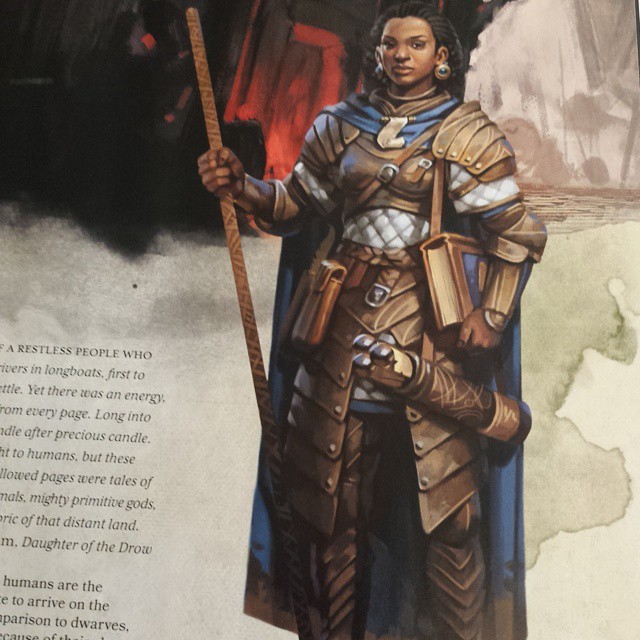
As a giant nerd, of course I got the new Dungeons and Dragons Player’s Handbook. When I first cracked it open in the store and began paging through, I was floored. Page after page after page of women– as many women as men– all looking like legitimate heroes in functional armor, not scantily-clad pose monsters pretending to fight while twisted into impossible shapes that manage to show both cleavage and ass. I never realized how much I felt like I was a girl horning in on a “guy game” until I saw these pictures and felt welcomed.

What also immediately stood out was the diversity. The book is filled with people of color. I stood there holding the book in the game store, and I almost cried. I held the book out to my husband, a longtime player, and fought back tears as I explained to him what it meant to me just to see these women. And to think about what it would mean to young nerds of color to see themselves reflected on those pages.

I could go on and on about what this means for women. But to stay on target: There will be an entire generation of nerdkids who will learn this game in this edition, for whom Black heroes will be a natural part of the game, who will experience narratives of Blackness that aggressively disrupt Black = Dangerous. All D&D adventurers are dangerous. But they are all individual, as individual as the people playing them. A Black D&D adventurer is no more or less dangerous than anyone else. His Blackness is part of his identity, but nowhere in that universe is the color of his skin a marker for his dangerousness. His broadsword or his spellcasting, on the other hand . . .

Let me show you a few examples. These are just a few out of an incredible diversity of images. If you EVER had an interest in D&D, or thought you might someday check it out, now is the time.

This is the first example they give of the Human race. LOOK AT THAT FUNCTIONAL ARMOR!

This is the first illustration in the Human race profile!

dnd2

This is the first illustration in the Fighter class profile.

This is the first illustration on the Wizard class profile.

This is the first illustration in the Wizard class profile.

There are still plenty of white guys in there, but along with them, there are just as many women and people of color pictured as legitimate adventurers in their own right, not window dressing or tokenistic afterthoughts. Bravo, Wizards of the Coast. You fucking nailed it. I hope this new edition brings you legions of new, diverse fans. And you can BET I will be showing these pictures to my students and talking about narrative creation in our culture.

Do I actually think D&D can save the world? YOU BET I DO. But it can’t do it alone. It’s up to us as artists and entertainment industry professionals to reject the idea that the only trope worth funding or distributing about African American men is Black = Dangerous, and replace that harmful idea with a wide variety of tropes– yes, including Black = Dragon Slayer. I’m not leading some campaign against art that depicts Black men committing crimes or being violent. I am, however, one small part of a campaign against a widespread artistic and cultural practice that PRIMARILY depicts Black men as threats.

This CAN be done. We just have to pay attention to the cultural context of what we’re creating, funding, distributing, and consuming, and make a commitment to real diversity. When it’s done right, it’s glorious.

Tagged , , , , , , , ,

The Class Divide in Theatre

For so long I’ve wanted the Theatre Industry machine to behave a certain way and suddenly I realized I want to take that machine apart and build a new one instead.

It’s been brewing in the back of my mind for awhile, but it really came to a head last week in a Facebook discussion about Charles Isherwood’s condescending language when writing about plays by people of color. Isherwood has enormous power to make or break the success of a play and/or playwright, and he’s not the only one using that kind of language, but he has extraordinary power because of his position with the New York Times.

But I think the problem isn’t just Isherwood personally, since we could fire him into the sun and there’d be another one right behind him to take his place. We should start thinking in terms of dismantling the power we accrue to that position rather than just calling out the person in it, and while we’re at it, let’s also start thinking in terms of dismantling the way we conflate “important” with “in New York” or “well-funded.” This last idea, which I’ve fielded a few times, has been met with a ton of resistance. And I’m not surprised– it really is a big, frightening dream to imagine that we can successfully disrupt the class-based divides in the theatre community that make New York theatre seem so much more important than theatre elsewhere (which accrues an inordinate and wholly undeserved amount of power to the tiny handful of individuals who review theatre for the New York Times) and that make well-funded theatre seem more important than everything else. But I feel like the time has come for us to try. This may not be my work to finish, but it sure as hell is mine to begin.

I think we have two challenges to face. The first is the mythology of the importance of New York, a class-based mythology that places New York above everywhere else. A large amount of wealthy and influential people have enormous personal stakes in the perpetuation of the myth that New York is the pinnacle of theatrical achievement and success, and there are even more people who have pinned all their aspirational hopes (and childhood dreams) on that as well. But as in any discussion of privilege, it’s painful for the privileged minority to allow those without privilege to rise to equality, and it’s perhaps even more painful for those who are in the middle of struggling to achieve that privilege, or who believe that privilege is potentially achieveable for them. We accord New York theatre an enormous amount of privilege that we’re denying theatre elsewhere for no reason other than that we DO, and that there are people who believe that myth with all their hearts, have sacrificed for it or profited from it, and therefore are loathe to give it up.

There’s no question that New York has a LOT of well-funded theatre that employs more theatremakers than any other single location in the country. But we accrue an inordinate amount of prestige to a show in New York for no other reason than that it’s New York, the historical heart of theatre in the US. Our language reflects that: There’s “New York” theatre and there’s “Regional” theatre– everywhere else. This is an incredibly outdated point of view. Why, in 2014, are we still perpetuating the mythology that a show in New York with a (for example) $100K budget has somehow achieved something that a show in (also for example) Minneapolis with a $100K budget has not? It massively undervalues the theatre happening all over the country. A show that starts in Chicago and then transfers to Off-Off Broadway is held up as having achieved something significant.

The second is the mythology of importance = money. The importance we accord theatres and productions is directly related to the size of the budget. This class divide impacts every single thing we’re trying to achieve, because it doesn’t just marginalize theatre below a certain level, it renders it completely invisible. When we’re discussing problems or strategizing solutions in the theatre community, we’re almost always discussing LORT and/or Broadway and/or companies with an annual budget over a certain amount. The eligibility requirements to become a TCG member theatre (a first step in “counting” as a nonprofit theatre) are primarily FINANCIAL. Out of eight eligibility requirements, just three are related to the actual theatremaking (“commitment to the rehearsal process,” “minimum of one year’s prior existence,” and “community vitality,” which, to be fair, mentions funding sources, but allows for other evidence like “awards” and “media coverage.”) There’s no such thing as a study of diversity in “theatre,” or gender parity in “theatre.” We have studies of those things in wealthy theatres, but not in “theatre” as a whole. When we talk about diversity in theatre, what we’re almost always really talking about is a glass ceiling that prevents a more diverse distribution of money and resources, not actual diversity across all types of theatre.

It’s foolish to pretend that money doesn’t matter at all. Of course it does, and the conversations around who gets hired and which playwrights get the higher-paid commissions or production slots and WTF glass ceiling are valuable ones to have, but we need to stop pretending that this is a conversation about whose voice is “important.” It’s a conversation about unfair income, resources, and jobs distribution. But by refusing to call it that, and instead talking about which voices are “important,” we’re reinforcing the cultural idea that the only marker of importance is money.

When The Kilroys list came out (full disclosure: I contributed to it and I would again in a heartbeat), I saw a number of playwrights flipping out for not being included. I saw people saying they were, and I quote, “pissed” for not being chosen. The Kilroys had asked contributors to name the five best plays they’d read that year that fit the criteria (written by a self-identified woman, no more than one full production). The final list included a number of luminaries along with rising stars. Artistic Directors of smaller companies started posting on social media immediately about how they’d do readings of every play on the list, or how they were going to stage this or that play. And I had to just take a deep breath, because they would all eventually find out: Most of the 46 “winning” plays, if not ALL 46, would be denied to them. I had already asked for the production rights to two plays on the list and been shut down. And that’s FINE. The list isn’t about getting those plays produced AT ALL. It was about going Hulk Smash on the glass ceiling. I think the list’s rollout suffered for its lack of clarity on that issue– this list wasn’t meant to be comprehensive, and it wasn’t meant for the likes of me. It was for big money theatres, in direct response to Ryan Rilette’s comment that there were not enough plays by women “in the pipeline.” The Kilroys built a new pipeline of LORT-ready and Broadway-ready plays as determined by a ton of existing gatekeepers, and shoved it right in everyone’s face, an act of bravery and enormously successful activism. But it was about the distribution of money and resources, not about getting women’s work done at all. I’m willing to bet most of the 46 would have had more productions, and therefore been ineligible, if the rights had been released to the small companies who had asked. I’m not critiquing that decision in the least, and I think activism that works to dismantle the glass ceiling and create equity in the distribution of money, jobs, and resources is incredibly important. But we need to stop reinforcing the idea that money and/or location are the only kind of “important.” It’s time to build a new machine.

I’m a big fan of Bindlestiff Studio in San Francisco, the only Filipino American theatre company in the nation. I’ve been to a number of their shows, and a few days ago I went to see The Guerrillas of Powell Street. Guerrillas is a play about the Filipino WW2 vets who were promised military benefits by the US and later denied. They were made to wait 70 years for any kind of compensation, and to this day some are still being denied due to poor recordkeeping during the war. The play is also a beautiful, at times heartbreaking, examination of the meaning, strength, and limits of friendship and family, as well as a celebration of Filipino culture. Guerrillas was fantastic in every way. Every show I’ve ever seen there has been packed to the rafters with eager audience members, with more on the waiting list, almost all Filipino Americans, almost all under 40– an audience we’re told repeatedly does not exist. Bindlestiff is a small theatre you’ve probably never heard of. It’s all volunteer-run, non-AEA, with tiny production budgets. This play, this theatre, this audience will never make it into a national study about “diversity in theatre.” Their productions, audience, playwrights, existence are not considered important enough to include because of the size of their budget. Their work, like the work of indie theatres all over the country, is invisible. But those audiences are having an intense, emotional, moving, unique, life-changing theatre experience. It’s not in New York, nor is it a 20 million dollar a year LORT, but the audiences and the work at Bindlestiff, and at indie theatres everywhere, are every bit as an important. The tiny, very elderly woman sitting next to us at Bindlestiff Friday night, who sang along to every song, laughed at every joke, and made comments in both English and Tagalog, completely enraptured by the show, is somehow in a less important or culturally valuable experience than a wealthy white woman who saw a Broadway show the same night unless we refuse to continue validating that point of view and conflating “importance” with money and location.

When we talk about what work is “important” in theatre, invariably we’re talking about a category that has a pricey entrance fee. You don’t get on the board unless you have the right budget and/or the right location. We ignore this class division each and every time we talk about problems in “theatre.” The majority of companies are waiting at the rope line outside while the well-heeled are inside talking about themselves. And again, I think it’s VERY valuable to discuss who gets in that door, and why we’re not seeing more women, people of color, people with disabilities, and trans* people let through the rope line. But we’re ALL, even those of us in the rope line, always in the process of either ignoring the rope line or talking about it as a lesser state a being– a place you come from, not a place worth belonging to.

I’m tired of trying to convince the bouncer that he needs to let more of us, and more types of us, into that club. I want to tear down that building and build a new one that includes us ALL, a building that recognizes that money is important, but that importance isn’t money.

And yes, fuck yes, I want to see more diversity on big money stages, and I think a lot will change when that finally happens, when more diverse artists and arts administrators are able to quit those day jobs and just be artists and arts administrators. (Don’t even bother telling me that arts adminstrators don’t belong in that sentence until you’ve spent a decade running a small theatre on 50K or less a year, paying everyone but yourself.) But I want us to be clear about the terms of these discussions. When we’re talking about money, let’s talk about money, where it goes and why there’s not enough diversity there. But when we’re talking about diversity of plays, theatremakers, and audience, let’s talk about diversity as such and stop requiring outdated entrance fees to that discussion. Why isn’t Bindlestiff at that table? THEY’RE THE ONLY FILIPINO THEATRE IN THE COUNTRY. And it’s like they just don’t exist. There’s nonstop talk in the club about how “theatre” needs to diversify or die, while everyone inside pretends there aren’t hundreds of diverse theatres they stopped at the rope line.

I want to make sure we continue to talk about money, but I also want to dismantle the language and the thought processes that accord “importance” only to theatres with the right location and/or the right budget. The undeserved, massive power of someone like Charles Isherwood can’t be dismantled by disrupting his personal power– it can only be dismantled by disrupting the power of the position. And I think we all benefit from doing that. Not only do we have more honest discussions about both money and diversity, but we also start according importance to work that is ACTUALLY important rather than just well-funded, using better, more realistic and inclusive criteria. Money is a KIND of importance, but it can’t be the ONLY kind of importance, especially in the nonprofit world where the entire point of our 501c3 status is supposed to be rising above the concerns of commerce, using grants and donations to make up the ticket income shortfall because nonprofit theatres are supposed to be doing risky work that furthers the art rather than sells scads of tickets.

So examine your language. Examine why you think the way you do, and why you think this company or production is more important, or worthy of your attention, than that company or production. When you talk about money, or its gendered and/or privileged allocation, be honest, because it’s an important conversation to be had. When you talk about diversity, stop shutting people out because of location or budget. Recognize that, while money is important, importance cannot be money. Otherwise, who are we?


Tagged

Why Forced “Audience Participation” Doesn’t Work

(UPDATE: I tweaked the title a bit due to the number of people confusing me with the recent Chicago Trib article. If you’re here to read something against all forms of audience participation indiscriminately, you’re in the wrong place.)

There’s been a lot of talk in the past few years about “audience engagement.” It’s partially been driven by a few big grantors requiring some form of it, and partially driven by the psychology of trends. Because every new entertainment technology sends people right to the THIS IS THE END OF THEATRE box, frightened by the popularity of the internet and its DIY culture, some grantors and theatremakers have been scrambling to create theatre that borrows some of that mojo in order to glean a portion of that success. The problem is: It doesn’t work.

OK, that’s an exaggeration. It CAN work. For starters, “audience engagement” need not mean “audience participation.” That’s just the most prevalent (and problematic) form. There are other ways to engage your audience. Shotgun Players in Berkeley, for example, has created several excellent theatre pieces based on interviews with members of the local community, telling their stories and telling the story and history of the area. The most recent was Daylighting, for which they set up a recording booth in the lobby for people to tell their own Berkeley stories after the show, which were posted on their website. That’s what I’d call excellent, effective audience engagement that should stand as a national example for how to get it done. Interrupting an otherwise traditionally-structured performance to haul audience members onstage or force actors to put individual audience members on the spot by making them perform actions or engaging them in conversation– not so much. A recent production I saw, otherwise traditionally structured, actually had an actor begin a benign conversation with an audience member at the top of the show and then suddenly verbally attack her, shouting insults. I had enormous sympathy both for the woman being attacked– women are verbally assaulted by male strangers all the time, and it’s an extremely unpleasant experience– and for the actor forced to perform the attack. While that’s an extreme example, that kind of “audience engagement”– audience participation as surprise, forced interaction– is by FAR the most common kind. It just doesn’t work, and I have a theory as to why.

But first let me say that there are very specific ways in which audience participation works very well. One great example is the new trend toward what people are somewhat misguidedly (I’ll get to that in a second) calling “immersive” theatre– the kind of theatre partially based on narrative gaming (especially video games) and partially based on narrative ride-through or walk-through experiences (think haunts or Disneyland’s Pirates of the Caribbean)– which works very well. The most famous example of this is Sleep No More. This is better titled “interactive theatre,” so that’s what I’ll use.

What makes audience participation work has been perfectly described in Jeffrey Mosser’s 2012 Howlround piece, “The Psychology of the Audience: Rules of Engagement.” In it, he describes how this kind of theatre must be conceptualized and constructed with the audience as a participatory element from the beginning, and that the participation must be completely voluntary. In other words, a successful audience participation piece can’t exist without audience involvement, and the degree and type of audience involvement has to be chosen by each individual audience member. This is why interactive theatre pieces work, as well as HOW they work. A video game’s narrative doesn’t exist until you play it, and in most cases now, the narrative changes according to how you play the game. You’re playing the theatre piece like a video game, and/or being taken through an experience that happens around you, and with which you interact on your own terms. You go to that type of theatre (and other types of interactive theatre structured around the concept of voluntary audience participation) specifically for that experience, and it’s a different experience entirely than traditional theatre. Megan Reilly’s excellent article in Howlround about the gamification of theatre is well worth a read for anyone interested in this kind of work. She describes both the ups and downs of the format– both which I’ll get to in a bit.

People who are fired up about the promise of interactive theatre can be very disparaging about traditionally-structured theatre– a show that’s performed for an audience that sits in the dark and watches it. It’s often touted as the “future of theatre,” as if other (both participatory and traditional) models were useless. It’s an enormously disappointing and short-sighted point of view, especially considering the fact that this kind of experience– becoming wholly immersed in a story someone is telling you– works. It works not only in theatre, but also when you’re lost in a novel or a film, or when you’re spellbound by a storyteller, even when that person is just a friend at a party. And let’s stop for a moment and look at that word– SPELLBOUND. We all know what that means– so rapt, so caught up in the narrative we’re consuming that we have a truly singular, magical experience. People aptly describe it as “losing themselves” in a story. It’s something that we’ve all experienced, and that only happens when we’re passively immersed in someone else’s narrative. That’s become a dirty word– “passive.” The “passive” audience is seen as a sack of potatoes sitting there, doing nothing but having something spoon-fed to them, detractors claim. Au contraire, neurology has discovered.

That supposedly “passive” audience, when experiencing what we colloquially call the state of being “spellbound” by a book, film, play, or story, are experiencing hugely active and unique brain states. Researchers have discovered that while “passively” consuming fictional narrative, the human brain not only experiences that narrative as if it’s actually happening, but also improves and expands the consumer’s empathy. A different study found that when an audience is “passively” spellbound by a narrative, their brains experience neural synching with the storyteller (and therefore, in a group setting like a theatre audience, with EACH OTHER), again experiencing the narrative neurologically as if it’s real and again expanding empathy. These studies confirm what theatregoers already know: there’s something magical about being rapt in a story someone is telling you– something unique and undeniably immensely valuable. That’s the kind of theatre I would be more likely to label “immersive.”

When you’re playing through interactive theatre, you’re very much aware of your relationship to it, even more so than in a video game where your hands are manipulating the controller almost involuntarily as you navigate the world on the screen, losing yourself in your avatar’s experience. In interactive theatre, your physical body is in the game, rather than an avatar, and you become the self-aware center of your own narrative, a narrative you create with the tools the production has given you. In the traditional immersive experience, you’re in someone else’s narrative, experiencing their lives and feeling their feelings, which is the theory behind how that kind of theatre creates empathy. Interactive theatre is about having a magical, self-involved, self-aware experience of your own. It’s no less valuable, but it is different, and there are both gains and losses. The gain would of course be the wonder and magic of being surrounded by, and a part of, a fictional world. The loss, I think, is related to the loss of the immersive experience– the loss of that “spellbound” near-trance state, which loses the neurological synching experience that creates empathy.

In fact, I would say that the interactive theatre experience is more likely to deter empathy. As Megan Reilly describes, slower-moving patrons are literally elbowed out of the way as other patrons, people who are on their second or third playthroughs, are pushing their way through the crowd to be in the right place to trigger certain events or be chosen for certain special content. Anyone who’s ever been in an online multiplayer environment knows exactly what that’s like. And while face-to-face contact could lessen the rudeness one encounters in online co-op, it does not entirely eliminate it, especially, as Reilly notes, when patrons are given masks. I wouldn’t bother to see Sleep No More for that very reason– as someone who is short and has some mobility issues, I assume that I will be pushed out of seeing and experiencing a lot of the best content. It’s something I experience all the time in public spaces, so I wouldn’t expect it to be different in a show. I don’t need to spend $100 to have people push ahead of me and block my view when I can experience that for free at Trader Joe’s.

But that doesn’t mean that people, especially people who’ve never experienced it before, can’t be awed by interactive theatre, or can’t have a fun or even emotionally intense experience. The fact that something isn’t disabled-friendly or favors the aggressive player doesn’t make it a shitpile for the people who have what it takes to be high-level players. Additionally, there are interactive shows that better handle those aspects, as Reilly documents, using an “on-rails” rather than open world structure. There’s no question in my mind that some company somewhere is working on an open world interactive theatre piece that creatively corrects for both. (Reilly herself is working on an interactive piece, and I have every expectation that it will kick all of the ass.) Despite the fact that interactive theatre trades the spellbound neurology for a self-focused one doesn’t make it LESS than traditionally immersive theatre, just a different, and no less valuable, experience. Playing through an interactive theatre experience– being literally within the world of a play– can be a wonderful experience. But so can being in the audience in a traditional performance setting.

So let’s take a step back, see interactive theatre as a TYPE of theatre, not as the FUTURE of theatre, and stop disparaging traditional audience experiences as if they don’t work, because they DO. These two types of theatre do two very different things, both valuable. We’re big enough to value both for what they are, without demanding that one is better, more important, or the replacement for the other.

So to bring it all back home, my theory about the reason forced audience interaction doesn’t work in otherwise traditionally-structured theatre is based in the neurology of narrative: If your piece isn’t constructed around audience interactivity, when you force an audience member to participate rather than observe, you disrupt their neurologically synched “spellbound” state, jerking them back into a self-aware state. In most cases, that’s not just a normally self-aware state but a HIGHLY self-conscious, awkward one. It’s a matter of conjecture how long it would take for that audience member (or the audience members nervously wondering if they’ll be next) to recover neural synching with the narrative and the people around her. And of course, this is just a theory as to why forced audience participation so rarely works. When a neurologist is looking for funding for that project, I’ll be the first to contribute to the Kickstarter (award level: brain candle).

I think interactive theatre, while something that has been in and out of favor for centuries, is really hitting its modern stride with the gamification format, and I expect exciting things from it as they work out the kinks. I would love to see forced audience participation fall by the wayside completely as we explore the neurology of the audience more and more. And despite everything, I still think it’s valuable to imagine the ways in which *voluntary* audience participation can work in some forms of traditionally-structured performance (my guess is that it’s much more likely to work in direct address theatre that never establishes a fourth wall, like Always . . . Patsy Cline or in meta-theatrical and camp performance). Emphasis on VOLUNTARY.

All this boils down to: you MUST consider your audience’s experience carefully. We have more tools than ever to understand what their experience will be like. Avail yourself of them and make your decisions with open eyes.

But really, apart from the neurological experience you may want to create and nurture, and apart from the considerations of what may or may not “work,” understand that forcing someone to do something is never OK, and can sometimes even be dangerous. I’ve seen actors force audience members into conversations or physical actions that would feel HUGELY invasive and inappropriate to, say, an abuse survivor, or physically painful for someone like me– you can see the cane, but you can’t see the surgery scars or the areas of injury. I recently saw an actor climb over the seats and into the audience at a huge professional theatre, and all I could think was, PLEASE ALL YOU GODS DO NOT LET HIM COME THIS WAY, as using my shoulder as leverage (as I could see him doing) or bumping into my leg could cause me enormous pain. I stopped watching the play and started strategizing how to block the actor with my cane should he come near me.

I suppose you could sum up my entire post with “Voluntary good, forced bad,” but the REASONS for that are critical. We have more tools than ever to create amazing audience experiences. Let’s use them all to their best advantage.

Tagged , , , ,

You Need a Dramaturg (Because Clowns are Creepy, and Other Semiotic Shifts)

Image

I should be sorrier for this than I am.

Like everyone (right?) I have a running joke with a friend about how scary and creepy clowns are. It’s just a joke– considering I sleep every night with a Dell’Arte-trained actor, it’s obviously not an indictment of physical theatre professionals, for whom I have enormous respect. It’s not even related to physical theatre at all– it’s about the imagery. The idea that clowns in full makeup are creepy is now a pervasive cultural trope that everyone recognizes, whether they personally agree or not. It’s now more present in our culture than any other trope about clowns. Yet this was not always the case. I’m not interested in getting into why or how this happened (I’m sure someone’s writing a dissertation about this very subject). The point is that it HAS. And that this kind of cultural shift happens ALL THE TIME.

My husband in a student performance at Dell'Arte International with a fellow student.

My husband at Dell’Arte International, performing with a fellow student.

So my friend recently sent me this 2008 BBC article about the University of Sheffield study that surveyed 250 children between the ages of 4 and 16, and found that clowns were “widely disliked,” prompting researchers to urge children’s hospitals to consult with (shocking) ACTUAL CHILDREN before decorating their hospitals. The article goes on to quote a child psychologist:

Patricia Doorbar is a child psychologist in North Wales who has carried out research into children’s views on healthcare and art therapy.

She said: “Very few children like clowns. They are unfamiliar and come from a different era. They don’t look funny, they just look odd. (emphasis mine)

“They are unfamiliar and come from a different era.” OK, she knows clowns do indeed exist in this era. The ACTUAL point she’s making is that the semiotics of the clown– what that imagery means within the context of our culture– has changed dramatically from previous generations to today. In my father’s generation, children’s shows featuring clowns and clown toys were much more common. The trope about the scary clown existed (this Smithsonian article blames it on Grimaldi via Dickens and Deburau via . . . um, child murder), but was far less prominent in popular culture. In two generations, the meaning of that imagery in context changed enormously. When someone creates a clown character in popular culture today, it’s more likely to be something creepy than something lighthearted and fun, because that semiotic has shifted. Clowning for children still exists in popular culture, of course, just usually out of traditional makeup. A picture of a clown on the wall of a hospital, once (evidently) a comforting sight to most children, is now a frightening sight to most children. The “creepy clown” has supplanted the “happy, funny clown” as the primary trope about clowns in full makeup in our culture, and it happened fast. Lights up on a clown in full gear 50 years ago would generate a different audience reaction, and create a different set of expectations, than lights up on a clown in full gear today.

Image

Seriously, what do you think is going to happen next? Balloon animals or murder? From “Top 5 Clown Makeup Ideas” on designsnext.com

And so it goes with imagery, tropes, characters, and narratives throughout the entire history of dramatic lit. When we stage classic plays, we’re looking at material that comes from a world that no longer exists– a world full of symbols and tropes that have shifted meaning. For example, Taming of the Shrew was, in context, taking a bit of a stand. It stood out from the many popular shrew-taming comedies of its day in that it did NOT advocate beating women into submission. It instead advocated isolating them, starving them, gaslighting them, and denying them sleep until they became tractable and obedient. The Christopher Sly framing device demonstrates how well gaslighting works (and it’s inescapably connected that Sly, like Katherine, is in a position of social inferiority and relative powerlessness). You can convince anyone to believe anything as long as you control what they see, hear, and, ultimately, think. While Petruchio’s techniques are horrifying to us today (you can see them all codified in Biderman’s Chart of Coercion, a tool used by Amnesty International and domestic violence organizations to help people define and understand abuse), they were a gentler approach in the context of the time. Check out the scold’s bridle if you’ve never heard of it.

The idea that a woman who isn’t obedient and who speaks her mind is a “shrew” who needs “taming,” while not fully banished from our culture, is no longer mainstream. Petruchio’s techniques are now considered abusive. But understanding the historical context of the play provides a window into the playwright’s intent and opens the possibility of a recuperative staging that preserves that intent. And while Shrew may be an extreme and controversial example that some feel is unrecuperable (I’m honestly not even certain where I land on that myself, although there’s a local production about to open with an amazing team that I’m dying to see– if anyone can do it, it’s these badasses), the point stands. A dramaturg can help you navigate the wily waters of narrative and text in historical context if that’s something you’re not already doing yourself. And even if it is, a dramaturg might have access to resources or knowledge that you don’t possess, bringing in points of view or historical context you didn’t even know to look for.

Theatremakers are divided into three categories: Those who have no idea what a dramaturg does, those who think dramaturgs are for new plays, and dramaturgs. OK, that’s a joke. But I see people approaching classic work all the time with misguided points of view. Either they’re beating the playwright’s intent to death on the rocks of fussy (and ultimately egotistical) purism, or they’re making changes in the name of modernization that don’t make sense in the context of the work, that obfuscate rather than illuminate the work. If you’re not into historical linguistics or history, and/or if you don’t have a clear understanding of the culture and semiotics of your audience, get a dramaturg. Work with her before the first rehearsal. Let her help you conceptualize the work in a way that will preserve the writer’s intent, which means the engine of the play– what makes it kick ass, what makes it endure, what makes it work for audiences for decades or even centuries– remains intact and clearly presented for a 21st century audience. And that’s IMPOSSIBLE to do by just “doing the play” without thought to the distance between the play’s original cultural context and current one. Insisting on a purist interpretation is essentially insisting on changing the meaning of the play. The older a play is, the more this is true.

Image

Vivien Leigh and Marlon Brando in the film version of A Streetcar Named Desire.

Even in plays that are much closer in time to us– Miller, Williams, O’Neill– there are symbols and tropes that either have completely lost their meaning, or whose meaning has shifted. For example, a man enters a living room where his sister-in-law is standing. The man removes his outer button-down shirt and is now just wearing a T-shirt. In 2014, that symbology would likely go completely unnoticed– a T-shirt has become perfectly acceptable public attire. Even an A-line undershirt is acceptable public attire. It’s no longer inappropriate for a man to take off an outer shirt and wear a T-shirt in his own living room in front of his sister-in-law. The original semiotic attached to that moment has been lost. If you want to preserve the intent– a man doing something that most people in the audience would consider inappropriately intimate– you need to do it another way, such as create that feeling through the acting. And if you don’t understand the historical context, the playwright’s intent for that moment is completely lost on you, or you may misread it as something else entirely. If you’re not well-versed in the history– and that’s no shame, plenty of great directors aren’t– a dramaturg will help you find and work with moments like these.

Conversely, a working knowledge of contemporary (and local– geography can change everything) symbology, popular culture, and slang can be crucial to speaking successfully to your audience. Terms change meaning, and the new usage may be obscure. You may think a line or a word means one thing to your audience when it really means another. I once saw a local director post on facebook that the community here is far too supportive and uncritical, so much so that people refer to it as the “Yay Area.” Or take, for example, the way words such as “mod” and “ratchet” have taken on new meanings. Think for a moment: There will be people in your audience who have never heard either term used ANY OTHER WAY. Sure, older people will think first of the Kinks and socket wrenches– but that’s my point. Understanding how meanings change in different contexts is important, and if that’s not your jam, then find a dramaturg, because I assure you, it’s hers.

I’m barely covering the beginning of what a dramaturg can do. A dramaturg is your in-house expert in research, narrative, semiotics, and history. Consider working with one! Wondering where to find a dramaturg in your area? I bet the fine folks at LMDA can help you.

Image

By Jon Wolter, from keepingwolteraccountable.tumblr.com


Tagged , , , ,