Category Archives: Culture

Maybe we should pretend black people are lions

cecil

Cecil.

I was sad for the killing of Cecil the lion. I really was. I’m softhearted about animals and haven’t eaten meat in over 20 years because of it. But with the nonstop public outrage, and now the support for extradition, I have reached my limit.

Are we seriously going to create an internet outrage machine to extradite that dentist fuckwit for shooting a single lion? Let’s put this into perspective.

People who eat meat every single day are screaming for this man’s head. And no, it’s NOT “different.” The difference between that lion and the cow you ate for dinner is imaginary, created in your head and in our culture to make you feel better. I’ve seen literally hundreds of posts about how disgusting it is to shoot a “defenseless animal,” and the hypocrisy is wearing me down. I’m seeing post after post about how disgusting hunters are. I saw post after post outraged over that dog meat festival, written by people who eat cows and pigs without a second thought. The difference is cultural, imaginary, artificial. And I would be a lot less irritated with that hypocrisy, and probably even laugh it off, if it weren’t part of a performance I’m tired of seeing.

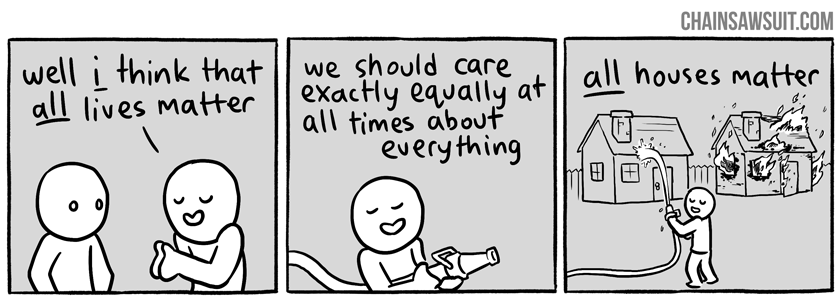
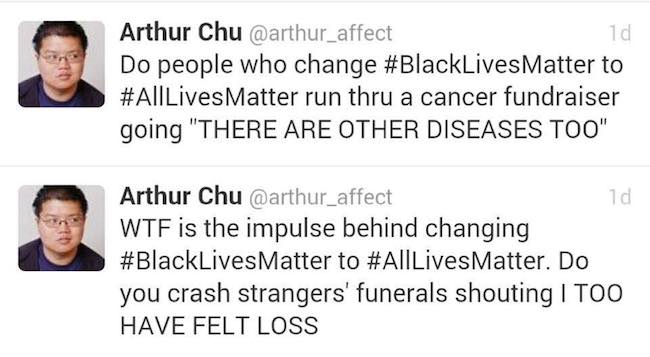
Yes, I’m going to be one of those people bringing up #BlackLivesMatter, because this extradition thing has pushed me over the edge. The entire country is screaming for extradition, but a 12-year-old boy was gunned down in the street for playing with a toy gun– something I am willing to wager 95% of the men, and a large chunk of the women, in this country have done at similar ages– and white people charged onto social media to explain why it was OK for a police officer to shoot this CHILD within literally 2 seconds of rolling up, let him bleed while he cried for his mother, and not even bother to call an ambulance himself. This case is ongoing. And people are calling for the EXTRADITION of this idiot who shot a lion.

BlackLivesMatter-AllLivesMatter

Tamir Rice? I chose him at random, because I’m a mom, and my heart aches and I tear up every time I think about him. But I could have put any one of HUNDREDS of names here of unarmed Black Americans killed by police just in the past few years.

Here’s what’s going on.

People love to play out scenes from “The Lottery” when they believe someone has done something wrong, but only when it’s something to which they can feel morally superior. They’re not calling for the head of this dentist (in some cases, literally) because they care so much about a lion they had never heard of a week ago. They’re calling for his head because it makes them feel like Crusaders for Justice. It’s a performance: I AM OUTRAGED OVER WRONGS COMMITTED AGAINST THE INNOCENT. I am GOOD. I am a good person. We will hunt down and eradicate evil together.

I am just as susceptible to this as anyone else.

But white people aren’t fighting anywhere near as hard, or in anywhere near the numbers, for Black lives. The movement for Black lives is different than Cecil. White people can’t participate in hunting down and scapegoating evil against Black people, because we’re the ones who are fucking up. White people are terrified of being called “racist,” seriously. And to be an effective ally, hell, to be an ally AT ALL, step one is to realize that we live in a white supremacist society that puts racism into our hearts and minds, and that being an ally means acknowledging that racism, and fighting it in ourselves and in the culture every day, forever. You don’t get a “Not Racist” trophy for hiring a Black guy as shift manager. It’s a process, and it requires honest self-examination, and white people do not get to be the hero.

WHITE PEOPLE DO NOT GET TO BE THE HERO.

But with Cecil the lion, they do get to pretend they’re the hero, and they create little performances about it, little LOOK AT HOW DISGUSTED I AM BY VIOLENCE AGAINST INNOCENT ANIMALS performances they use to play Good Guy. While eating a different animal they don’t give two fucks about because reasons.

And I am angry enough to delete any comments that try to “prove” how it’s OK to kill cows but not lions, because we EAT cows, and we need to eat, and lions are different. First of all, you have choices about what you eat, and you no more needed to kill that cow than that dentist needed to kill that lion. Secondly, focus your outrage on Black lives, not on creating a performance about how you eat meat but you still get to be the Good Guy.

blacklives.matter

Yes, I am angry. I was sad for the lion. I really was. And I still am. But the ongoing firestorm of outrage over that while your brothers and sisters get killed in the street and my fellow white people ARGUE with me, tell me they “hate” Black Lives Matter because they don’t want to have to tell their children about racism, or because it doesn’t include them (the ridiculous “All Lives Matter”), or because they might have to, for one second, not believe they’re the GOOD GUY all the time. They’re charging after this dentist because doing so makes them feel better, makes them feel like champions for justice, protectors of the innocent. And they fight against Black Lives Matter because they don’t get to be the Good Guy, because the fight requires that we admit our place in this oppressive system.

It’s time to step up, white America. You desperately want to be the Good Guys. Well, here’s your chance. Allow someone else to take center stage for one freaking minute, and focus your attention on the hundreds of unarmed Black men, women AND CHILDREN killed in this country each year. You can be mad about the lion, too, although I still have an eyeroll for you if you’re mad about this one creature and you ate 7 creatures last week. Just please remember that being a Good Guy takes more than being upset about a hunter.

Tagged ,

Time to Retire the Word “Offended”

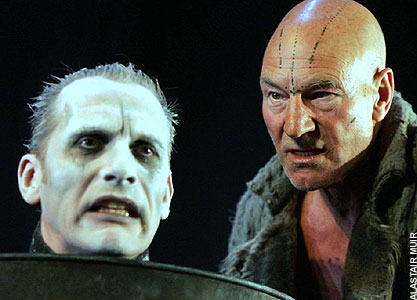
Julian Bleach as Ariel and Patrick Stewart as Prospero in The Tempest at the Novello Theatre in London, 2007. Photo by Alastair Muir. The Tempest has come under fire in certain circles for its implied criticisms of colonialism and racism.

Julian Bleach as Ariel and Patrick Stewart as Prospero in The Tempest at the Novello Theatre in London, 2007. Photo by Alastair Muir. The Tempest has come under fire in certain circles for its implied criticisms of colonialism and racism.

There’s almost constant talk online about what’s “offensive,” or who’s “offended,” and it’s high time we retired this word.

“Offend” means “to annoy, upset, or anger.”  Usually people use it to mean, “This has made me personally uncomfortable.” People use “offended” when they hear someone say “Jesus Timberlake Christ,” see part of a boob on TV, or find out their kids read The Tempest or Harry Potter. In other words, they’re complaining that something they’ve encountered opposes their personal tastes and beliefs. They are having a personal experience that they find upsetting. “Offended” does not extend beyond that– it’s entirely personal. It’s an emotional opinion that doesn’t differ in the slightest from any other emotional opinion, like, “Picard is the best captain,” or “I hate Nickelback.”

Sorry.

Where the term becomes insidious, however, is when it’s used to belittle the concerns of people fighting bigotry. When someone is objecting to bigotry in, for example, a news item, they are speaking out against injustice. A racist news article hurts real people. It contributes to the very real oppression people of color face every day. It perpetuates an aspect of our cultural mythology that literally kills people. And then someone in the thick of white fragility comes along and says, “I’m sorry you’re offended,” or “you get offended too easily,” or any number of variations. “I know this will offend some people but [racist comment supporting the article].”

racist_news

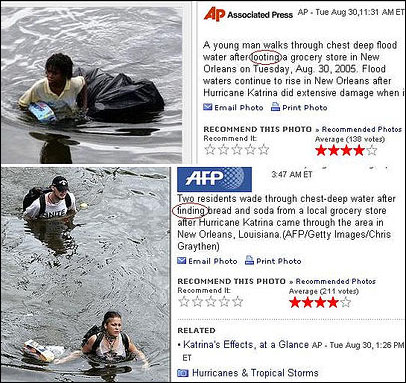
Black people “loot”; white people “find.”

Resisting bigotry is not the same as being “offended.” Resisting bigotry is to resist injustice against groups of people. It’s far bigger and more important than someone’s personal comfort level, and the people who use that word as a weapon against the fight for social justice understand that completely.

People who are resisting bigotry are often dismissed with the belittling idea that they’re “offended,” as if fighting cultural oppression and the tools with which it creates, disseminates, and preserves that oppression are equivalent to an imaginary schoolmarm shocked at finding the word “fuck” carved into a desk. No, we are not “offended.” We’re fighting bigotry, and it’s belittling to pretend it’s just about offending our personal, delicate sensibilities.

When someone points out an example of racism, misogyny, fat hatred, homophobia, transphobia, ableism, ageism, antisemitism, Islamophobia, or any other kind of bigotry, people with privilege often reduce that act– a call for equality that’s at its core a challenge to privilege– to a matter of someone being personally “offended.” People who are white, male, thin, straight, cis, able-bodied, young, and/or who have Christian heritage (not the same as being a practicing Christian, as you experience all the privilege of your group regardless) will sometimes seek to preserve that privilege by characterizing resistance to bigotry as nothing but “taking offense”– having an easily-dismissable, personal opinion based in emotion. We must call this out whenever we see it.

When we’re talking about a casting practice, a review, or a play, that’s bigoted and perpetuating dangerous, oppressive cultural mythologies that have real-world consequences, we must call out and resist that belittling when it happens, and refuse to be lumped into the same category as people who are upset because they heard the word “fuck.”

We need to watch our own usage of this word as well. Do we really think the most important aspect of a racist play is that the racism is “offensive”– that someone would be upset by it? Shouldn’t we be calling attention to the larger fight– that perpetuating racism in our cultural mythology is dangerous and literally killing people of color? Do we really think the most important aspect of a misogynistic article is that it’s “offensive”– that someone would be upset by it? Continue to extrapolate this– Is the most important aspect of the preponderance of transphobia in our cultural mythology just “offensive”– upsetting individuals? Do we really believe the most important aspect of fat hatred, homophobia, ableism, etc, etc in our cultural mythology is their ability to upset people? Then why are we using that language? Why are we using the language of personal discomfort to describe our resistance to artifacts of our cultural mythology that oppress and even kill people? Why are we using language that makes us easy to dismiss– language people use specifically to belittle resistance?

I don’t mean to imply that people don’t experience personal discomfort with bigotry. But let’s not make the mistake of confusing personal discomfort with the way bigotry makes its targets feel unsafe; or, rather, be reminded of their existing lack of safety in our culture. That’s part and parcel of cultural oppression. When you (for example) target people of color with racial slurs, or otherwise use dehumanizing language about them, you’re not “offending” them– you’re terrorizing them. You’re invoking a cultural mythology that has real, material power at its back. You’re flexing a muscle that you know can harm or even kill. A person of color objecting to a racial slur is a human being resisting real, ongoing, culturally enforced oppression. That’s not personal discomfort caused by offense; it’s a visceral reaction to living through the kind of violence and oppression that lends bigoted speech and cultural artifacts their power. This is why jokes about people in power (“punching up”) are funny, but jokes about oppressed people (“punching down”) are furthering that oppression. You’re not “offending” people of color, women, trans* people, disabled people, fat people, or Muslims. You’re reminding them that our culture dehumanizes them, sees them as lacking worth, and continually devalues and violates their bodies, rights, and property. You’re reminding them that you belong to a group with power over them.

When you see someone using the word “offend” to belittle resistance against bigotry, call it out. Recognize what they’re doing and call it out. Don’t let them equate fighting for justice with primetime side boob ever again.

Tagged , ,

Adam Sandler, Charlie Hebdo, and “Freedom of Expression”

America has been exploding with issues surrounding the concept of “freedom of expression.” Like many freedoms, “freedom of expression” sounds great in the abstract. In the abstract, pretty much everyone outside of political and religious extremists are for “freedom of expression,” and the very fact that political and religious extremists are most decidedly not in favor of freedom of expression makes a certain kind of person even MORE in favor of it.

In the concrete, the issue of “freedom of expression,” like everything else in the world, is much more complex and nuanced, and if there’s one thing political and religious extremists– and the people who love to piss off political and religious extremists– hate, it’s complexity and nuance.

loren-anthony-adam-sandler-640x400

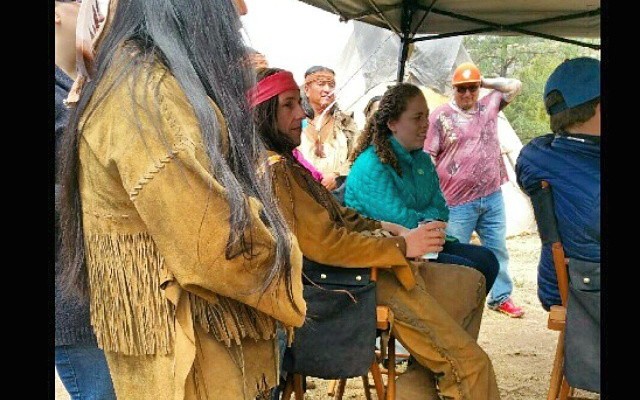
Adam Sandler on the set of The Ridiculous Six. Photo courtesy of actor Loren Anthony’s Instagram, which you can follow at @lorenanthony


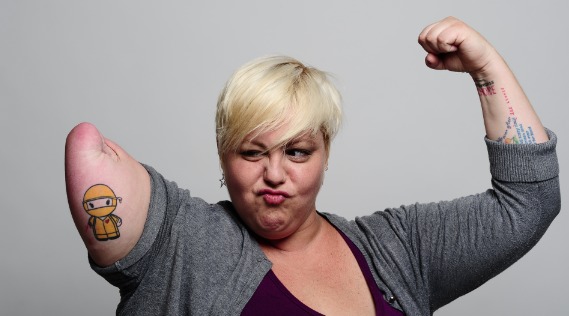
When Native American actors walked off the set in protest over the racism in Adam Sandler’s latest film, the ensuing controversy was unsurprising. The internet exploded with the coverage, and the backlash was instantaneous and fierce. Those who supported the actors were accused of suppressing freedom of expression, and misunderstanding the boundary-crossing nature of comedy. When PEN announced that Charlie Hebdo would be receiving its Toni and James C Goodale Freedom of Expression Courage Award, the ensuing controversy was also unsurprising. When 145 PEN members formally protested (that number has now grown to over 200), they were met with another predictable backlash that included a wealth of BUT FREEDOM OF EXPRESSION scolding. A lesser-known, but equally important, controversy happened earlier this year when stand-up comic Ari Shaffir viciously attacked fellow, lesser-known stand-up Damienne Merlina both for her disability (Merlina lost an arm in a car accident) and her weight, in his Comedy Central special. When Merlina posted a YouTube video calling Shaffir out for the attack, she was met with a barrage of criticism– and even mockery– for daring to speak out against her own attacker. A major part of the backlash Merlina received was centered around the fact that comedy was meant to cross boundaries, and that those attacked should understand that, shut up, and take it.

Damienne Merlina, photographed by Jeff Forney.

Damienne Merlina, photographed by Jeff Forney.

“Freedom of expression” is an emotional issue. It’s difficult to have productive conversations about its complexities. People have knee-jerk emotional reactions around protecting it in the abstract that prevent them from considering its complexities in the concrete. But it’s well worth the effort to at least try.

You may have heard the expression “punching up” and/or “punching down.” It’s fairly easy to understand. “Punching up” means comedy that makes fun of people or groups in power. This is the kind of humor most often used throughout history by progressive political and social movements. Imagine a cartoon making fun of a political figure, or Christianity’s active oppression of LGBT rights. “Punching down” means comedy that makes fun of people or groups who are marginalized, oppressed, and targeted by bigotry. Imagine a film mocking Native Americans. Imagine a cartoon mocking the girls kidnapped by Boko Haram just to make an unrelated political point. Imagine a comedian with a national spotlight attacking a young woman by name– a woman who wasn’t even there and had nothing to do with the event– for her disability and weight.

Comedy that “punches up” has long been a tool for political and social change. Punching holes in the cultural and political power of dominant groups is what people do when they want to call that power and dominance into question, when they want the culture to begin considering how that power and dominance is wielded, and whether such consolidation of power and dominance is, actually, a good idea. “Punching up” requires extreme bravery. “Punching up” is more than speaking truth to power– it’s speaking truth to power while telling power its fly is open. Punching up is dangerous because it challenges power, and power retaliates brutally. Thousands of people have been jailed and executed for punching up. There are people sitting in jail right this moment in many areas of the world for punching up, and they will not be the last.

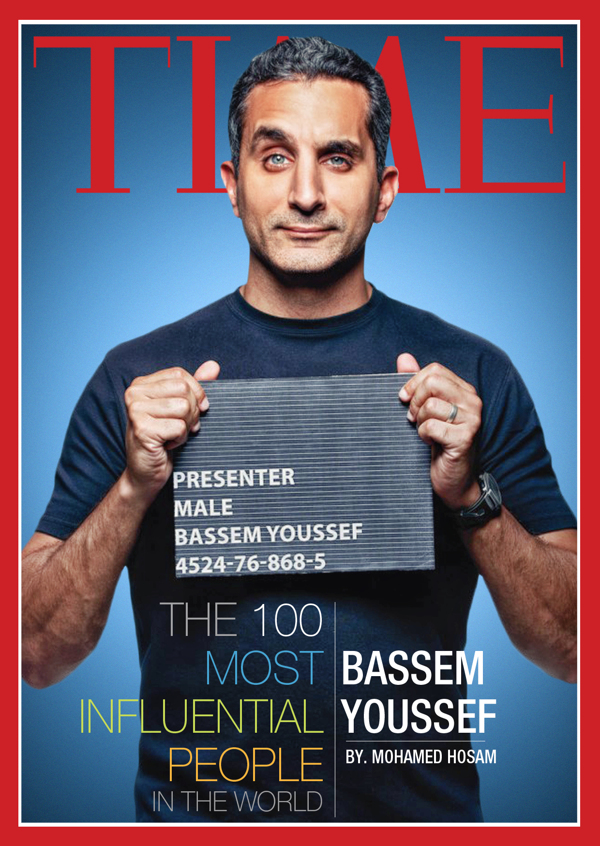
Bassem Yussef, an Egyptian satirist often compared to Jon Stewart, was arrested in March, 2013 for allegedly insulting President Mohammed Morsi and Islam. He was released on bail. In April 2013, he was named one of Time's 100 most influential people.

Bassem Yussef, an Egyptian satirist often compared to Jon Stewart, was arrested in March, 2013 for allegedly insulting President Mohammed Morsi and Islam. He was released on bail. In April 2013, he was named one of Time’s 100 most influential people.

Comedy that “punches down” has long been a tool for political and social oppression. Mocking groups that suffer bigotry and oppression is what people do when they want to solidify that bigotry and oppression, when they want to solidify their own cultural and political power and dominance over that marginalized group. Punching down requires no bravery whatsoever, because it’s done from a place of cultural primacy. Occasionally extremist members of a marginalized group will retaliate in reprehensible ways. Murder is never an acceptable response to comedy, period. But that kind of retaliation is rare. No one in their right mind believes that murdering people who work at Charlie Hebdo is an acceptable response to the content they publish, no matter what it may be. But no one in their right mind believes– or should believe– that Charlie Hebdo’s mockery of Islam in a nation where Muslims are common targets of bigotry puts it in the same position as a North Korean drawing cartoons mocking Kim Jung Un.

Many people are quick to point out that Adam Sandler, Charlie Hebdo, and Ari Shaffir punch both up and down. Charlie Hebdo, apologists are quick to point out, mocks Christianity as often as it mocks Judaism or Islam, and mocks right-wing politics even more. But that argument is the height of intellectual laziness. Punching up does not inoculate you from the effects of punching down. Mocking the powerful is one thing; mocking people who are daily victims of bigotry is entirely another. Despite France’s humanist bent, Christianity still holds enormous cultural power there, while Jews and Muslims suffer routine bigotry and discrimination. (Attacks against Muslims since the Charlie Hebdo attacks have focused primarily on women.) Despite Adam Sandler’s willingness to mock himself and other people in power, Native Americans suffer routine, institutionalized, daily bigotry in America. Despite Comedy Central’s willingness to air comedy that mocks people in power, the disabled suffer enormous daily bigotry in our culture. Punching up is a completely different activity– culturally, politically, and morally– than punching down.

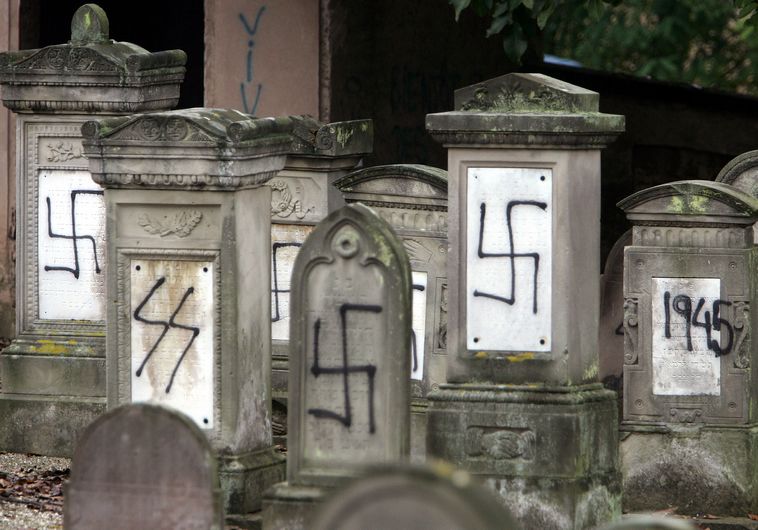
Graves desecrated by vandals with Nazi swastikas and anti-semitic slogans in the Jewish cemetery of Brumath close to Strasbourg, October 31, 2004. Jewish cemeteries have been, and continue to be, targeted as antisemitism rises in France. (photo: Reuters)

Graves desecrated by vandals with Nazi swastikas and anti-semitic slogans in the Jewish cemetery of Brumath close to Strasbourg, October 31, 2004. Jewish cemeteries have been, and continue to be, targeted as antisemitism rises in France. (photo: Reuters)


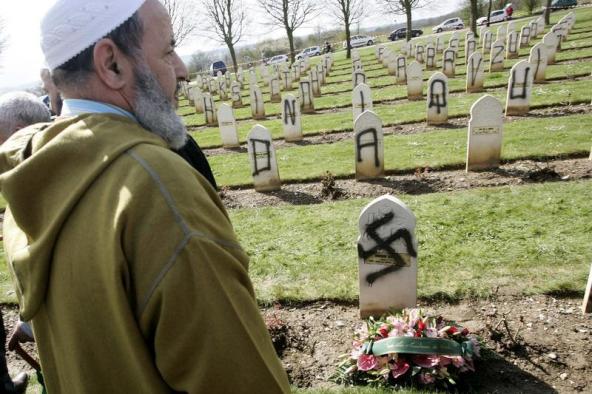
Muslim cemeteries are similarly vandalized. Notre Dame de Lorette cemetery near Arras, northern France, April 7, 2008.  Photo: Reuters/Sadouki

Muslim cemeteries are similarly vandalized. Although anti-Muslim attacks have skyrocketed in France since the Charlie Hebdo shooting, anti-Muslim bigotry and attacks were well underway beforehand. Notre Dame de Lorette cemetery near Arras, northern France, was vandalized in April, 2008. (Photo: Reuters/Sadouki)

And yet, because power rewards power, PEN granted an award for courage to Charlie Hebdo. Because power rewards power, Netflix continues to give Adam Sandler millions of dollars to make his crappy movie. Because power rewards power, entertainment corporations continue to shower Ari Shaffir with money. And so it goes.

I believe in freedom of expression, both in the abstract and in the concrete. I don’t think we should be censoring bigotry. I am adamantly opposed to censorship. But I also think– because this issue is complex– that we need to be thinking hard about the difference between tolerating the expression of bigotry and rewarding it.

We need to stop pretending that speaking out against the expression of bigotry is “anti-freedom of expression,” when in fact it is the exact opposite– it’s exercising one’s own freedom of expression. Being told your opinion is nonsense is not the same as being denied the right to express your opinion. Being told that your employer is not interested in paying you for expressions of bigotry is not the same as being denied the right to express bigotry at all. And speaking out against giving an award for courage to a magazine that routinely mocks marginalized groups is not equivalent to speaking out against that magazine’s right to print whatever the hell it wants. Supporting your right to freedom of expression need not include rewarding you for that expression, nor need it include freedom from criticism.

I think Adam Sandler, Charlie Hebdo, Ari Shaffir, and anyone else should be allowed to punch down as often and as viciously as they like. And I think those with the power to dole out awards– whether literal awards or financial awards– should stop and think for a moment about whether they actually wish to reward punching down.

We spend millions of dollars on anti-bullying campaigns, initiatives, and education in schools. We’re fooling ourselves that kids can’t see through the hypocrisy of adults telling them bullying is always wrong and then turning right around and rewarding bullying done by adults. What’s the difference between a playground bully mocking a Muslim kid, a disabled kid, an overweight kid, or a Native American kid, and what Adam Sandler, Charlie Hebdo, and Ari Shaffir have done? If the bully says, “But I make fun of everyone,” does that excuse the rest of his bullying? Of course not. So why is that used to excuse adult behavior?

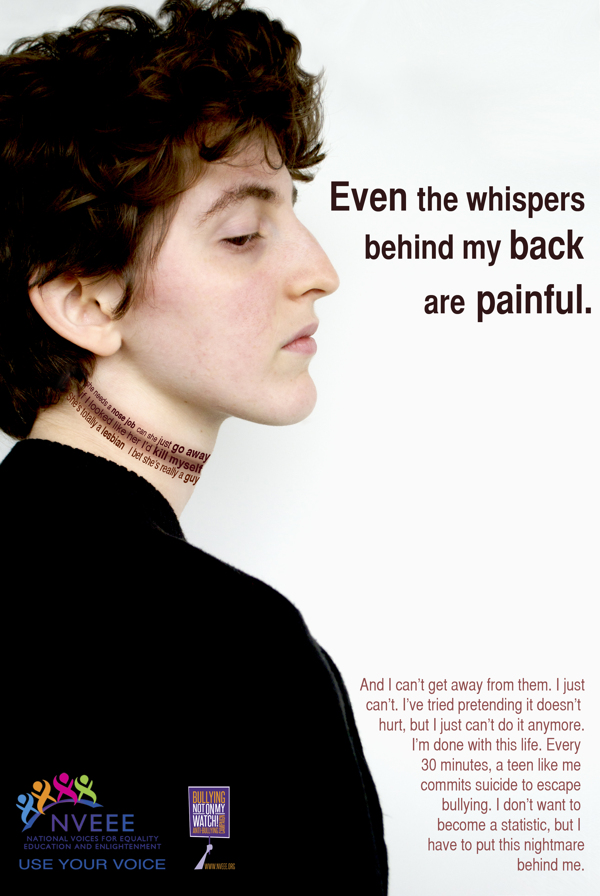
An anti-bullying poster from National Voices for Equality, Education, and Enlightenment. Learn more about them and their anti-bullying initiatives, at nveee.org.

An anti-bullying poster from National Voices for Equality, Education, and Enlightenment. Learn more about them and their anti-bullying initiatives at nveee.org.

And before you even bother posting comments defending any or all of the three I’ve discussed, the principle remains whether I’m right in my analysis of those particular three or not. We punch down in this culture all the time. We reward that kind of bullying with accolades, money, and power. We defend it with “it’s just a joke,” “you’re too sensitive,” and a barrage of like nonsense from privilege stomping its feet and throwing tantrums because their bigoted fun is being spoiled with our dissent. “It’s just a joke” is perhaps the most intellectually lazy argument of them all, as if the presence of humor evacuates its long history of keeping marginalized people “in their place.”

And while I will be the first one to defend your right to punch down– your right to freedom of expression– I’m appalled at the fact that we reward that behavior. It’s long past the time we stopped confusing tolerance with appreciation and reward.

Tagged , , , ,

Handheld Technology Has Not Ruined Today’s Youth Any More Than Dig Dug Ruined You

If there’s one thing that grinds my gears, it’s the disingenuous concern trolling over the rising generation’s “addiction” to technology, and how it has impacted their ability to [fill in the blank] the way WE DID WHEN WE WERE KIDS AS GOD INTENDED !!11!

Because this is a blog about theatre, I’m going to limit myself to speaking specifically to the outrageous idea that technology prevents the rising generation from appreciating art.

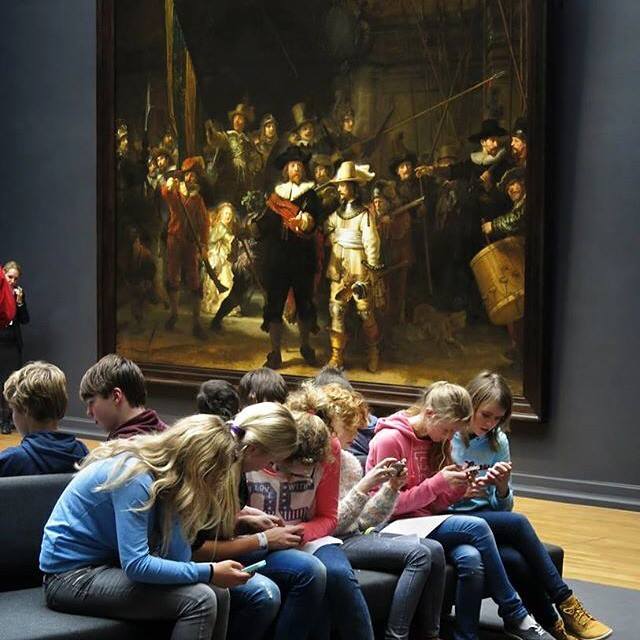
This picture is blowing up my various feeds right now:

Photo by Alvaro Garnero

Photo by Gijsbert van der Wal

This is one brief snapshot. We have no idea what these kids were doing just before or just after. Yet there are approximately 17 shitloads of “tsk tsk” and “This is our future” in my feed. Speaking as someone who has personally witnessed hundreds of high school and college kids blown away by art, I implore you to think more deeply about this.

We’re unthinkingly and unfairly using this picture (and the entire concept of handheld tech) to condemn an entire generation. Think for a moment: were kids enthralled to go to museums in the 1950s? Were kids enraptured by Mozart in the 1960s? Were kids stampeding Joan Didion lectures en masse in the 1970s? What pretend past are we mourning here? Sure, there have always been kids who were enthralled by classical art at an early age (and I was one of them), but the vast majority of kids– and adults– are not. Why are we condemning kids for looking at their phones instead of Rembrandt when most of you would be doing the exact same thing? How long have these kids been on this field trip? How tired are they? How many paintings of white men standing around have they been dragged past? And we dare to use this snapshot to condemn not just them, but their entire generation?

And has anyone bothered to note that this painting is hanging in a museum with an app-guided tour?

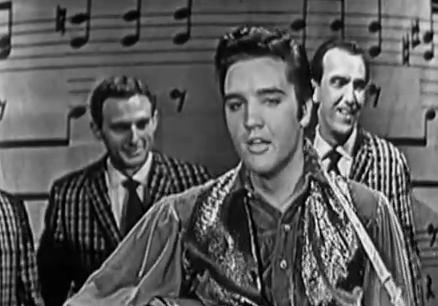
Elvis Presley was shot from the waist up when he appeared on the Ed Sullivan show in 1957 to protect teenage girls watching at home from his hip-shaking and its perceived sexuality.

Elvis Presley was shot from the waist up when he appeared on the Ed Sullivan show in 1957 to protect teenage girls watching at home from his hip-shaking and its perceived sexuality.

We talk a lot about wanting to engage the rising generation in theatre, and I’m seeing a lot of “what can we do about this?” commentary on this picture. Listen: If you want to engage the rising generation, the first thing you need to do is stop lying to yourself about them. You’ll fail to engage them if you don’t approach them with honesty. You can start by dropping the lie that our generation was any better in any way. Kids can smell dishonesty, and self-congratulation masked as concern is about the most dishonest approach you can take.

This is exactly why 99.999% of “audience engagement strategies” fail miserably to bring in young, diverse audiences. This is why “tweet seats” failed. We’re not looking at this generation honestly. Instead we look at studies designed from the outset to confirm our hypotheses. We make assumptions about how the rising generation thinks and feels based on how they make us think and feel. We refuse to engage them on their own terms, instead dictating the terms to them and then blaming them for boorishness when they fail to meet them.

Gorgeous young Franz Liszt, seen here in an 1839 portrait by Henri Lehmann, inspired a  frenzy in his young, usually female, fans, known at the time as

Gorgeous young Franz Liszt, seen here in an 1839 portrait by Henri Lehmann, inspired a frenzy in his young, usually female, fans, known at the time as “Lisztomania.” Women would wear vials containing his discarded coffee dregs and bracelets made of his broken piano strings. He was chased through the streets by young women attempting to grab a lock of his hair. The older generations were horrified and believed it to be a literal psychological disease.

Young people are no different now than they ever were, and the current pearl-clutching over tech is no different than the worry that comic books would ruin childrens’ minds, reading would make young women hysterical, jazz (and then rock and roll) would turn teens into sex-mad beasts, and television would “rot” children’s minds.

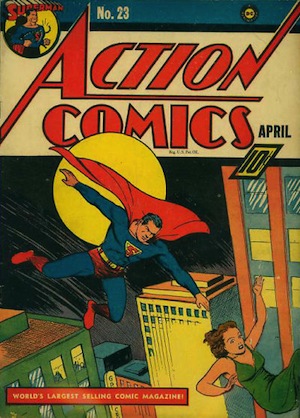
“Badly drawn, badly written, and badly printed – a strain on the young eyes and young nervous systems – the effects of these pulp-paper nightmares is that of a violent stimulant. Their crude blacks and reds spoils a child’s natural sense of colour; their hypodermic injection of sex and murder make the child impatient with better, though quieter, stories. Unless we want a coming generation even more ferocious than the present one, parents and teachers throughout America must band together to break the `comic’ magazine.” – Sterling North, Chicago Daily News, May 8, 1940

There’s no need to fight a battle we’re creating in our own minds. If we don’t look at the rising generation honestly, but instead seek to confirm our own biases about them, we are only going to speak to them in ways they know are dishonest, and get nowhere. Remember how lame older people sounded to us when we were teenagers, and how little they understood about our lives? That’s how we look to kids today when we post stuff like the museum photo above as proof of their lack of worth and how they are, essentially, a problem for older generations to solve.

The rising generation? They are wonderful. They are more politically active than your generation was at the same age. They are more supportive of equality than previous generations. They are brilliant, creative, funny, bold, and bright. And most importantly: They create and consume TONS of art. Whether or not it’s art you like is entirely irrelevant.

Are they perfect? Of course not. But approaching them as a problem to be solved is not going to create the kind of engagement we want. Give them room to speak. It gets us nowhere to tell them what they should be interested in, and then condemn them for their lack of interest. When Ms. Nelson made you read Keats in the 6th grade, and you hated it; when Ms. Sciambi made you look at all those Goya paintings, and you hated it; when Mr. Rodriguez made you listen to Wagner, and you hated it, what did that say about you? When you went home from school and read your D&D Player’s Handbook, listened to Run DMC, and played Dig Dug, what did that say about you? Right, nothing, apart from the fact that you were a normal kid who liked normal kid things.

Yes, we need to expose kids to the arts. We need much much more arts education than we have now. Art saves lives– I believe that. BUT. I was that nerd kid grooving on Keats, Goya, and Wagner in class, and everyone (apart from my nerd clique) gave me no end of shit about it. So now, while the rising generation behaves exactly as you did, you’re talking about how they need to be saved from themselves?

You were fine. They’ll be fine. Keep making art and inviting them. Keep trying– always keep trying. But appreciate them on their own terms. Do not ignore their art, or dismiss it as worthless. And please keep your judgypants in the closet or I will start publishing those pictures of you all from that middle school museum field trip where you were wearing sunglasses and Hammer pants and refusing to look at the paintings that didn’t have naked ladies in them.

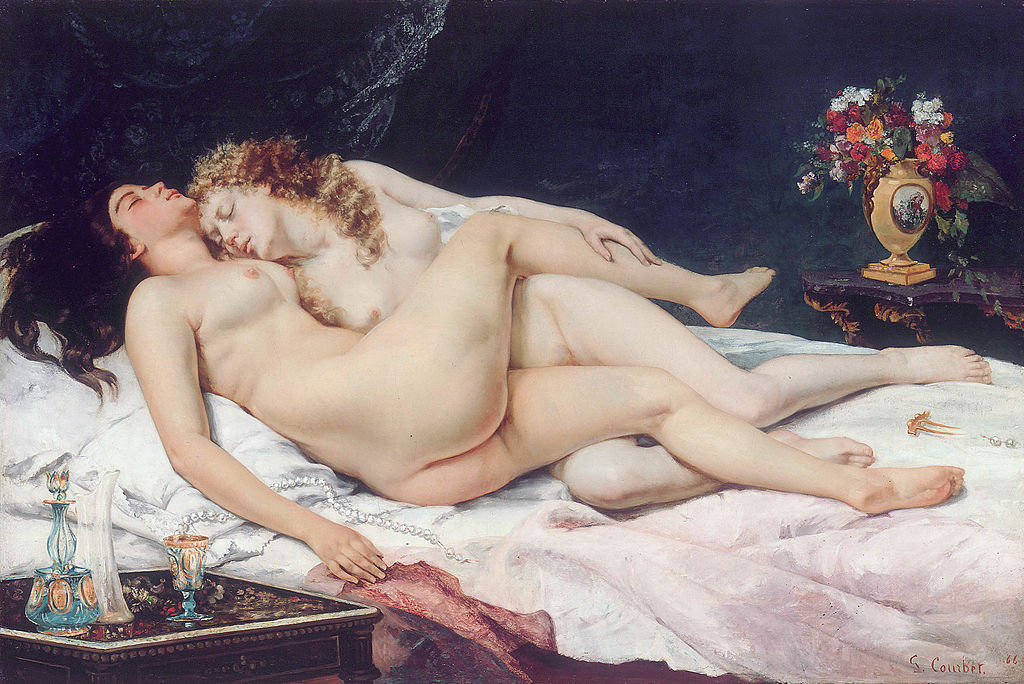
Le Sommeil, Gustave Courbet, 1866. Turning middle schoolers into art lovers for 150 years.

Le Sommeil, Gustave Courbet, 1866. Turning middle schoolers into art lovers for 150 years.

Tagged , ,

The White Guy Problem

Before you start limbering up your fingers to write NOT ALL WHITE GUYS before you even read the article, lemme just say this: I KNOW. The only reason I’m able to track the performative phenomenon I’m about to discuss is because it only occurs in a small subset of white guys. Since most white guys are NOT doing this, but a solid and vocal minority are, it’s been easy to spot, track, and wonder about.

Earlier this week a friend of mine posted Cera Byer’s Salon article, “To My White Male Facebook Friends.” The article, originally a facebook post that was reposted so many times Salon asked Byer for permission to publish, has a basic thesis: White guys, don’t immediately get defensive when women or people of color tell you about their experiences. Listen and believe them.

Like everything ever in the history of ever, the reaction to that article proved the need for it repeatedly, thoroughly, and with no room for doubt.

In one thread of which I was a part– a public post (I know, I know, I usually know better)– a young Latina grad student was commenting in support of the article and about her experiences with white men as a queer woman of color, and one man– let’s call him “Jake”– posted this in response to her:

“Ah yes, the fiery Latina, hot in the sack, but not much going on upstairs if you catch my drift, and that temper? Yikes. It’s cool if you’ve nothing substantial to contribute, I’m good at ignoring. Just let me know if you’re going to slap those bongos of yours, ’cause I’d like to watch. “

He was immediately called out for his racism and misogyny, of course, by a healthy percentage of the people still actively participating in the thread, many of whom were white guy allies. Shocked, and, quite frankly, exhausted by the public racism and misogyny we’ve seen so much of in recent weeks, I copied and pasted the above into a status of my own and told people where to find the public thread.

His response to the censure he received for such open racism and misogyny was enormously telling, and, as it dawned on me that I was seeing a predictable pattern, the impetus for this article.

For the past few decades, our cultural norm in cases where someone has been caught in public making a racist or sexist comment has been some kind of apologetic (or half-assedly apologetic) performance. “I never intended to offend anyone” is a popular (half-assed) performance in these cases. Think Mel Gibson. Think Michael Richards. Think Donald Sterling and Bruce Levenson. Think Paula Deen. Public racism, in particular, has been long considered the kind of activity that can ruin a business, get someone fired, destroy reputations. But something has changed, and quickly, spearheaded by a small but vocal minority of white men.

When “Jake’s” comment was first posted and subsequently called out, I fully expected, given the egregious nature of the comment and the fact that it was in a public thread (and thus viewable by his boss, clients, whoever), some kind of, “While I disagree with you and the article, I should not have said what I said. It was inappropriate and I apologize.” Standard American CYA behavior.

Instead, he opted for a new pattern of behavior I’ve since begun to think of (after Byer’s article) as “the Defensive White Guy performance.” While I realize this has always been happening *privately*, I’m seeing a new, widespread willingness to behave this way *publicly*.

This Defensive White Guy performance is particular and predictable the moment it begins. Of course I understand that a LOT of human behavior is predictable, for all types of people– I live in Berkeley and can predict a knee-jerk liberal reaction to the letter and the link– but this DWG phenomenon is representative of a widespread willingness to perform and then defend racism and misogyny publicly.

It’s a very particular performance I’m seeing more and more of, and it’s always the same: the Defensive White Guy makes a racist or misogynistic statement, is called out for it, then immediately begins claiming he’s the victim, either in the discussion, in American culture, or both. He claims that he is not racist or sexist. He labels any oppositional commentary, no matter how bland, as an attack, often conflating the commenter with entire groups, such as “liberals,” “feminists,” or “SJWs.” Often he will double down on the original racist/misogynistic statement by posting more of the same, even while claiming not to be racist or sexist. His attacks are filled with horrible insults. He claims perfect entitlement to the usage of those terms because he is being “attacked,” or because the people who disagree with him “deserve” it.

In this particular case, “Jake” responded with accusations of slander (playing the victim) and responses to women like, “Don’t you have dishes to do?” (doubling down), in addition to a wide variety of attacks of various types. While attacking me publicly, he came to me privately, begging me to take the status down, claiming he was receiving “threats” from my “friends.” I hid the status and then asked him for specifics, stating that, if that were true, it’s not OK, and I would speak with those friends and personally ask them to stop. In response, he accused me of being a (somehow anonymous) participant in these supposed “threats,” said he would give my name to “the authorities,” and blocked me, forcing me to conclude this was just another “playing the victim” performance. Despite the fact that he was almost certainly lying, I reopened the thread and posted a request for people to leave him alone, left it up for 24 hours, and then re-hid the thread.

So what’s happening here? Why would a guy be all bluster, racism, and misogyny in public, then come privately to me and ask me to protect him from the consequences of attacking me (and others) and expect me to comply? Why couldn’t he just man up and sincerely– or even somewhat sincerely– apologize to the woman he originally attacked, utilizing the same CYA performance that’s been the standard for the past several decades?

Again, just to head off the inevitable YOU’RE BEING RACIST AGAINST WHITE MEN reactions, most white guys are great. Most white guys are empathetic people trying to understand the lives of others. But the entire nation is currently being dragged down by a small group of people whose reaction to the pain of others is MY PAIN IS MORE IMPORTANT, whose reaction to racism and the role of their own privilege in that is LALALA I CAN’T HEAR YOU, or worse, PRIVILEGE IS MADE UP BECAUSE MY LIFE IS HARD.

Here’s what I think is happening:

We all see ourselves as the “good guy” in the narrative of our lives, and these Defensive White Guys are no different. They believe in their hearts that they understand racism, and believe they understand the experiences of others. They believe in their hearts they are not racist or sexist, and that assertion is almost always a loud component of the DWG performance. They BELIEVE it. They grew up with Free To Be You and Me and learned in school about the many laws and customs we once had that barred women from participating in public life– voting, higher education, certain kinds of employment. They learned about the income disparity. And they said to themselves, “I am not that.” And they believed it. In school they learned about lynchings and listened as their teacher played “Strange Fruit” or read to them about Emmett Till. They saw pictures in their grade school textbooks of drinking fountains marked “WHITES ONLY,” they learned about the 1963 Birmingham church bombing, they learned about brave little Ruby Bridges, they learned about racism and they said, “I am not that.” And they believed it.

As they grew up, they demonstrated this by talking about how little they cared that their co-workers were Black, or their boss was a woman. They voted for women or people of color. They didn’t see anything wrong with interracial marriage. They BELIEVED they were not sexist or racist, and for that, they believed they were one of the “good guys.”

As our culture progressed, however, and became more and more willing to study racism and misogyny, and how they both operate systemically within our culture, we articulated the concept of privilege, we studied it and created a mountain of statistics to show its existence, we began to examine the myriad ways in which racism and misogyny are encoded into our culture. We realized the problem was deeper and wider than we thought.

And the definition of “good guy” changed. It was no longer just a public declaration that you weren’t bigoted and a lack of active oppression of women and people of color. Being a “good guy” now meant engaging in a difficult and complex process of understanding privilege, including your own privilege, acknowledging that, and understanding how racism and misogyny are created and disseminated, how much of that we’ve internalized, and how we work to end that. Suddenly a stated belief in “equality” and a simple lack of active oppression– both relatively easy to understand and believe you can accomplish (despite the fact the we now know this is much more complex than originally thought)– were no longer enough. Many white people had the courage and/or resources to meet these new challenges head on. Many had to slowly come to understanding. Most of us are still struggling with these issues and our place within them every day. But some white people, including these men I’m discussing, whose personal narratives and self-conceptions, like all of us, rely on being “the good guy,” are LIVID. The definition of “good guy” changed. It requires understanding and accepting something they do not have the will and/or ability to understand, and they are angry. They feel betrayed that “good guy” went from easy to difficult, was taken away from them while they weren’t looking, and is something to which they feel entitled, but is in reality something they now have to earn.

In addition to the fact that the qualification for “good guy” status has changed, the culture is changing all around them. While white men still hold almost all of the positions of power in our culture, and control almost all of the wealth, demographically their numbers are shrinking, and the culture is changing slowly to reflect that. The entire shape of the economy slowly changed since the Reagan Revolution, tipping the nation’s wealth to the hands of a few families, shutting people without wealth out of the political process, and almost entirely ending the American Dream of upward mobility. Many white men are hurting economically. Since all white American-born men have lived their entire lives in a culture that always put their needs first and was structured around their narratives, the idea that someone else’s narrative could be just as important, or, possibly, for even just a moment, more urgent and important, is, for some white men, literally impossible to understand. This subset of white men cannot comprehend that idea as anything but a MASSIVE injustice against them. They’ve been first in line for so long THEY NEVER EVEN KNEW THE LINE EXISTED, and they believe that being asked to wait in line like everyone else is bigotry against them. This subset of white men cannot comprehend that ending street harassment is a more urgent issue than their desire to approach women whenever and however they like; that actual rape is a more urgent issue than their fear that one day someone might possibly accuse them of rape; that the killing of unarmed Black men (and BOYS) is a more urgent issue than their fear of Black “thugs”; that the killing of unarmed Black men is a more urgent issue than a few broken windows.

This subset of white men cannot comprehend that the expression of the pain and anger of a long-oppressed group of people is a more urgent issue than their need to be seen as “a good guy.” It takes a truly mind-blowing amount of self-absorption, entitlement, and privilege to answer “White people are hurting us; please help make it stop” with “NOT ALL WHITE PEOPLE.” What this response is saying is: “My need to be seen as a ‘good guy’ is more important than your pain. Please direct your attention to that and confirm that I am ‘good’ before I will consent to recognize your pain.” It’s the social equivalent of demanding that someone compliment your bitchin’ Camaro before you agree to roll it off their foot. OR HEAD.

In the face of the changing culture, and the changing job description of “good guy,” this subset of white guys, these Defensive White Guys, have sunk into their anger and resentment and are filling the culture with a level of unapologetic, overt racism and misogyny that we haven’t seen in decades. And while I don’t have the answer, I suspect it’s because they resented having to make room in their social concept for women and people of color to begin with– they were only playing along so they could secure the title of “good guy” and be liked, not because they truly believed it was the right thing to do. And now that the culture has progressed and these DWGs have discovered that they are no longer the “good guy” without a little more work and direct engagement, they’ve reached a “fuck it” moment. They are reasonably sure– and they’re right, at least for now– that the culture at large will protect them in some way because it always has.

So when they express their resentment, anger, and feelings of betrayal by making these public racist and misogynistic statements, and are inevitably called out for them, they cry victim because they BELIEVE they’re the victims– the victims of a culture that changed behind their backs and deprived them of being the well-liked “good guy” without meeting new qualifications; the victims of a culture that deprived them of the American Dream; the victims of a culture that tricked them with social issues that everyone knew were inevitably lost into voting for conservative politicians who had no intent of doing anything but further distancing that American Dream from everyone but the wealthy; the victims of a culture that suddenly “doesn’t care” about their issues because the issues of other groups are starting to be seen as equally important; the victims of a culture that no longer posits “white guy” as the one human in constant possession of the benefit of the doubt.

These DWG performances reek with fear, desperation, panic, and the hatred those three inevitably create. The world is changing, and their role in that world is changing, HAS changed, and there’s precisely nothing they can do about it. The panic is as thick as tear gas.

Most white guys are up for the challenge the new America presents, especially the rising generation. Eventually this DWG phenomenon will die down, just as anything succumbs to cultural inevitability. They’ve already lost the battle they think they’re fighting– a battle best represented by the ultimately meaningless slogan “Take Back America!” The knowledge of the loss is, of course, what’s driving much of the anger.

But I think it’s important that these guys are so pissed in part because they believe they’re “good guys,” and believe the culture betrayed that by changing the terms of the agreement. They’re attacking and attempting to discredit everything and everyone they can find that represents, disseminates, or even just discusses the new “good guy” job description. I have to believe, despite everything, that there’s hope in that “good guy” self-image. I have to believe that eventually, at least some of these guys will come to an understanding of the truth, and put in the work required to really be good guys– good citizens of a diverse America– because (again, I have to believe) they honestly want to be. Maybe that’s naive, and my internalized white privilege is making me give these guys too much of the benefit of the doubt even as I condemn their actions. But I do. I still do. I have to have hope for change.

(NOTE: This is my personal blog. I am under no obligation to approve any particular comment. Racist, sexist, or threatening comments will be trashed.)

Tagged , , , ,

The Performance of Protest vs The Performance of Excusing Apathy

Once upon a time I met an actor with mental health issues. Just . . . save that joke for later; I’m serious times right now. He told me that the Korean government was trying to kill him because of his political street theatre. When I tell this story, it never fails to get a laugh. Political street theatre? Harhar. No one cares about political street theatre that much! Harharhar.

In the wake of the failure of the grand jury to indict Darren Wilson, protests have exploded all over the country. The internet has also predictably exploded with people condemning the rioting and looting that have been an unfortunate component of some of the protests. The theatre around this issue is fascinating, and enormously telling.

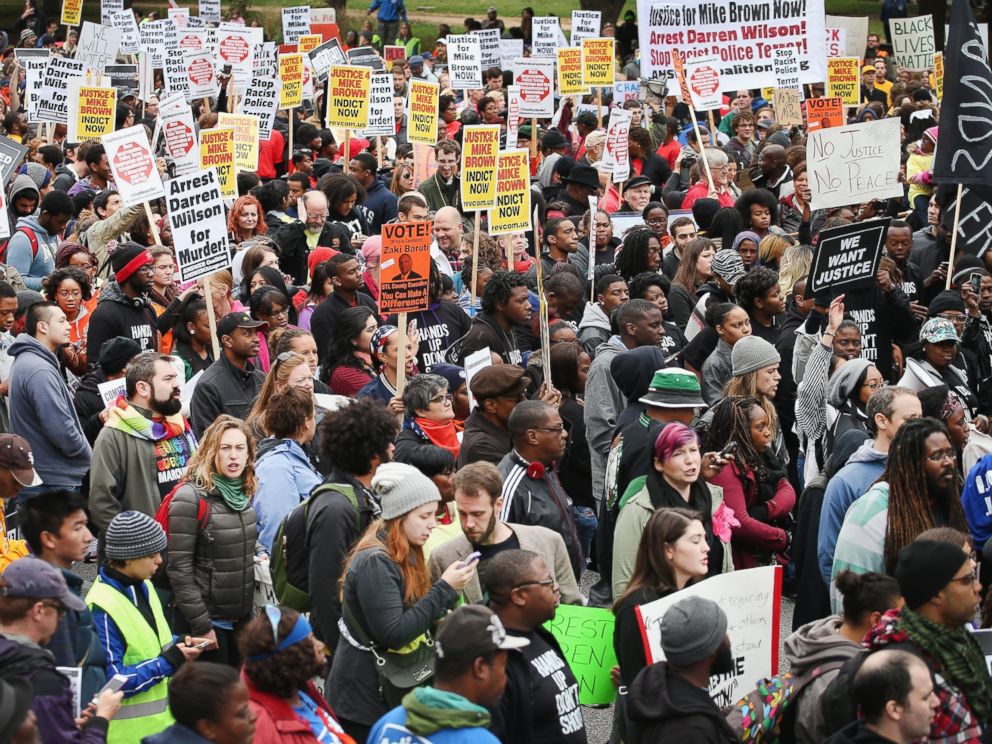
There have been peaceful protests in Ferguson (and elsewhere) literally every single day since Michael Brown was killed. Here are some shots:

Ferguson, August 11. Photo by Robert Cohen, AP.

Ferguson, August 11. Photo by Robert Cohen, St. Louis Post-Dispatch/AP.

People march in Washington on September 6, 2014 to protest the killing of black teen Michael Brown whose killing by a white policeman in Ferguson, Missouri, ignited violent protests and debate on race and law enforcement in America.    AFP PHOTO/Nicholas KAMM        (Photo credit should read NICHOLAS KAMM/AFP/Getty Images)

Washington, DC, September 6. Photo by NICHOLAS KAMM/AFP/Getty Images.

Ferguson, September 29. Photo by Robert Cohen, St. Louis Post-Dispatch.

Ferguson, September 29. Photo by Robert Cohen, St. Louis Post-Dispatch.

St. Louis, October 11. Photo by Scott Olson/Getty Images.

St. Louis, October 11. Photo by Scott Olson/Getty Images. You’ll see Scott Olson’s name on a lot of photos of Ferguson and St. Louis. You’ll also see photos of him being arrested by Ferguson police for taking pictures. Some of his fellow professional photographers caught his arrest on camera. Because evidently we’re the kind of nation that arrests journalists now.

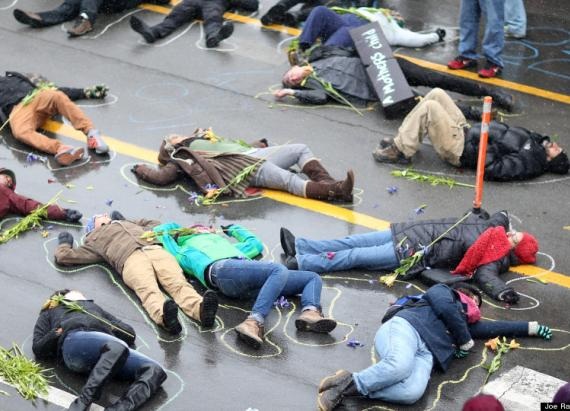
Protestors staging a

Protestors staging a “die-in” in St. Louis, November 16. Photo by Samuel Corum/Anadolu Agency/Getty Images.

Protests are political street theatre. The last picture shows an example of the kind of actions we’d more normally associate with “theatre,” but a protest of any sort is a performance intended to capture attention and make a certain point. The problem is: the peaceful protests were almost completely ignored. Sure, we saw some pictures early on, and the “die-in” got a little press, but by and large, Ferguson disappeared off the cultural radar within a few weeks of Brown’s death, only resurfacing as the grand jury decision was nearing. Headlines roared impending violence: “Police in Ferguson Stock Up on Riot Gear Ahead of Grand Jury Decision.” “State of Emergency Declared in Missiouri for Grand Jury’s Decision on Ferguson.” “Officials Prepare for Ferguson Grand Jury Decision, Urge Calm.” Everyone knew the grand jury would fail to indict. Even those who still had hope knew. Everyone expected there would be riots. And, amid the many peaceful protests over the past few days, there have indeed been many incidences of property damage and looting.

This shot, seen round the world, of a looter in Ferguson. November 24. Photo: David Carson/AP.

This shot, seen round the world, of a looter in Ferguson. November 24. Photo: David Carson/AP.

Dellword, MO, November 25. Photo by Scott Olson/Getty Images.

Cars burned during the riot the night before in Dellword, MO, November 25. Photo by Scott Olson/Getty Images.

Despite the violence and looting, most protesters are still peaceful.

Protestors in Oakland, CA, November 24. Photo: Jim WIlson/New York Times.

Protestors in Oakland, CA, November 24. Photo: Jim WIlson/New York Times.

Times Square, New York City, November 24. Photo: Kena Betancur/AFP/Getty Images.

Times Square, New York City, November 24. Photo: Kena Betancur/AFP/Getty Images.

The peaceful protests have been nearly completely ignored while America obsesses over the images of violence. That message is loud and clear: WE WILL NOT PAY ATTENTION TO YOU UNTIL YOU DO SOMETHING DRASTIC. And when you do something drastic, well, then you lose our respect and your issue becomes secondary to our scorn.

A significant chunk of America is terrified of the future diverse America they can do nothing to stop, or don’t care about people of color, or any marginalized people, and are livid that the culture is slowly lumbering towards expecting them to care. They’re in a flat-out panic trying to stop immigration (but only from the brown countries), trying to roll back the gains of feminism either overtly (denial of birth control) or covertly, pretending it’s all about a different issue entirely (Gamergate), trying to roll back marriage equality, trying to roll back the separation of church and state, trying to roll back diversity anywhere they find it. These are the people who use “social justice warrior” as a pejorative. The terrified and the indignant.

That chunk of America is comforting itself with those images of African American looters. They make an enormous amount of theatre about the rioting and looting– little performances on TV, social media, blogs– scolding African Americans, claiming they’re demeaning their cause with riots, or that the cause itself is just a fabricated excuse for violence and looting. Thousands of little performances that accuse Black people of expressing “sadness for a death” by rioting. Performances where Martin Luther King is trotted out to posthumously scold Black people. (White people always reach for MLK when they want to scold Black people without looking racist.) Performances scolding Black people for “honoring Michael Brown with looting.” Thousands of little, belittling performances that pretend this is about the death of one man, an isolated incident. Thousands of little, belittling performances that pretend the looting and property damage are the most important aspects of this cultural moment.
These performances deliberately miss the point because they are only meant to comfort that terrified and/or indignant chunk of America. If the protests are just senseless riots and looting, then nothing is actually wrong and nothing needs to change. They were right all along. Case closed.

In truth, no one actually believes this is just about Michael Brown. I think, by this point, everyone understands that it’s about Michael Brown AND Amadou Diallo, John Crawford, Ousmane Zongo, Timothy Stansbury, Kendrec McDade, Aaron Campbell, Victor Steen, Steven Eugene Washington, Wendell Allen, Trayvon MartinTravares McGill, Ramarley Graham, Oscar Grant, Jordan Davis, Darius Simmons, Eric Garner, Ezell Ford, and, just the other day, little Tamir Rice. AND MORE. So, so, so many more cases of white people killing unarmed African Americans, usually young men, because we have a culture that frames Black as a symbol for IMMINENT DANGER. White people imagine guns in the hands of unarmed Black men while they would never imagine such a thing in a similar situation with a man of a different race. They imagine a Black man walking towards them is a threat, a Black man adjusting his waistband is reaching for a gun, a Black man standing on the street is a weapon just waiting to be used against them.

I know it’s hard for some of you to imagine the anger of a community whose youth are routinely seen this way, and subsequently gunned down in the street, more often than not with impunity or the lightest of sentences, whose pain goes completely ignored or even contradicted– the terrified and indignant love nothing better than a performance about how wonderful things are now for people of color, how people of color are upset over nothing, how Black-on-Black crime or Black-on-Caucasian crime is the real issue (as if those two types of crime erase the problem). I know it’s hard to focus on a Big Problem that needs Big Work to solve. But we MUST.

I’m exhausted by people who think the riots are the most important aspect of this cultural moment, who ignore everything else. I’m exhausted by those people both because they’re using the riots to comfort themselves into believing the cause itself is worthless, and because they’re creating a self-fulfilling prophecy: IF YOU ONLY PAY ATTENTION TO VIOLENT PROTESTS, THEN PEOPLE MUST RESORT TO VIOLENT PROTESTS TO GET YOUR ATTENTION.

African Americans are just 13% of this nation, and this issue directly involves white people. White people MUST be involved if we’re going to have justice here. Most white people completely ignored the peaceful protests. They sent their last fuck off to seek its fortune with a knapsack and a pocket full of dreams two days after Brown was shot. The ONLY thing that got their attention was violence, and the ONLY reason they suddenly decided to pay attention was that violence gave their inattention a REASON. They couldn’t post “I’m ignoring these daily peaceful protests because the idea of losing my privilege in the face of equality terrifies me,” or “I’m ignoring these daily peaceful protests because I don’t give a shit about social justice or racism and I’m pissed that you expect me to care.” They stayed silent until the violence gave them a handy reason not to care, and then they finally erupted in thousands and thousands of little performances demonstrating why they didn’t need to care.

“A riot is the language of the unheard,” wrote Martin Luther King. When no one pays attention to peaceful protests, that anger, depair, and rage will boil over into violence. But MOST of the protestors, remember, are still non-violent. Most of the protest performance is still peaceful. Not that anyone notices or cares.

Of course you can decry looting and property damage while simultaneously fighting for justice. But I don’t see that in the many little performances blowing up social media. The most common theme in these is open racism. Many of the memes created aren’t even using images from Ferguson– they’re using images from other places and times. I’m seeing little racist performances like these everywhere:

“In memory of how Michael Brown lived his life. Looting isn’t a crime! It’s a tribute!”

“Not a single pair of work boots was looted in Ferguson last night.”

“The best way to end the rioting and looting in Ferguson is to hold a job fair. They’ll scatter like cockroaches when the lights come on.”

There are more. I won’t link to any of them. You’ve already seen them.

If you want to decry riots and looting while simultaneously working for justice, then by all means, do that. In actual fact, that’s what most people who support this cause are doing. While we recognize that riots, looting, and destruction of property are the language of the unheard (see Tea Party; Boston), we’re still working in peaceful ways to bring about change. But right now, we’re forced to push against a monolith of people using the violence to comfort them in their terror and apathy, and/or using the looting and property damage as a vector through which their racism can be channeled.

I wrote an article about how our culture frames Blackness as a symbol for potential danger, and how we as artists can work to change that. I’d be thrilled if you read my own little protest performance. I’d be even more thrilled if you shared it. But I’d be THE MOST thrilled if you wrote your own.

YES. WE. FUCKING. CAN. Change the country, create justice, and end racism. It’s a Big Problem that requires Big Work, and that’s scary and intimidating. You can’t do a Big Work all on your own. But a million small works add up to the Big Work. Create your own protest performance, even if it’s as small as a single meme, a single article, a single sign. Do what you can. Together, we can create so many they can’t be ignored. Let’s do this. Drown out the apathy, the fear, the hatred, the racism.

Tagged , , , ,

Words and Symbols: Not Just Decorative

Theatre is storytelling. A large part of that job is understanding how various aspects of your story, visual, aural, linguistic, etc– will affect your audience. You’ll never be 100% accurate, of course, but it’s your job to have a basic working knowledge and understanding of the way words and symbols are interpreted by the culture in which you’re staging your work. Unless you’ve contracted to tour an existing show in another area and are using a word you didn’t know was local slang for “extremely large penis,” it’s your job to understand those things well enough to manipulate them effectively.

So it always comes as a surprise to me when theatre people screw this up. Let me break down my past few days for you:

swastikaring

redskins

michonne-cosplay

1. Sears listed this ring on its website, then immediately took it down, saying a third party vendor had posted it in violation of their terms. Whether Sears knew about this or not, in the online discussions I saw of this, people were LEAPING to defend it. Whenever you get into a discussion of swastikas, the first apologists you see are the people charging in with “it’s a religious and/or cultural symbol that was used in art all over Europe and Asia for centuries.” To which I say: LOL. WE KNOW. But the historical usage of an image doesn’t change the way that image is perceived NOW, in this time and place. Its usage in traditional art cannot evacuate its current semiotic– and what’s more, YOU KNOW THIS. You KNOW that most people in the Western world associate that image with the Third Reich. The next apologists say things like, “I don’t think most people even know what that means anymore; kids are ignorant.” To which I say: LOL. They’re kids, not hamsters. They know.

If you’re a theatre professional, you should understand what that symbol means and the impact it has on a western audience– whether it’s the one in your theatre or the one walking down the street checking out your cool not-Nazi-I-swear ring. Whatever background information you have about that symbol is worthless in that process. The swastika is one of the most recognized symbols in western culture, and its semiotic is as clear as any semiotic gets.

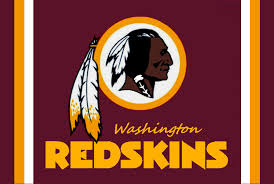
2. The same thing can be said about the Washington Redskins logo. Although the association of the word “redskin” with racism isn’t as widely discussed in our culture, about fourteen seconds of thought should be enough to straighten you out. How difficult is it to ascertain that the word “redskin” is racist? Let’s ask the “ignorant kids” of Urban Dictionary:

“An offensive and derogatory term refering to native americans.”
This is the third definition; the first two are along the lines of “greatest team in the NFL.” In addition to every legit dictionary definition designating the term “offensive” or “racist,” even a crowd-sourced dictionary used almost exclusively by the under-30 population knows what’s up. EVERYONE KNOWS.
The apologists are exhausting: “It honors Native Americans,” “I grew up with it; it’s not meant to be racist,” “I totally know a Native American who thinks it’s fine,” “It’s tradition.”
So what is anyone– let alone theatre people– doing defending this name? Why would anyone try to pass off a word widely accepted as a racial slur as “honoring” that group? Why would anyone defend the use of a racial slur as “tradition”? We have plenty of racist traditions we no longer employ because they’re racist. So what makes this word different? Because . . . you like it? You’ve always been allowed to get away with it, so having the power to use a racial slur without consequence is your right? You get to determine what’s racist or culturally insensitive to marginalized people?
*****
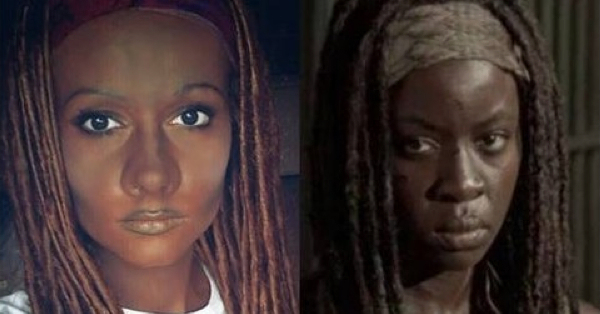
3. The third image comes from a debate that broke very recently. A German cosplayer posted a picture of herself  in dark makeup as part of her cosplay of Michonne from The Walking Dead, pictured next to her. The internet went (predictably) apeshit.  Whether or not blackface occupies the same cultural position in Germany as it does here, the fact remains that plenty of people in the US are defending this, and this is hardly the first time I’ve seen this in cosplay. The defense goes something like this: “She’s honoring the character,” “It’s OK when black people do whiteface, so what’s the big deal,”  “no one even knows what a minstrel show is anymore,” and the ever-popular, but completely perplexing, “anyone who says this is racist is a racist.”  Several threads about this issue have contained comments from Black people saying things like, “You don’t understand how hurtful this is because of its cultural and historical context; whiteface is entirely different; please believe me” only to be shouted down with a barrage of “So white people don’t get an opinion?”

*****
A few days ago, I was in an online discussion with a young white guy who took extreme umbrage at the fact that I said it’s a pile of nonsense-flavored nonsense for white people to tell people of color they’re wrong when they discuss their lived experiences of racism, using as my example my frustration with seeing white people jump on an Asian American who was calling out yellowface. This young white guy– a theatre person, btw– insisted that the opinions of white people need to be welcomed and honored in those discussions, or they would never “be convinced” that diversity is good and bigotry is bad.  That white people need to be “allowed” to argue (read: allowed to argue without consequence) with people of color when people of color point out racism, or white people will refuse to care about racism.
*****
Setting aside the  fact that no one should have to “be convinced” to have basic human decency and care about racism, both the blackface apologists telling Black people they need to “calm down” (literally) because cosplay blackface isn’t a problem, and the young white guy above are saying the same thing: The opinions of white people are ALWAYS important, no matter what the context, no matter how uninformed or misguided. In short: white people should be respected when they whitesplain racism to people of color. To which I say: LOL.
privilege
When theatremakers who should know better defend racist and/or culturally insensitive symbols, there are several things operating at once: White privilege, wishful thinking, and their combined ability to override the basic theatre skillset of understanding cultural context and semiotics. It’s one thing to understand a racist symbol and then use it with that understanding; it’s entirely another to try to argue that a symbol with a well-known racist semiotic is actually just fine if you squint (and stop listening to people of color).
 *****
Only someone consumed by their own white privilege could possibly imagine that social justice demands respecting white people shutting down people of color as people of color recount their lived experiences of racism. That’s not a discussion– it’s a deployment of privilege and power– or an attempted one. It’s whitesplaining.
*****
It’s not that white people don’t get an opinion because they’re white. Have all the opinions you like. I HAVE A WHOLE BLOG OF THEM. It’s just that white people should stop expecting people of color to STAND ASIDE while in discussions of racism so that white people can seize control of definitional authority. No one believes that white people aren’t “allowed” an opinion– we all understand free speech– but like so many people who misunderstand free speech, whitesplainers are upset because they’re not allowed an opinion without consequence. What they’re upset about is that they’re the ones being shut down instead of being accorded the authority to shut others down. When the discussion goes “PoC: That’s racist; Whitesplainer: Actually, it’s not; PoC: You don’t get to decide what’s hurtful to people of color” the whitesplainer gets upset because the person of color didn’t step aside and allow him to define the terms of the discussion. The whitesplainer derailed the discussion away from the racist act itself and into an argument about whether or not the person of color is correct and/or respects him. It’s exactly the same as this:
“What should we do for lunch?”
“This isn’t lunch, you’re wrong.”
“Dude, I’m the one facing the clock and I’m telling you it’s noon.”
“Why aren’t you respecting my opinion?”
 *****
White theatremakers, please think before you start jumping to defend symbols of racism, bigotry, and cultural insensitivity. If you find yourself in a discussion where you’re disagreeing with targeted people and passionately defending someone’s right to wear a swastika ring, or use the term “redskin,” or wear blackface, stop and think about what the actual fuck you’re fighting for. Seriously. You’re fighting for the right to be, at the very least, culturally insensitive without consequence. You’re fighting for the right to sieze definitional authority over terms and symbols that target marginalized people away from the people targeted. Why do you believe you deserve the authority to tell marginalized people what they are and are not allowed to find hurtful?
 *****
If you want to be a theatre professional, you MUST come to terms with the fact that, no matter how hard you wish it, the semiotic of a symbol IS WHAT IT IS. Manipulate it how you will after that, but don’t go on facebook trying to convince people that swastikas are OK in America because of the way they were used in India.
*****
There are privileged people out there who are fighting HARD for their cultural privilege. I’m not saying they’re deliberate bigots– they’re by and large not– but they are so used to occupying a certain positionality within our culture that they freak directly out when that positionality is challenged– when their authority isn’t automatically respected in a discussion, or when they’re asked to believe people of color when they talk about their lived experiences, no matter how hard those stories are to hear. Take a step back, listen, and think.
Tagged , , ,

RANTYPANTS

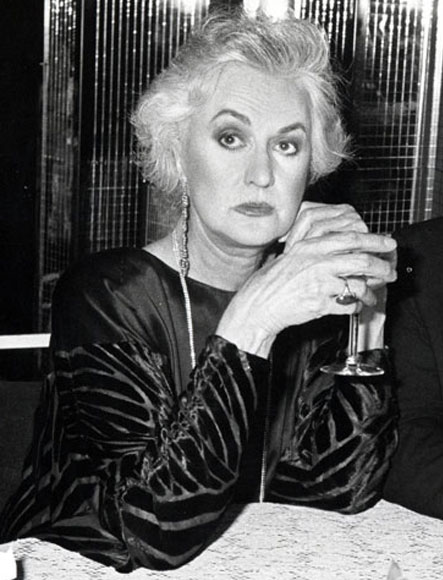
Bea Arthur is my spirit animal.

Bea Arthur is my spirit animal. I will never achieve such epic glare.

Oh, internet. I love you so much. But sometimes, sometimes . . . you work my last available, barely functional nerve.

I have some things I need to get off my chest.

The internet in general and social media in particular are amazing. Now we’re interacting with far more human individuals per day than at any other point in human history. This has one million positives and a handful of ass-clenching negatives. I just really need to get some of these negatives off my chest (SEE ABOVE).

1. Evangelical Atheists and Evangelical Religious People.

Look, I’m glad that you’re excited about what you believe. Truly. I think you have every right to believe it, and every right to talk about it all you please. I think you should make a blog where you write an article a day about how happy you are being an atheist or whatever it is that you are. Decorate that shit with blingee smiley faces and unicorns. SPREAD YOUR LOVE. But can we all agree to stop spreading hate? Atheists and religious people, I know almost all of you are awesome, normal people who have zero shits to give about the beliefs of others. But there are vocal minorities in both groups that are in a constant process of evangelizing– blorking out a nonstop barrage of posts and comments about how they belong to the ONLY belief system in possession of THE FACTS, and therefore everyone else is not only WRONG but STUPID, ignorant SHEEP who believe everything they’re told and have no capacity for rational thought.

You guys . . . knock it off. Have a little compassion. Religious people, atheists are not amoral deviants who are so blinded by hedonistic modern culture that they cannot see the awesome truth of whatever religion you believe is true. They don’t need religion to be good, moral people. Atheists, believers are not mindless sheep whose personal beliefs are worth mocking simply because you do not share them. They don’t need to be atheists to be intelligent, worthwhile people. Is mutual respect too much to ask? Do we need to do a preschool circle time unit about manners? Can we all stop posting memes about how atheists are stupid jerks whose UPPANCE WILL COME or how spiritual belief causes every bad thing ever, from war to erectile dysfunction, and is only followed by DUMB IDIOTS WHO ARE DUMB? You’re both wrong, and impolite to boot.

You see, it's all about being friendly neighbors. These guys look friendly, don't they?

You see, it’s all about being friendly neighbors. These guys look friendly, don’t they?

2. Inability to Cope with the Woes of Friends.

It’s natural to reach out to friends when shit goes down, and now that reaching out includes social media. When a friend posts something like, “Blah happened and I felt bad about it,” saying any of the following is like handing your friend a flaming bag of dogshit instead of a hug and a cupcake. And if you’re saying any of these in response to someone expressing hurt over being the target of bigotry or harassment? Sexism, racism, anti-LGBT, ableism, fat hatred, anti-Semitism, Islamophobia, street harassment? It’s even worse.

“Don’t let it bother you.” OK, thank you for telling me I shouldn’t be feeling what I’m feeling. I’ll just put all my feels back in the box.

“They were just (joking, trying to be polite, asking you a question). You should (laugh it off, take it as a compliment, help them understand).” Yes, my feelings about this are all due to my misunderstanding of the situation. Since this is my very first day on earth (I was recently hatched and flash-trained at the Spaarti Cloning Center), I had no social context within which to interpret my own experience. Thank you, oh wise one, for explaining my experiences to me.

“You think that’s bad? You should hear what happened to ME.”  UNFRIEND.

“You’re too sensitive.” UNFRIEND AND COLDCOCK.

“(Name of group to which you belong) are too sensitive.” UNFRIEND, COLDCOCK, and SEND TO SIX WEEKS OF SENSITIVITY TRAINING BY HIPPIES IN THE WOODS.

“They’re right. (Name of group to which you belong) really are like that. I’m not saying you are since you’re one of the good ones.” DETONATE.

Why is it so hard for some people to say, “Wow, that sucks. I’m so sorry you have to go through that”? It’s an INTERNET MYSTERY.

Let's put this bitch on the case. PROBLEM. SOLVED.

Let’s put this bitch on the case. PROBLEM. SOLVED.

3. Assuming that the first thing they see someone do is the ONLY THING that person has EVER DONE.

Oh, the judgy comments. Video of guy retaliating against his noisy neighbors: “He should have tried talking to them. How annoying.” Online activism: “Why aren’t you donating/going to rallies/volunteering?” Article about a lawsuit: “Ugh, they should have tried mediation first.” I just don’t understand why people assume that we all go into cryosuspension when they’re not looking at us.  HOW DO THEY KNOW we haven’t done/always do/are in the middle of doing EXACTLY what they’re accusing us of not doing?

chewie

4. Spreading hoaxes and nonsense.

So basically it takes under a minute to check Snopes to see if that meme you’re posting about Monsanto or Fukushima or Wal-Mart is accurate. Anything from the “Daily Currant” is satire. Anything on any website trying to sell you something isn’t “scientific proof!!!1!” of the efficacy of the thing they’re trying to sell you.

And it’s cool– we all fall for those sometimes. But when you find out that the thing you’ve posted is inaccurate, WHY DO YOU LEAVE IT UP? You’re like the Johnny Appleseed of bullshit. Worse, when you’re dealing with a company whose business practices have come into question for good reason, you’re weakening the accurate arguments by spreading ones proven to be inaccurate.

WHEW.

OK, my darlings. I promise my next post will be full of positivity, rainbows, chocolate, and puppies.

endtransmission

Speaking from Privilege

I posted the other day on facebook and twitter that white privilege and thin privilege are the toughest scrappers in the game– they’ll throw any kind of punch they can think of to preserve their privilege.

I posted that because there have been a handful of responses in the blogospere to my blog post of the other day, The Weapon of Invisibility, that advocate for “taking a step back” and “approaching these issues with nuance” and “allowing for respectful appropriation.” In other words: Go easy on the privileged when we cross boundaries, because sometimes we do so accidentally, or with respect in our hearts. Not one had a word to say about the thin privilege portion– the point wasn’t even WORTH MENTIONING. Ah, the weapon of invisibility. But I digress.

Listen, I get that you’re frustrated and want activists to go easier on people who cross boundaries of cultural appropriation. I see it all the time. You’re terrified of fucking up– or that you have already massively fucked up in something you wrote, staged, or said. Relax– of course you fucked up. So did I. So has everyone. But that doesn’t mean you get to decide what respect looks like for marginalized people. You have to live with the fact that, if you have privilege and you wish to fight for social justice, you do not create the terms of that and must listen carefully to the people who have been marginalized. If the privileged are the gatekeepers, then nothing has changed.

And yes, I completely understand how scary it is. But you cannot sit from your place of privilege and decide which cultural appropriation has crossed the line and which is respectful because, quite frankly, that is not your decision to make. What does that look like? “Dear people of color, sorry you’re all so pissed, but I believe that production was respectful borrowing, so please calm down”? Privilege cannot decide the terms of this if the goal is social justice. All that accomplishes is preserving privilege.

We all have some types of privilege and we all have some areas wherein we lack privilege. In those areas wherein you have privilege your job is to listen and allow those without privilege to set the terms of the discussion– WHAT crosses boundaries and HOW.

In those areas wherein you lack privilege, you get to set the terms of the discussion. You get to decide when boundaries have been crossed. And when, as so often happens, someone with privilege you lack comes along and tells you that you aren’t approaching the issue with “nuance” or that you should give someone the benefit of the doubt because they were appropriating with “respect” (as if intent erased results, but fine), then you have every right to be outraged at the attempt to silence you, at the attempt of privilege to retain its privilege by seizing control of the terms of the discussion and turning it into a debate.

I understand that we’re all scared. I’m scared, too, both for the areas in which I have privilege– How many times will I get it wrong today?– and the areas in which I don’t– How many times will I be told that my outrage is unjustified today? How many times will my feelings of marginalization be met with “You people are too sensitive” or “I didn’t mean it that way, so relax,” or “It’s just a joke/play/school production/Hollywood film/etc”? Because EVERY SINGLE TIME I speak out, someone with privilege I lack is there within moments to say ALL of those things to me.

Just take a deep breath and listen. When people who lack privilege you have are speaking out about that lack of privilege, and how it looks every day, and how their culture is appropriated, LISTEN. BELIEVE THEM. And use your place of privilege to speak out as an ally.

When you lack privilege and want to speak out, know that there are allies who WILL listen to you, support you, and yes, screw it up, but still keep trying. Don’t let the people who tell you that your outrage isn’t justified silence you. I see you. I stand with you. And I know you stand with me, in my fear, in my outrage, in my strength, in my mistakes, in my triumphs. There are millions of us, and for the first time in history, we’re all saying NO.

Tagged , , , ,

Fathering Daughters: You’re Doing It Wrong

Image

I’m choosing to accompany this article with pictures of gorgeous women who don’t conform to the beauty myth. This is Malaysian model Loretta Lucia Kwek Leng Choo. Picture from thestar.com.

I’ve seen several articles about fathering daughters recently, all focused on combating the beauty myth, and they’re all about things dads should SAY to their daughters. This is bullshit. Or, more accurately: It’s less than half of the story.

Most men have only a vague understanding of what it’s like to live as a woman under the constant, unrelenting onslaught of cruelty the beauty and fashion industries deliberately create– an onslaught supported wholeheartedly, and continually reinscribed, by our culture. No matter how much you try to “protect” her from Disney, or the media, or whatever you think sends her the wrong messages, she is getting those messages, all day, every day. That she MUST be unhappy about her body. It’s not lean enough, strong enough, hairless enough, light-skinned enough, shaped properly. That she MUST be unhappy about her face. It’s not pretty enough, “refined” enough, it’s not perfectly even-toned, blemish-free, “flawless.” Unhappiness sells products. Our culture is exceptionally supportive of the idea that women’s bodies are in constant need of some kind of product or procedure to attain acceptability.

Image

Mollena Williams, photographed by Substantia Jones for adipositivity.com. Check out Mollena’s blog, The Perverted Negress, at mollena.com.

It’s inescapable, relentless. It’s so normative that people who speak out about it are slammed for overreacting, or said to be speaking from a position of sour grapes. It starts at birth. You cannot be in public or consume media for more than a few minutes without encountering it. I’ve barely described the tip of the iceberg. There’s a lot to be said about the beauty myth, misogyny, and fathers and sons, or mothers and daughters, or mothers and sons, or parents and their gender non-conforming kids. The existence of those important issues, however, does not erase or even diminish the importance of this one. The father-daughter relationship is powerful.

Rei Bennett Photography - Kitty Creme 07

Clothing Designer Catriona Stewart, photographed by Rei Bennett. Catriona’s blog, Lingerie, Latex & Life, can be found at catrionastewart.blogspot.com, and Bennett’s site can be found at reibennett.co.uk.

So what is your daughter learning from YOU? She sees what you look at, how you look at it, and what you say, especially when you do not want her to. If you think she isn’t silently comparing herself to the pictures, people, and videos to which you react positively, you’re delusional. Before she experiences the male gaze from any other source, she’s experiencing it from you, and she’s learning ALL OF IT. I’m not saying don’t watch porn, or don’t look at women. I’m not here to Carrie Nation your cock. Just remember that everything you say, do, and consume while she is within earshot of you is making an impact on how she sees herself. (Determine how far away you can hear a whisper and add 20 feet if you want to calculate Child Earshot Value.)

Image

Cassie Rosenbrock. Photo by Heather Elizabeth. Check out her work at heatherelizabethphotography.com.

I know you’re not critiquing your daughter’s looks because you’re not a huge jerk. But if you want to have any hope of combating the massive monolith of cultural messaging that tells her that her worth is related primarily to her looks, you have to be deliberate, and relentless. It’s not enough to just tell her she’s beautiful the way she is, or that intelligence or kindness are more important than beauty. She’s watching everything you do and say. If you’re contradicting your platitudes with your behavior every day, she knows which one to believe.

In other words, you have to walk the walk, not just talk the talk. If you tell her that she’s beautiful just the way she is, but she sees you react positively ONLY to pictures of photoshopped skinny young white women, you might as well have never said a word. She sees you define “good” and she is already calculating her distance from it. If you think she’s too young, you’re delusional. Can she walk? She’s old enough to understand your behavior.

plus.amy

Model Amy Marie, photographed by Aug Glamour. See Amy’s portfolio at modelmayhem.com/627470.

The world is a big, messy, unfair place full of contradicting objectives, needs, goals, and desires, and that’s just in one person. Decide which of those you want to privilege in any given moment. The answer doesn’t always have to be the same. All I’m saying is: Don’t tell yourself you’re fighting for your daughter if you don’t understand that she’s watching you ALL the time, not just when you want her to.

From Ladybug Pin Up, a photography project in the Dominican Republic. Check out their work at ladybugpinup.com.

From Ladybug Pin Up, a photography studio in the Dominican Republic. Check out their work at ladybugpinup.com.

Tagged , ,