Author Archives: melissahillman

Sanders, Trump, and their Angry White Men

This is the Election Cycle of the Angry White Person, Mostly Men. This particular kind of Angry White Person supports either Trump or Sanders, and is defined both by their privilege and by saying they’d rather stay home than vote for anyone else. A surprising number of Sanders supporters have said they will vote for Trump if it’s HRC/Trump. This phenomenon bears examining.

This is a certain type of Angry White Person, not all angry white people everywhere, just in case you’re feeling fragile and need a #notallwhitepeople or #notallmen. Or even a #notallSanderssupporters, because it most definitely is a subset, and a minor one at that, but so vocal, so active, so, well, LOUD, they’re impacting the election cycle as a whole. I may yet vote for Sanders myself, not that it matters, as I’m in California and our primary is like five minutes before the election.

This subset of Angry White People I’m talking about are attracted to either Trump or Sanders, period. Their personal politics will push them in one direction or the other, but the basic exchange between voter and candidacy is exactly the same.

Right now, white people are starting to lose their privilege (or, more accurately, fear they might lose it) as we strive as a culture for equilibrium. White people are being asked to examine their complicity in a system that’s racist, sexist, ableist, transphobic, etc. Many white people, especially men, are upset and angry that they, who believe they are good people– who ARE good people– who believe they are “not racist” and “not sexist,” are still associated with systemic oppression, still asked to examine their privilege. Unjustly accused, they believe, of being “the bad guy.”

Along come two angry white men, both of whom say “America’s problems are not your fault. YOU’RE the victim of an unjust system. You have every right to be angry! The system is rigged against you, so get angry and fight back!”

This is music to the ears of a certain type of white person. Trump lays it at the door of “political correctness” unjustly oppressing white men, and Sanders lays it at the door of an unjust economic system. I agree that economic injustice is a massive problem in the US, but that’s immaterial to the point I’m trying to make.

Many Sanders supporters are baffled when their fellow Sanders supporters say they would stay home and allow Trump to win or even vote for him themselves should the general election be Trump v HRC. Liberal and progressive politics center around championing the vulnerable, and in general, those voters recognize the danger that Trump– and the GOP in general– present to the vulnerable in the US. They understand that the perfect cannot be the enemy of the good when actual lives are at stake. They know that the luxury to pretend that Clinton is the same as Trump only comes with the kind of privilege that insulates one from the consequences of the election. They understand what Sanders’ support of feminism and anti-racism initiatives means.

But, as we’ve seen, not every Sanders supporter actually listens to Sanders, and many are so caught up in the message that they, as white people, are victims of an unjust economic system that they refuse to consider how the consequences of this election might impact people more vulnerable than they, making them “Bernie or Bust.” And while there are indeed “Bernie or Bust” people of color, the vast majority of them are white– the vast majority of Sanders’ supporters in general are white. It’s been a problem dogging the Sanders campaign from the beginning and the reason he’s not likely to win the nomination.

This particular type of Angry White Sanders Supporters are defined by their response when it’s suggested that they should “vote blue, no matter who” in the general election to protect the vulnerable against the real dangers of a Trump presidency. They reject, with angry indignation, the idea that the actual lives of the vulnerable should take precedence over what they’re mistakenly calling their “conscience,” but what is really “my anger is more important than the lives of the vulnerable.” They say, “If I’m Bernie or Bust, don’t blame me, blame Hillary Clinton,” which means exactly same thing: my feelings matter more than, to name just one example, protecting Muslims from the policies of Donald Trump or Ted Cruz. They’re more than willing to sacrifice the safety of vulnerable Americans if they don’t get precisely what they want. They see compromise as a line impossible to cross, no matter the cost– especially when the cost is one they themselves will not have to pay.

This kind of Angry White Person is excited to finally be in a place where they’re back in the center, where they’re The Victim, where they’re no longer associated with The Bad Guy, The Man, The White Male Monolith, The Patriarchy. They finally have a place that tells them that they’re the true victims of injustice.

Of course they aren’t going to vote for HRC; of course they’re going to believe whatever debunked propaganda they can find about her, of course they’re going to disparage her in sexist terms; of course they’re going to demonize her. There’s a certain kind of person who needs to believe the propaganda about her, because he’s enraptured by a world wherein white people, especially men, are the victims of an unjust system, not the architects and enforcers of one. He can’t– or he won’t– entertain the notion that white people can be both simultaneously. “Bernie or bust” = “my worldview at ALL costs.”

(And here it is again, in case you tend to confuse “people who do this” with “all you people do this”: #notallSanderssupporters #notallwhitepeople #notallmen.)

While White Anger is pretty much the alpha and omega of the Trump campaign, it’s only part of the Sanders campaign. Yet it’s such a vocal part that it’s become one of the most persistent negative aspects dogging it, doing Sanders much more harm than good.

There are two kinds of anger dominating Sanders followers: The first is the righteous anger over decades of economic injustice bolstered by every aspect of the oligarchy we foolishly made of the republic we were given. It’s an anger that recognizes that racism, sexism, homophobia, transphobia, ableism, Islamophobia, and every kind of injustice and bigotry are serious problems in and of themselves in addition to, not in opposition to, economic injustice, that recognizes the importance of intersectionality. These are people fighting for the vulnerable, whether their own intersectional identities fall into any of those categories or not. I believe these are the (somewhat silent) majority of Sanders supporters. I hope they are. I would count myself among them, no matter who I vote for in the primary. In the general, I will proudly cast my vote for either Democratic candidate, because these issues– these people– matter to me.

This brings me to the particular kind of White Anger I’m discussing– the second kind of anger dominating Sanders followers. It’s an anger that rejects any consideration of other issues, that rejects any consideration of others, period. The White Anger that revels in its own importance and cannot, even for a moment, entertain the notion of having to return to a place where their white privilege or their male privilege– their association with, and potential complicity with, systems of oppression– becomes important, instead refusing to leave the circle where they can claim that they are the ones against whom the gravest injustice has been committed, everyone else be damned. The people who would throw the vulnerable under the bus to preserve the illusion that they are the ones suffering the gravest injustice, deserving of the most urgent attention, and entitled not just to the front of the line, but to the entire line.




Tagged , , ,

“I’ll Never Vote for Hillary!” Yeah, OK.

hrc.sanders
The latest installment of “The Internet Explodes with Hatred for Hillary Clinton” happened earlier this week, when HRC (whose own record on AIDS research and funding is better than any other candidate) mistakenly said that Nancy Reagan was a lowkey supporter of AIDS research, when Reagan was, in reality, a massive asshole about AIDS in every possible way. Clinton immediately apologized, then apologized again, at length. Yet we’re still seeing a wagonload of “I’ll never vote for her” from progressives, as if her words about Reagan trump (and I’m using that verb deliberately) her actual record on AIDS research and funding. Why?
.
Clinton’s stellar record on AIDS is ignored while people indignantly attack her for making an inaccurate statement. I like Bernie. I really do feel the Bern. But I see Democrats brush aside things he and other male politicians have done while raining fire on Hillary for the exact same thing– or something much less. This happens all the time. Hillary is flamed for being a “career politician” and an “insider” when Sanders has been in political office for much longer than she has. (Hillary was first elected to political office in 2000; Sanders was elected to his first office in 1981 and his first national office in 1991.) People flame Hillary for speaking in favor of the omnibus crime bill in the 90s when she was First Lady– a position with no political power– but Bernie, as a member of Congress, actually had the power to enact it into law, voting in favor of it despite the fact that many of his colleagues did not.
.
I’m not here to argue Hillary vs Bernie. I genuinely like them both. I’m here to say that I’m sick of seeing her reviled for the same things people forgive easily when they’re done by men, and that the stakes are too high this election cycle to indulge that or leave it unexamined. If you’re reviling Hillary for saying something racist and stupid in 1994 in favor of a crime bill that turned out to be a very bad idea, but you’re not reviling Sanders for actually using his political power to make that very bad crime bill law, I want you to take a long, long think about why that is. If you’re reviling Hillary for campaign contributions made by banks, but did not revile Obama for the same thing, I want you to take a long, long think about why that is.
.
Those of us who are old enough to remember what it was like to live under Reagan and the Bushes remember how bad it was. How much better almost everything– including the economy and job growth— got under Clinton and Obama. I lived through it, and I would support half a Snapple as the Democratic nominee rather than go back to the policies of Reagan or (any) Bush.I see people swear up and down their hatred of Hillary isn’t because she’s a woman, or doesn’t stem directly from decades of vicious, lying conservative propaganda— they will swear it!– and then immediately turn around and eviscerate her for something Bernie did (or is) himself, or call her a “crook,” or say nonsense like, “She doesn’t have an honest bone in her body.” Conservative copywriters, whoever you are, I applaud you for your success in taking a complete and total fabrication and successfully integrating it so far into the American consciousness that there are people who agree with nearly every policy position HRC has today, yet will still claim she’s “dishonest.” That’s some impressive chicanery, and I mean that.
.
We should be closely examining all candidates for office, and balanced, honest criticism of a candidate’s record and policies is crucial. Respectful debate about the candidates is necessary and healthy. But supporting Sanders should not be the same as hating Hillary. Too many people are not debating the candidates and their various records or platforms logically, instead viciously reviling Clinton– often in misogynistic terms– for things they routinely excuse in male politicians. And I have to say, the level of unfocused, irrational vitriol feels an awful lot like what conservatives have been doing to Obama for years.

There’s not a thing wrong with choosing Bernie over Hillary, or disliking Hillary’s current policy proposals. However, the out-and-out hatred we’re seeing from some Sanders supporters (and about which I am hardly the first person to write), bears some serious scrutiny. While the Sanders campaign has made real efforts to deal with the worst of it– the “Bernie Bros” acting as a misogynistic mob, attacking Clinton and her supporters Gamergate style; the “Bern the Witch” controversy– there’s still far too much active hatred, and far too much of it is misogynistic or coded misogyny. Far too much of it stems from willing belief in conservative propaganda about HRC that has been debunked over and over.

I think we all expected it, but I did not expect it from our side.

It’s one thing to prefer one candidate over another. That’s healthy. That’s admirable. It’s another to actively HATE a candidate for doing EXACTLY the same things as the last three men you voted for, despite her liberal record.
 .
Let’s think practically about the election in November.
.
If Trump gets elected, how many vulnerable people will be hurt, how many programs cut, how bad will the the economy get under conservative policies? How much damage will be done if Trump, an open racist and misogynist, is empowered to command our military, veto bills, and nominate people to the Supreme Court, impacting life in the US for decades to come? Trump exhorts his followers to attack Black protestors at his rallies (“The next time we see him, we might have to kill him,” a follower said  after punching a Black protestor at a rally earlier this week), excuses his followers who attack Mexicans on the street, claims Mexican immigrants are rapists, refused to distance himself from the KKK, supports banning Muslims from even entering the US, advocates killing the families of terrorists, and is openly sexist. Trump is the worst America has to offer.
 .
How privileged do you need to be to imagine that it’s a good idea to risk the actual lives of vulnerable Americans because you “hate” Hillary so much you vow to stay home if Sanders doesn’t get the nomination? How protected from the consequences of a Trump presidency do you need to be to think your hatred of Hillary constitutes, as I saw someone say earlier this week, an “inviolable principle,” meaning, more important than the actual lives of vulnerable Americans? That all applies equally to anyone saying the same about Sanders. (We have yet to see the full weight of American antisemitism aimed at Sanders, and if he wins the nomination, we most certainly will.)
.
Vote for whoever you like in the primary. But let’s step away from vicious attacks and hatred. Let’s step away from buying into debunked conservative propaganda about Clinton’s trustworthiness. Let’s look at the candidates’ actual proposals and weigh those proposals’ actual strengths and weaknesses. Let’s respect each other’s choices in the primaries.

And whoever becomes the Democratic nominee, the stakes are far, far too high for us to selfishly stay home because we didn’t get our first choice. I will happily, proudly vote for either Clinton or Sanders, and I hope you will do the right thing and join me.

NOTE: The comments for the post are now closed. Thanks for reading Bitter Gertrude!
Tagged , , ,

White People: Shut Up About Beyoncé

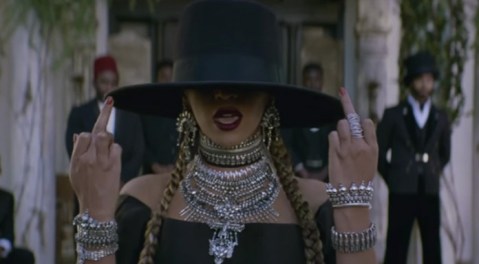
After the release of her game-changing, brilliant video, Formation, and the stir her Superbowl halftime show caused with dancers dressed like Black Panthers, Beyoncé is blowing up everyone’s feeds everywhere. And one thing I am shocked/notshocked to see is white outrage about both.

Let me begin by saying that I’m not a Beyoncé fan. I’m not a fan of any of the pop divas. I don’t have anything against them; it’s just not music that interests me. So Lady Gaga, Beyoncé, Madonna, Mariah, Adele, I apologize, but I’m sure you and your massive success could not possibly care less that I would rather be listening to punk or classical. The only reason I’m pointing this out is to make sure you know I’m not a Beyoncé fan. This is not about defending a beloved star.

Let me tell you what it IS about.

The vast majority of Black people in the US are descended from people who were dragged here against their will and forced to live in a culture that shut them out completely from mainstream artistic production for 400 years. For 400 years, Black people were living in a culture where their pain, their culture, and their art were appropriated and sanitized for white consumption, or, more often, shut out of the narrative entirely, replaced by racist caricatures or rendered invisible. For 400 years, the stories of Black people on this continent were untold, belittled, or made the tools of white narrative and white profit.

Now we’re in a cultural moment where there are powerful, mainstream Black artists telling Black stories that may or may not include white people, may tell uncomfortable truths about white people in Black lives, or may use white people as metaphors. For 400 years Black people were used as metaphors in white art, so my sympathy for “not all white people” and “that’s not fair” is somewhere at the bottom of a pile of Magical Negroes, Gone with the Wind, and token Black friends.

In this cultural moment where powerful, mainstream Black artists like Beyoncé are telling their stories on their own terms, the white people who controlled the narrative– including how and when Black stories have been told– for the past 400 years need to sit back, shut up, and listen, listen, listen. You don’t like how white people are being portrayed? Spend some time thinking about why Black artists are portraying white people that way instead of demanding they adjust their stories to conform to your self-image as “the good guy.” We are not the heroes in these stories. We are not the intended audience. We are irrelevant, and there’s nothing people in power hate more than to be made irrelevant, but the fact remains that these are Black stories, by, for, and about Black people. You don’t like it? Don’t watch. But I recommend that you do, and give it some real thought. This is their truth. You do not get to dictate how Black artists see or portray their own lives.

And if the image of the tiny child dancing in front of a line of police officers, who then surrender to him, does not move you after little Tamir Rice (and so many others), you have no soul.

Formation-surrender

The line of riot police surrendering to the power of a beautiful dancing child is not “anti-white” or “anti-police.” It is pro-hope, pro-life, pro-art, and pro-Black. If you don’t like the metaphor of the line of white police officers here, I suggest you spend some time thinking about why Beyoncé chose it.

The Formation video and the Superbowl show are examples of a powerful Black woman at the top of her game brilliantly telling Black stories for Black people, brilliantly seizing the narrative and asserting the beauty, power, and truth of a people who have been stringently and deliberately silenced for centuries in this country.

The call for Black women to get in formation, get information, and celebrate their power gave me chills. You hear a lot about “Black excellence,” and Formation is a potent reminder that Black excellence isn’t something created by white people congratulating themselves for bending down to hand out opportunities. Too many of us define “white ally” as “someone who is desperately needed by Black people to help them, and therefore deserves all the cookies.” Black excellence is already there, has always been there. It doesn’t need white validation, and the lack of fucks Beyoncé has for white validation from the center of her Black power is giving some white people fits.

beyonce-formation-video-696x385

Beyoncé, I hope you’re bathing in a marble tub full of white tears this morning.

My fellow white people: Listen. Listen. Listen. This is a Black moment, rarer than rare in this culture. If you don’t like the way Black artists portray white people, work on changing the impact of white people in Black lives, not on telling Black people they’re wrong about their own lives.

SIGNAL BOOST: “We Slay, Part I” by New South Negress is an excellent analysis of Formation.

IN ANSWER TO YOUR QUESTIONS:

  1. No, the title is not meant literally.
  2. No, I am not an angry Black lady, but thank you for the compliment.
  3. No, capitalizing “Black” does not reveal a secret plot for racial superiority. Capitalizing the word “Black” in reference to people is a linguistic thing. “White people” has a squidgy definition and refers to a hodgepodge of people from varied ethnic groups, all of which are capitalized, such as “Celtic people” or “Swedish people.” “Black” as shorthand for “The people of the African Diaspora living in the United States” is rightly capitalized as “Black people” in the same way we say “French people.” “African American” is linguistically and historically troubled because “Africa” is a continent with thousands of disparate cultures, and the people we label as such were forcibly separated from most aspects of their cultures of origin when they got to the US, creating an entirely new, coherent culture best described as “Black.” Of course, the word as an ethnic descriptor has other applications (“Black people in Germany,” for example), but this is the one I’m using in the article. Not all linguists agree, but that’s my position.


Tagged , ,

The Oscars: As Silly and Useless as Ever, and Yet Crucially Important

The Oscars are nonsense. They’re Hollywood’s Homecoming Queen elections, as insular, as clique-ish, and as disconnected from any actual merit as any Homecoming election in any rich white high school. Rich white people congratulating each other for the kinds of achievements attainable only by people sitting atop an obscene amount of money– their own or someone else’s. They ask you to believe that the actual best acting, best directing, best editing, and best design of the year just always happen to be located in the one narrow strip of filmmaking that (entirely coincidentally!) has the most funding.

So the Oscars are more or less the Tonys of the filmworld– limited to a very narrow strip of exceptionally well-funded work while we all pretend the awards somehow represent the best of the nation’s work as a whole.

Most of the artists who receive Oscars or Tonys did a fine, in many cases excellent, job. I begrudge them nothing and honestly wish them nothing but the best. But it’s important to remember that we don’t give awards for the “best” work in theatre or film because we don’t even consider most work, and, most importantly, there’s no objective way to measure whose artistry is “the best” once you’ve eliminated some of the obvious worst– and, let’s face it, when it comes to Oscars for acting, even that’s seldom done.

We give these kinds of awards based on how an artist makes us feel; generally, how an artist makes us feel about ourselves. There’s an old saying: “When the audience cries, it’s not about you; it’s about them.” The people who vote for these awards are no different.

Despite the fact that these awards are meaningless as measures of artistic merit, they contain an immense cultural value. A great deal of that stems from the narrative of artistic supremacy created by Broadway and Hollywood. There are an entrenched group of extremely wealthy and powerful people whose fortunes depend on you continuing to believe that Broadway and/or Hollywood represent the pinnacle of American performative art. They’ve built and expertly marketed a superstructure of dreams and wishes that will make people who’ve never worked in either Broadway or Hollywood defend their artistic supremacy as if they’re defending their own children. I actually admire the way Broadway and Hollywood have controlled that narrative. There’s a terrible beauty to that level of cultural manipulation.

An immense part of that narrative of supremacy is rooted in the cultural supremacy that comes from cultural saturation, something only money can buy. A film like Fifty Shades of Grey–a film of questionable merit on many fronts— had the financial backing to play in theatres all across the country (and the world, but our cultural exports are a story for another blog), saturate the market with advertising, and command enormous press attention, garnering $166 million at the box office ($570.5 globally) and a basket of award nominations for The Weeknd for Best Original Song (Oscars and Golden Globes among them), while literally hundreds of much better films lacked the financial backing to receive such culturally potent– and lucrative– attention. Fifty Shades of Grey becomes, therefore, a permanent part of our culture, attaining a position of influence unrelated to merit, created by the wealth of its backers. People in the BDSM community were largely aghast at the misconceptions about themselves and their lives now lodged like a tick into the national consciousness. Now people who have never met anyone in the BDSM community “know” what “those people” are like, will make decisions about “those people” based on that. The power of cultural saturation coupled with the myth of artistic supremacy is immense. Everyone sees X + X comes from an “important” source = X is truth, even when X is demonstrable bullshit.

This is why, despite the fact that I will laugh in your face if you tell me the Oscars have artistic meaning, I think it’s crucial that we look closely at the messages we’re sending when we shut people of color out of those awards, because those messages have immense power in the real world.

First of all, do not bother to comment that a number of people of color were nominated for the Oscars this year, including Best Director and Best Original Song, mentioned above. I know many people who work behind the camera, and I am keenly aware that the current discourse is limited to the actor awards. It irritates me that tech people, directors, designers, and writers are so easily disregarded, and that the work of actors is regarded as so much more important in a medium where the work of the actor is actually of far less import than the underscoring, cinematography, and editing. The cultural primacy of the film actor exists, whether I like it or not. There’s a culturally important mythology around film actors that just doesn’t exist for most of us behind the camera. They are our mythological figures– our Achilles, our Ajax, our Helen, even our Artemis, Athena, Hermes, Apollo. We create unending mythology about them and their lives. The mythological Jennifer Lawrence is a combination of Artemis and Dionysus in our culture right now. Yet the real Jennifer Lawrence is just a young woman, no different than any other. We have raised her (more accurately, a mythologized version of her) to a mythological height that makes what she eats, what she wears, what she says, what she does, and who she sleeps with a matter of national interest, just as humans once created stories about what their gods ate, wore, said, did, and nailed. Film actors are seen, in essence, as metaphors for Human.

Because the Academy members are nearly uniformly white men over 60, the awards are almost always given to other white people– human metaphors that are emotionally potent for the person voting on the award. When an award is given to an actor of color, these older white men are still voting based on how the artist makes them feel about themselves– in this case, self-congratulatedly “not racist.” Then, satisfied that they got the Good White Person cookie, they go right back to nominating and awarding reflections of themselves.

So when we choose a thin, able-bodied, all-white pantheon to honor for film acting, it says that the people who are the best metaphors for Human are thin, white, and physically “perfect.” Our culture is filled to the brim with negative portrayals of people of color. When children grow up, they look to the culture at large to determine what’s expected of them. Are we really OK with a culture that tells children of color– on the cusp of becoming the largest population of children in this country— that they’re not as worthy as white children? For that matter, are we really OK with telling our girls that their worth is indelibly attached to their attractiveness to men? Because we do both, all the time, and they’ve resulted in a million different kinds of cultural and personal problems.

So I applaud the Academy’s response to the current controversy. I think increasing the amount of women and people of color on the panel is the best thing the Academy can do, since that diversity will result in more diverse choices. What needs to happen concurrently, of course, is better representation of women and people of color across the board in Hollywood, just as there should be on Broadway and across the professional theatre community as a whole.

But let me be clear here: (coughs, turns on mic) NOTHING CHANGES IF ALL THE GATEKEEPERS CONTINUE TO BE WHITE MEN.

The Academy is making the best possible decision. I hope it happens in time to make swift changes, not glacially slow ones, as is too often the case. And our own best possible decision is to increase the number of women and people of color who are in gatekeeping positions of power in the rest of the film industry and in theatre.

It’s a massive problem if the solution to a lack of diversity becomes asking white men to please hire more women and people of color, thank you. We need more women and people of color in these decision-making, content-creating positions of power or all we’re doing is preserving the cultural primacy and power of white men.


I’m not saying that we should fire all white men and give their jobs to women and people of color. I AM saying that when these jobs become available– when it’s time to hire artistic directors, producers, and the like– let’s consider hiring someone other than the white guy every single time. I’ve been watching this for a couple of decades now, and almost every time a position of power opens up, it’s filled by a man, usually white, always able-bodied, usually straight. Out of 70 LORT member theatres, 50 (71.4%) have white male Artistic Directors, 16 (22.8%) are led by white women, 4 (5.7%) by men of color, and zero by women of color. When you consider that white men are just 31% of the population, that’s significant favoritism at play.

It’s nonsense to say that there are just fewer women qualified to produce either theatre or film. The indie world is dominated by women. We just don’t promote them to the high-paid gigs as often as we do the straight white guys because our hiring practices are exactly the same as our awarding practices– the white guys in power are looking for reflections of themselves.

We’re asking the existing people in power who created the lack of diversity in the first place to create the diversity we want. And they will, to a point, if we push hard enough. But as soon as the cultural attention moves elsewhere, those people– straight white able-bodied male people in power– will go right back to making decisions that reflect their own experiences of the world– will go on making decisions that mythologize people like themselves– because they are human, and that’s what humans tend to do. And yes, there are many white men who are committed to diversity in their theatre or film companies, but they are, obviously, the exception or we wouldn’t be here, sitting in the middle of dismal diversity stats.

All I’m asking is that we, who work in these industries, make conscious decisions to include women and people of color when we’re hiring for these gatekeeping positions. We understand the immense cultural power of the actor, but we who work in these industries– most of us behind the scenes– also understand the even more potent gatekeeping power of the people who choose the actors– and everyone else on staff.

There’s nothing wrong with telling stories from a straight white male perspective. They are humans who deserve to have their stories told. But we need to make room for the other 69% of our population as well. The way to do that is to ensure that the people making the decisions about what stories get told, how they’re told, and who tells them are representative of the population as a whole.

In case you’re interested:

Over the course of its history, 66 Black actors have been nominated for an Oscar and 15 have won; 28 Latino actors have been nominated and 9 have won; 17 Asian actors have been nominated and 4 have won. This is the 88th Oscars, meaning 352 awards to actors have been given overall out of 1760 nominees.

Black actors nominated = 3.75% of total nominations; Black actors awarded = 4% of total awarded

Latino actors = 1.6% of total nominations; 2.5% of total awarded

Asian actors = 1% of total nominations; 1.1% of total awarded

For comparison, Black people are 13.2% of the US population; Latinos are 17%, and Asians are 5.6%.


Tagged , , , , , ,

Goodbye, Old Friend


creviceprod-9889

Marissa Keltie and Reggie D. White in the world premiere production of Lauren Yee’s Crevice, 2012, directed by Desdemona Chiang. Photo by Cheshire Isaacs.

The news has dropped that this, our 20th season, will be my company’s last as a producing organization. It’s been overwhelming and emotional to say the least. I’ve been away from the blog, social media, and, you know, REALITY for awhile while we were working toward this decision. I have a lot of things to say and some memories to share.

jack

Alyssa Bostwick in a PR shot for Scab, 2003, the production that introduced the work of Sheila Callaghan to the Bay Area. Directed by me. Photo by Cheshire Isaacs.


briefs1

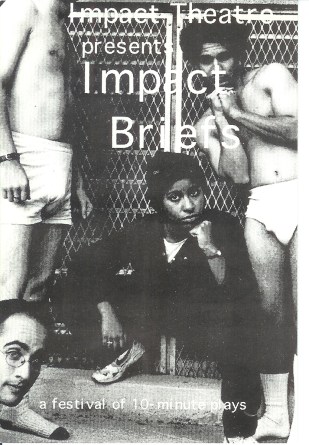
One of our earliest flyers. This was 1997. Pictured are the people who wrote and directed the short plays, since that’s who we had on hand. L to R: Charlie Marenghi, Alex Pearlstein, Tonia Sutherland, and Christopher Morrison.

I’m deeply grateful for all the love and support given us over the years by our artists and audiences, local critics, and theatremakers and writers nationwide. Impact’s mission was always one of service. Our mission was to provide early-career actors, writers, directors, designers, and tech professional opportunities while producing work that spoke to a younger generation of theatregoers– early-career audience, if you will. We felt that mission was underrepresented in the theatre community, so we set out to change that. Watching our artists grow– both in-house and as they moved on to bigger things– has been one of the most satisfying aspects of my life. Right this moment, there are artists who came through Impact working Off Broadway and at OSF, and, of course, in TV and film, whose voracious appetites for playwrights support emerging writers with regular salaries, a development I never could have predicted when we began this company in 1996. I know one day someone who came through Impact will be accepting that Tony, Oscar, or Pulitzer.

disassembly.2011

Andrea Snow and Marissa Keltie in Disassembly, one of the six Steve Yockey plays (5 of which were world premieres) Impact produced, including the short play he wrote for Bread and Circuses, which he also curated. The first, Cartoon!, introduced his work to the Bay Area. Steve Yockey is the one who came up with the name “Bitter Gertrude” for this blog. I will always be grateful for his trust in us and his friendship. Plus he introduced me to Bitch Pudding. Steve’s plays are now done all over the country, and he writes for HBO’s The Brink. (Photo by Cheshire Isaacs, production directed by Desdemona Chiang)


If I had a coat of arms, it would be a pair of hands giving someone a boost-up. My only regret is that I couldn’t help more artists. Thank you for trusting us with your talent, your time, your attention, and your work. I love you all, you magnificent bastards.

titusproduction-5846

Reggie D. White and Anna Ishida in Titus Andronicus, 2012, directed by me. Photo by Cheshire Isaacs.

odam-prod-0152

Jonathon Brooks as the character Jason portraying Kester the Younger, his D&D character, in Cameron McNary’s Of Dice and Men, 2011. When Of Dice and Men premiered at PAX, I was immediately contacted by a bunch of people asking me, excitedly, “Did you know there’s a D&D play?!” Evidently I was the leading nerd AD in the US at the time. I found Cameron, asked for the script, and knew within twenty minutes I had to produce and direct it. Cameron is yet another good friend I made working with this company.

macb

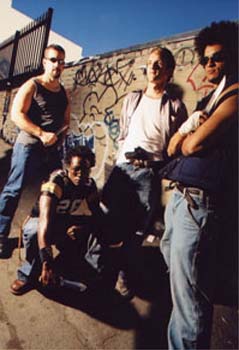
One of our PR shots for Macbeth, 2003, directed by me. Second from the left is Skyler Cooper (as Lenox), who would go on to play Othello in our lesbian Othello (picture below). Next to Skyler is Pete Caslavka (as Macbeth), a key member of my company for many years, now living in LA. I still miss him so much. Next to Pete is Casey Jackson (as Banquo), who would go on to play Iago in that same Othello. Photo by Kevin Berne in the alley behind our theatre. Skyler brought with her to this shoot the most beautiful woman any of us had ever seen in person. This was our introduction to Skyler’s power over women. They would show up at the theatre, dropping off gifts (like hand-dipped chocolate-covered strawberries for the cast) and cards, seeing if Skyler was there yet. I’ve never seen anything like it before or since. She’s also an amazing actor and a wonderful, big-hearted human. You may have seen her on RuPaul’s Drag Race in 2011.

0853-color

Marissa Keltie as Desdemona and Skyler Cooper as Othello. Photo by Cheshire Isaacs, 2005.

js3-8598

Prince Gomolvilas and Brandon Patton in one of the three incarnations we produced of their amazing show, Jukebox Stories. I adored all three of these shows. One day I’ll have to find a way to produce another one.

WHAT COMES NEXT

Impact 2.0 will exist online. Impact’s mission has always been one of service, so we’re discussing ways we can continue to be of service to the theatre community. We’re looking at providing profiles of artists and writers whose work we recommend, articles with advice for emerging artists, articles from varied and diverse perspectives in theatre, reviews of local indie shows, resources for teachers, and more. Nothing’s set in stone, but the new Impact will likely cover at least some of that. Our annual season planning retreat is MLK weekend, so we’ll be planning a new Impact for you then. Stay tuned. And again: THANK YOU.

howto1

Pete Caslavka in The How-To Show, a collection of shorts directed by Alyssa Bostwick, 2006.

t&c.fb.poster

Cheshire Isaacs created so many incredible posters for us. I’m partial to this one, because the actor on it is the Spawn of Gertrude– my youngest, Jonah, as Antenor, 2013. Jonah had tech instead of a 15th birthday party. We had cake and then got back to work. “Now you’re a real theatre professional. We don’t have birthdays– we have tech.”

ccc-poster1

One of several poster images Cheshire designed for Impact that became the cover of the published version. (We did the west coast premiere of Lauren Yee’s Ching Chong Chinaman, directed by Desdemona Chiang, in 2008.) Cheshire’s graphic design and production photography are the best in the nation. You can hire him for freelance work for your company by checking out Cheshiredave Creative at cheshiredave.com.

Hamlet2

Hamlet, 2006. The only Impact show I was ever in. L to R, Patrick Alparone as Hamlet, Cole Alexander Smith as Claudius, and yours truly as Gertrude. I was usually very ahem “hands on” in PR shots for our shows, but I obviously couldn’t be for this one. I couldn’t see what was going on, and my back hurt like fire trying to hold that position. Desdemona Chiang was my Assistant Director, and she kept stepping in to push my shoulder back to maintain that twist. Cheshire Isaacs was the photographer, and he later said that I complained more during this than anyone he’d ever shot apart from Olympia Dukakis. GOALS.

ayliproduction-1191

Stacz Sadowski as Charles the wrestler and Miyaka Cochrane as Orlando in As You Like It, 2013. Directed by me, photo by Cheshire Isaacs, fights by Dave Maier. Dave and I tend to exacerbate each other when we work together. Our stage combat work has been so, so much fun. Miyaka became a core member of Impact during this show. It was only three years ago, but it seems like he’s always been with us. You can see him in the upcoming Comedy of Errors.

Toil.3

Mike Delaney as Adam in the world premiere of Lauren Gunderson’s Toil and Trouble, 2012, directed by Josh Costello. Mike has been a key member of Impact for years, as well as (with Sarah Coykendall) half of the mad genius behind the half-filmed, half-staged cult classics The Sadist, Eegah!, and the upcoming Plan 9 from Outer Space, the last show of our 20th season, and our last show as a regularly producing company. Photo by Cheshire Isaacs.

bcproduction-lr-8004

Maria Giere Marquis as Zombie Marlene Dietrich in JC Lee’s “The Reanimation of Marlene Dietrich,” one of the short plays in Bread and Circuses, directed by Desdemona Chiang. Maria has been a core company member for years whose rock-solid brilliance in both comedy and drama has been recognized by critics all over the Bay Area. Maria will be in our upcoming Looney Tunes Comedy of Errors. JC Lee is now co-producing How to Get Away with Murder. Des Chiang is currently directing Nick Payne’s Constellations at Seattle Rep, then going on to direct Impact alum Cindy Im in The Winter’s Tale at OSF. Photo by Cheshire Isaacs.

twelfth.feste

Cindy Im as Feste in Twelfth Night, directed by me in 2010. Maria Giere Marquis as Viola and Seth Thygesen as Orsino in the background. Photo by Cheshire Isaacs.

Dragon

George Sellner and Sarah Coykendall in a PR shot for The Dragon Play, 2015, that introduced the work of Jenny Connell Davis to the Bay Area. Sarah has been a core company member for years. I can’t imagine what we would have done without her immense talents as a stage manager, designer, and actor.

Latina2

Carlye Pollack and Marilet Martinez in the world premiere of Learn to be Latina by Enrique Urueta, 2010. Marilet is a company member whose excellent work in comedy, drama, and stage combat is highly sought after all over the Bay Area. Photo by Cheshire Isaacs.

chalk.boy2.2011

One of my favorite Impact production shots. Chris Quintos in The Chalk Boy by Joshua Conkel, photo by Cheshire Isaacs, 2011.

odam

One of my favorite Impact poster images. My husband painted the mini to look like the actor playing our paladin, Jonathon Brooks. He painted minis for each member of the cast. Photo and design by Cheshire Isaacs.

r3portraits-2359

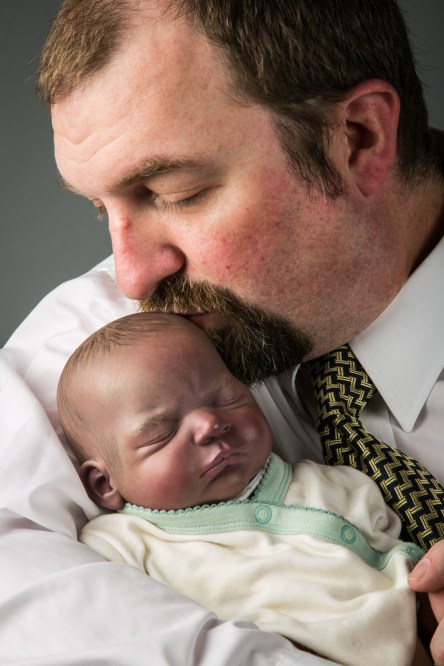
This was a picture Cheshire took to be used as a framed photo on the set of Richard III. Jon Nagel (my husband, an Impact actor and tech since 2003) as King Edward IV and Tamaaron Ishida-White as the little prince. Tamaaron is a reborn doll we bought to be used as the baby prop in Titus Andronicus. The actor playing Aaron, Reggie D. White, named the prop after its in-show parents (Tamora and Aaron) and the actors playing those roles (Anna Ishida and himself). The name stuck. Tamaaron has been one of the hardest-working babies in show business, going on to appear as the baby in the world premiere of Lauren Yee’s Crevice, as the infant Astyanax in Troilus and Cressida and as pretty much every baby we’ve ever needed.

jon.Ariel

This is a quick snapshot my husband, Jon Nagel, took of himself and Ariel Irula during an early rehearsal for Bekah Brunstetter’s The Oregon Trail, (directed by Ariel Craft) the play that introduced Bekah’s work to the Bay Area, 2015. For some reason, he’s wearing his show hat and she’s wearing her normal hijab. Ariel played my husband’s younger daughter. She’s more than a foot shorter than he is, so he’s either scrooching down or she’s on a box. Because she’s so tiny, we called her “pocket daughter” through the whole thing. I still do, tbh. Ariel is a young actor I believe in with all my heart. I would have loved to have made her a company member. Cast her in everything, you guys.


Tagged , , , , ,

Fellow Jews: Are We Going to Let Innocent People Go Through What We Went Through?

Thousands Of Syrian Refugees Seek Shelter In Makeshift Camps In Jordan

Syrian refugees in Zaatari refugee camp, Jordan, in February. (Photo by Jeff J Mitchell/Getty Images)

I’ve been in tech this week, so I’m behind on the news, and this will be a short one. It certainly won’t take long to say what needs to be said here.

Ahem.

As a Jew, I firmly denounce the stigmatization of Syrian refugees, along with all the GOP proposals for surveillance of Muslims, including a national database and closure of mosques. Fellow Jews, if you are not loudly and firmly denouncing this as well, I am ashamed of you.

Hudea_3252752b

A four-year-old girl named Hudea mistakes photojournalist Osman Sagirli’s telephoto lens for a gun and surrenders to him at the Otmeh refugee camp in Syria last December.

A national database? You know where registering people for being part of an ethnic group leads, right? And even if you don’t believe it could happen in America, you and I know what that kind of registration was used for even before the camps. You don’t know? You don’t remember? Talk to your grandmother. Pick up a book.

Kindertransport-Memor_Horo-965x543

The identity card of Herbert Levy, marked “J” for “Jude” (Jew). Levy was brought to England through the Kindertransport program in 1939. Activists successfully lobbied Britain to loosen immigration restrictions to allow 10,000 Jewish children– but children only– into the UK, taken in by foster families. Most never saw their parents again. (Photo: AP Photo/Kirsty Wigglesworth)

Proposing the closure of mosques should scare the living daylights out of you. For one thing, we have this little document called the US CONSTITUTION, and are we truly going to allow our hate, fear, and racism enable us to shred it? Are we going to mistreat our citizens? Or people looking for our legendary Land of Opportunity? The “opportunity” for what, virulent racism?

three-boys_sm

Three Japanese American boys stand at the perimeter fence at the Manzanar internment camp near Independence, California in this iconic photo by Toyo Miyatake. Japanese Americans were forced to live in internment camps 1942 – 1945. (Source: blog.janm.org, courtesy Alan Miyatake)


Probably the most heartbreaking, however, is the heartless turning away of refugees. It’s no surprise to me that there are so many conservative American Christians shrieking “No room at the inn” and slamming the door against Syrian refugees. They did the same to us. This was expected. But you and I? Our families? Not one of us, not one, should refuse these people a place AT OUR TABLES, let alone in our country. We know better.

jewishrefugees

These Jewish refugees from Nazi Germany fled to the US aboard the “St. Louis” and were forced to return to Europe after both Cuba and the US denied them entrance. 1939. Look at the hope in their faces. They believed they were safe. They believed they were among the lucky. How many of the children in this picture survived after we turned them away? (Source: ushmm.org)

Radical right-wing white men are the most dangerous terrorists in the US today (also see this and this). If you’re in favor of refusing Muslim refugees escaping extremist violence, if you’re in favor of (unconstitutionally) curtailing the rights of American Muslims, but you’re not in favor of tracking and/or limiting the rights of American far-right extremists, you’re not trying to protect America from terrorist attacks. You’re just a racist.

lesbos

A Syrian child sleeps in his father’s arms after arriving on a dinghy from the Turkish coast to the Greek island of Lesbos in October. (Photo: Muhammed Muheison/AP)


UNI177414

Syrian refugees struggled to keep warm during the snowstorms that hit the Middle East last February. Too many died of hypothermia. This was taken at a refugee camp in Lebanon. (source: UNICEF)

We’re talking 10,000 Syrian refugees here. That wouldn’t even sell out Madison Square Garden. You’re willing to shitcan everything America stands for because you’re afraid of a group of victimized innocents that number fewer than 1/50th of the people who saw the last Rush concert tour?

American Jews, please join me in denouncing, loudly and vociferously, the terrifying, all-too-recognizable treatment of Syrian refugees seeking shelter here, as well as our fellow Americans who happen to be Muslim. Join me in lifting the lamp beside the golden door, even if we have to wrench it from the hands of the racists seeking to hide it from them.

American Muslim Pride

(photo: Joel Gordon)

(NOTE: This is my personal blog, not CNN. While I approve all respectfully dissenting comments, I am under no obligation to approve comments I deem racist, disrespectful, derailing, or trollish. If you want to blame “the Jews” for government actions in nations to which most of us have never been, or “the Muslims” for criminal actions most of them have roundly condemned and in which many innocent Muslims have perished, I advise you to pick up your racism and move along. It truly pains me to have to include this, but bitter experience has taught me well.)


Tagged , ,

The Real Story of Clarion and Lloyd Suh

I don’t have any insider information. But I’ve been both teaching theatre in the university system and producing professional theatre for over 20 years, and I’m sick of the articles being written about this that have no understanding of what we do or how we do it.

Marilouise Michel of Clarion University wanted to produce Lloyd Suh’s Jesus in India, but never completed the licensing agreement, or responded to the agent when asked about casting. Michel cast with all white actors, including the roles written for East Indian actors. The rights, having never been granted, were denied.

Here’s what happened: In January, Clarion asks for a copy of the play. In May, they inform Lloyd they’re adapting it into a musical. For those of you unfamiliar with IP copyright, this is illegal if done without author permission. Lloyd generously tells Clarion that’s fine if it’s just a classroom exercise, but he (obviously) has questions if it’s for public performance. The director never responds. Meanwhile, she’s begun negotiations with the agent, who has asked her about casting. The director does the paperwork required for the university to disburse a check to the agency, but never completes the actual rights negotiations or licensing agreement. On October 30, five months after Lloyd asked about the musical adaptation, the director emails Lloyd asking if he would be able to skype with the actors who are currently in rehearsals. Lloyd, thinking WTF? heads over to google and sees that the production (still without the legal permission to adapt or even perform the work) has been cast with all white actors. He emails his agent. The agent emails the director. The director says LOL, we couldn’t cast it any other way, and I forgot you even asked. Lloyd discovers from his agent that the licensing agreement was never completed. He clearly restates what the agent was (obviously) trying to discuss with the director five months earlier: the Asian characters need to be played by Asians, or the rights will not be granted. The director says no. The rights were not granted.

And the world goes nuts BLAMING LLOYD.

The coverage of this has been enraging, painting Lloyd and his agent (the marvelous and wonderful Beth Blickers) as bullies, when nothing could be further from the truth. Clarion is completely to blame, even if you believe white people should be allowed to play people of color. 

The director maintains the agent never mentioned race in her email. That may very well be true. The email may have said something along the lines of, “Before we release the rights, how do you plan to handle the specialized casting in this play?” or even just “How do you plan to cast the play?” It’s disingenuous to assert that a question like that doesn’t, at the very least, make clear that casting is an important consideration in rights negotiations. I’m willing to bet Michel didn’t complete the licensing agreement because she didn’t want to have to confess to Beth that she had an all-white cast, knowing full well that would be a problem. I’m willing to bet Michel, who had a provisional yes and had already sent the paperwork required for the university to disburse a check, believed she was far enough along in the process that she wouldn’t get caught if she kept her head down.

I have had innumerable conversations with people in education about paying performance rights, rewriting scripts, or violating the playwright’s express instructions, and invariably I’m trying to convince someone that Yes, you WILL get caught, because internet. (I’m of course also discussing Ethics, and IP rights, and OMG are you even kidding me with this?) It’s depressingly common for my fellow educators (and even more so for administrators) to believe they won’t get caught violating contract or performing without rights, so I have no trouble believing that this director believed a little of both.

The people out there howling that Lloyd shouldn’t have cashed the check are spurred by misrepresentative coverage. First of all, Lloyd didn’t even see the check. The agency deposited the check along with every other one they received that day, and would eventually disburse payment to Lloyd for all the shows for which they’d contracted. It’s not at all uncommon to send a check before all the details of an agreement have been finalized. If the agreement isn’t completed for whatever reason, the agent returns the money. Cashing the check is not a tacit way of saying “I would love for you to violate my IP rights and do whatever you like with my play.”

Playwrights, agents, and publishers pull the rights for ALL SORTS of reasons. Beckett’s estate famously won’t allow women to be cast in Waiting for Godot (with some notable exceptions). Tams Witmark once shut down a production of Anything Goes because the company wanted to use a drag queen Reno Sweeney. MTI shut down a Bay Area production of Godspell— with a C&D!!–because the company changed the lyrics. Neil Simon refuses the rights to schools and companies that want to edit out his swear words. Lloyd owns his play. If he wants to refuse rights unless a production agrees to put a full-page elegy to Mr. Jingles the Sock Monkey in the program, he has that right. He sets the rules, just as you set the rules for who uses your property.

Clarion is in the wrong here, period, even if you believe white people should be allowed to play people of color. Which, in 2015, is just nonsense.

I’m sick of the mainstream articles (and posts and comments) wherein the years of activism, resistance, discussion, and progress around casting and diversity in theatre are invisible. Is the director at Clarion misrepresenting the issue deliberately? Or is she really so disconnected from the theatre community that she doesn’t know about these issues? Why are the writers of these articles so ignorant of the years of discussion, the hundreds of articles, and the massive national controversies around casting and diversity in theatre?

At least 95% of the available roles in any given season are open to white people. It’s embarrassing to watch white people throw a tantrum over the remaining 5%. We’re not entitled to everything just because we want it. I’ve written repeatedly about the many reasons non-white characters should be played by non-white people (search “diversity” if you’re interested). Many writers far better than myself have written about this issue repeatedly. In brief:

  1. History. Theatre, film, and television all have a long history of casting white people as people of color while shutting actors of color out. Those portrayals have almost always been insulting and racist. The historical context has made this issue a sensitive topic for people of color, and rightfully so as they have had to watch themselves portrayed in insulting ways by white people while being shut out of opportunities to play themselves. If you think this is a matter of the past, think again. And again. And again. And again. And again.
  2. Representation. Actors of color are still underrepresented in theatre. Most of the available jobs go to white actors, who are disproportionately represented. White men in particular have always dominated, and continue to dominate, the industry. It’s unethical to push people of color aside to allow even more white people to have even more roles, especially the tiny handful of roles written specifically for people of color. This is also why it’s not at all the same when a person of color plays a role written for a white person. That’s a step toward proportional representation, not “racism against white people.”
  3. Ethics. People of color in the theatre industry have been very clear that the continued use of yellowface, brownface, and blackface, as well as the continual whitewashing of characters, is hurtful to them in multiple ways. White people have three choices and three choices only: “We hear you and we’ll stop,” “We hear you, but we don’t care if it hurts you, so we’ll keep doing it,” “We don’t believe it should hurt you; you are incorrect about your own experience of the world.” The first choice is ethical; the others are not.

So when we discuss issues like the cancellation of Clarion’s production of Jesus in India, let’s focus on the facts. Let’s insist on accurate coverage. Let’s hold each other accountable. And let’s have the self-respect to admit when we’re wrong.

Tagged , , , , , , , , ,

AEA Should Be Making Realistic Choices, and I Wonder If This LA Lawsuit Will Wake Them Up

There’s been an interesting development in the small theatre/AEA controversy in LA. Actors have banded together to sue their own union. 

Part of the complaint is that the union ignored the will of its members when members voted down, by a 2-to-1 margin, AEA’s proposed changes to the 99-and-under code. To be fair, AEA signaled from the start they were going to do exactly that if the LA membership voted against them by telling them before the vote that it was “non-binding.” It doesn’t get clearer than that that a union has no interest in members’ opinions.

A major component of this fight is that LA actors are worried that AEA’s changes will force the LA small theatre scene to go largely nonunion.

Of course the plaintiffs are right. Indie theatre dominates the small theatre scene nationwide since so many places have no showcase, 99 seat, or waiver in place, or very limited ones. LA will just be joining the rest of us who produce indie theatre. I would imagine that LA AEA actors are upset about this because small theatres do the lion’s share of new plays and experimental new work. I’ve seen firsthand that many AEA actors are frustrated that they can’t get in on that. The indie scene is the literal ground floor of the theatre industry, discovering and developing the nation’s new talent. AEA contracts are limited in any market– most of the AEA membership is unemployed in any given week– and they’re usually offered by larger companies doing more traditional, safer, road-tested work, or new work by well-known playwrights. It’s no secret that large companies are risk-averse because they’re reliant on risk-averse subscribers and corporate funders.

It all comes down to funding. A large theatre with a massive overhead, including wages, building costs, and enormous production budgets, must scramble all day, every day to come up with that amount of money. They’re going to be risk-averse in programming so they can attract more subscribers and donors, most of whom come from an older, wealthy, white demographic, as well as corporate funding that doesn’t want to attach its name to controversial content, and very much does want to attach its name to glamour– star writers, star actors. Large theatres have developed relationships with foundations for years, decades even, and those foundations respond by awarding them the vast majority of the available funding. Meanwhile, most small companies are shut out of most funding streams. Companies under 100K a year– many thousands nationwide– are shut out of most grants out of hand, and the hundreds of companies between 100K and 1M are competing for an ever-shrinking slice of the pie.

The numbers are even worse when those theatres are theatres of color (which are underfunded at every level), proving that these funding decisions are not based on merit.

When you allocate the vast majority of funding to the same handful of large theatres year after year, who still must also cater to the tastes of their wealthy white subscriber base and conservative corporate patrons to make budget, it’s going to create a certain landscape. When you insist on defining “small theatre” as companies with a $1M annual budget or less, and then give all the “small theatre” money to those $1M theatres, it’s going to create a certain landscape.

You cannot make enough money in ticket sales for experimental new work to pay AEA wages. Sure, every so often you have a hit, but when you’re producing full seasons, year after year, show after show, you’re just not going to make enough money in ticket sales alone to pay all your bills, let alone union wages. This fact was so obvious to everyone, we created the 501c3 model around it, enabling these theatres to get grants and donations to make up the gap usually filled in other countries by government support. For quite some time, it was possible for small theatres to grow into larger AEA theatres. It was a little golden window of time. And then enough changed (detailing everything that changed about the American economy, funders, and the nonprofit theatre community would be a lengthy post all on its own) to make that growth well-nigh impossible for most small theatres. Some do grow– a few get through the glass ceiling. But for most small companies, growth is simply no longer something you can choose to do. Either you win the funding lottery, or you do not.

We deny most companies– most companies are small companies– the means to pay AEA actors and then refuse those companies waivers, saying they somehow magically “should” be able to pay AEA wages.

OF COURSE most theatres in the country are indie. OF COURSE nonunion actors are the ones getting most world premiere gigs by hot new writers. That’s the financial landscape we’ve created.

Actors in LA decided they would like to continue to have the option to work at small theatres that can’t pay union wages. It’s astonishing that they aren’t allowed that choice, and it’s astonishing that a common response is the demonstrably untrue “denying waivers protects union wages.” Since AEA wages are set by contract, they can’t be impacted by small theatres using waivers or showcase codes. A large theatre can’t suddenly decide to start paying less while they’re under contract. The existence of a waiver agreement at one theatre has as much impact on the existing contract at another theatre as a same sex marriage contract has on an existing heterosexual marriage contract. And when that AEA contract is up for renewal, the theatre can point to the existence of waivers all they want, but AEA isn’t going to agree to lower wages in the renewed contract, nor should they. So it’s just silly to pretend that shutting down waivers “protects” wages. Waiver work impacts no one but the actor doing the work. Either that actor gets to do the show, or they sit at home while a nonunion actor takes the role. AEA has decided that their actors should sit at home, and that this “encourages” theatres to grow.

But they’re wrong. Small theatres can’t be “encouraged” to grow any more than you can “encourage” a drowning person to breathe. We’re throwing out one lifeline per 1000 shipwrecked sailors in the theatre ocean.

Until the financial landscape changes, nothing else will change. Large theatres will be largely risk-averse, and most of the risk, the new writing, the experimentation, will continue to take place in indie theatres who are lucky to be able to scrape together small stipends for their nonunion personnel. Not every artistic risk or exciting experimental work is going to be a big seller, but that kind of work is enormously artistically fulfilling.

AEA has a choice: they can continue to move the country towards a more and more indie scene as they continue to gut waivers and showcase codes, or they can increase showcase codes and waivers for companies that meet strict financial requirements and empower their members to take the gigs now going to nonunion talent.

Either is fine, of course, from a producer’s standpoint. The indie scene doesn’t actually need AEA actors. We’d love to work with our friends, and it would be great to access a larger pool of actors, but it’s not necessary. We build your actors in our factories. We develop the nonunion actors you eventually sign and collect dues from. Your actors come from our theatres; they don’t spring full-formed from the head of Lynne Meadow.

AEA has pretended for years that they’re “encouraging” growth by shutting down waivers, but we all know that’s impossible, especially now, when the funding has been so dramatically tipped away from those small companies. The choices for most of us aren’t go indie or get more money to pay AEA wages. The choices are produce as an indie or stop producing. Most small companies are indie not because we’re horrible people who don’t want to pay actors, but because that’s the one option available to us.

So the real choice AEA faces is: Do you allow your actors access to the indie scene? Or do you work to keep it 100% indie? In LA, actors voted for the former, and AEA essentially told them to shut up and sit down. This lawsuit is the result, and we’ll see how that goes.

Until we change the funding landscape, the indie scene is only going to grow larger. There’s only so much funding for theatre out there, and it creates a finite number of AEA contracts each season at larger theatres. There is no magical untapped funding stream. Any company who gets money is getting a piece of a predetermined pie. Denying waivers will not create more funding. It just creates more indie theatres.

Tagged , , , , , ,

The Problem with the Shakespeare “Translation” Controversy

There has been some fiery controversy around Oregon Shakespeare Festival’s announcement that they’re commissioning “translations” of all 39 Shakespeare plays into “modern English.” It was the rollout that launched a thousand screams of condemnation.

People were either condemning the idea that Shakespeare needed “translating” at all, or condemning the people who were protesting the “translations.” It was either “This is the death of art” or “People against this need to stop being so damn precious,” as if there was no room for mixed feelings or thoughtful discussion. I was a little disappointed in the terms of the discussion being set up as a battleground. I was asked to comment no less than ten times before I had even read the PR myself.

At first, I will admit, I was shocked that OSF would sponsor something that seemed so obviously horrible. Then I read OSF’s PR and realized what the problem was. In the PR, OSF referred to the project as modern language “translations,” and then went on to describe a project that couldn’t be further from that. The PR quotes OSF director of literary development and dramaturgy Lue Morgan Douthit as stating that the texts won’t be line-for-line “translations,” but much more subtle. Douthit is quoted as saying that she used the word because she likes “the rigor that ‘translate’ implies.” I have some skepticism about that quote. Considering that the most famous “Shakespeare translation” is the appallingly bad “No Fear Shakespeare,” the word “translation” in this context implies exactly zero rigor. It was a deeply unfortunate choice.

OSF has instructed its list of playwrights and dramaturgs– all of whom are leading national voices– to first, “do no harm.” Lines that are already clear are to be left intact. But what, exactly, does “clear” mean?

Let’s start with the bad news.

The pilot for this was Kenneth Cavander’s Timon of Athens. In it, Cavander sets the clarity bar incredibly low, and the resulting updates are problematic.

Original:

TIMON: What, are my doors opposed against my passage?
Have I been ever free, and must my house
Be my retentive enemy, my jail?
The place where I have feasted, does it now,
Like all mankind, show me an iron heart? [Arden 3.4.77]

Cavander:

TIMON: What’s this? My doors locked—to shut me in!?
Haven’t I been always open with my friends,
And now my own house turns against me,
Becomes my jail? Does my home, where I have feasted,
Show me, like the rest of mankind, an iron-heart?

Original:

CUPID: Hail to thee, worthy Timon, and to all that of his bounties taste! The five best senses acknowledge thee their patron and come freely to gratulate thy plenteous bosom. There taste, touch, all, pleased from thy table rise, They only now come but to feast thine eyes. [Arden 1.2.121]

Cavander:

CUPID: Hail to you, worthy Timon, and to all who savor the feast he provides…The Five Senses salute their patron, and gratefully honor your unstinting hospitality. I will now present…Taste…Touch…and the rest of them. Please rise, everyone…You have been well fed, so now—a second feast…For your eyes only!

(Source)

While some of the “translated” lines above are stilted and clunky, I’m most concerned with accuracy and clarity. Cavander’s “Does my home, where I have feasted, show me, like the rest of mankind, an iron-heart?” is actually LESS clear than the original. Moving “show me” in the sentence order makes “like the rest of mankind” modify “me.” Now the house is showing an iron heart to Timon and all mankind, rather than the house joining mankind in showing Timon an iron heart. It’s not the only inaccuracy just in these two samples. “Have I been ever free” is rendered as “Haven’t I always been open with my friends,” which is a huge change to the meaning of the line. At the end of the second quote, “They only come now but to feast thine eyes” becomes the inaccurate (and trite) “so now– a second feast. For your eyes only!”

While I’ve only seen a handful of samples, in every one, Cavander’s “translation” is much deeper than it needs to be, discarding words and phrases that are clear on their own, and inserting stilted or inaccurate substitutions. So I respect the alarm some had when they discovered that OSF was commissioning like “translations” of the rest of the works.

Those who had no experience of the Cavander were alarmed by the word “translation” because, up to this point, it primarily meant uniformly awful modern updates like No Fear Shakespeare. No Fear is not only badly written, its “translations” provide a superficial understanding of the lines, and sometimes even inaccurate ones. A few examples: “sighing like furnace” becomes “huffing and puffing like a furnace”; “Bless you, fair shrew” becomes “Hello to you, my little wench”; “Two may keep counsel, putting one away” becomes “Two can conspire to put one away.”

There are excellent reasons to have legitimate concerns about a “translation” project. It’s not about being “precious”; it’s about the deep problems evident in previous “translations.”

But let’s look at the good news.

The Cavander “translation” is troubling, yes, but for the rest of the series (apart from The Tempest, which Cavander is also writing) OSF has commissioned a phenomenal group of writers: Christopher Chen, Sean San Jose, Octavio Solis, Luis Alfaro, Lloyd Suh, Migdalia Cruz, Aditi Kapil, Marcus Gardley, Naomi Iizuka, and Taylor Mac, just to name a few, supported by dramaturgs like Joy Meads, Nakissa Etemad, Julie Felise Dubiner, and Desdemona Chiang. These people are some of the cream of the crop of modern American theatremaking.

Most importantly, they’ve been instructed to leave language that’s clear intact, and I trust them to make good choices about what “clear” means. None of these writers could ever be accused of imagining audiences can’t understand difficult language. I also trust them to know the difference between “poetic” and “stilted,” and I trust those dramaturgs to prevent misreadings of lines that would wind up “translated” incorrectly.

Given the “do no harm” instructive and the focus on clarity, what’s surely happening here is not much different than what we all already do for production. The meanings of some of the words in Shakespeare’s texts have changed so completely in the past 400 years that performing them as is becomes, essentially, vandalism of the author’s intent. If you’re producing As You Like It, you can’t perform a phrase like “the humorous duke” and expect a 2015 American audience to understand that it means “unpredictably moody” and not “funny.” There are literally hundreds of words and phrases whose meanings have changed, and there are even more that are just no longer in use. Some are clear from context, particularly when seen acted on stage (prithee, anon, varlet, belike, wherefore), others, not so much (sack, doubt, shrift, horns, jointure, French slop). There are some words whose definitions are hotly debated (pugging, wappened). When we produce Shakespeare, we all make decisions about which words we leave intact, believing the audience will get the gist in context, and which need to be changed to preserve the meaning of the line. It’s rare to see Shakespeare completely untouched because it’s a foolish way to perform it.

And don’t forget that there’s no one definitive Shakespeare text. Every published edition, and many performance texts, are the result of a series of decisions made by an editor with every past edition, folio, and quarto open on their desks. With no definitive text, absolute purism is indeed just preciousness.

But the problem wasn’t precious purism. The problem with Shakespeare “translation” is not in what these playwrights will actually do– they haven’t even done it yet– but in the word “translation” itself. It’s one hell of a trigger. If OSF had used a less unfortunate, more accurate word, there wouldn’t have been a controversy.

We’ve covered the good and the bad– now it’s time for the ugly.

What if the doomsayers are right, and every one of these plays is as bad as the worst No Fear?

Well, so what?

There are already eleventy splatillion “translations,” adaptations, deconstructions, and the like of these plays. If Macbeth can survive Throne of Blood and Scotland PA, if Romeo and Juliet can survive West Side Story and Romeo Must Die, and if Hamlet can survive Strange Brew and The Lion King, then I think the plays will survive some of the best playwrights and dramaturgs in the country having a whack at deciding what to do about “horns” and “Barbary cock-pigeon.”

And I get that it’s upsetting to a lot of people that OSF, one of the stewards of Shakespeare’s work in the US, seems to be endorsing something you’re imagining as a combination of No Fear and Forbidden Planet, but if someone handed you a gigantic check, told you that it was only for this project, but that you could hire any playwrights and dramaturgs you liked, you would JUMP at the chance. This is EXACTLY what we want one of our flagship American theatres doing– paying artists to art. This is something to be celebrated. If you don’t like the results, well, don’t stage them or go see them. OSF has no plans to stage them either, apart from the developmental readings. Just be glad that these enormously deserving artists landed this fantastic gig.

Personally, I’d be FAR more excited by full adaptations from these writers, engaging with the texts rather than “translating” them, but I wasn’t the one writing the check and telling OSF what to do with it. That honor belongs to Dave Hitz from the Hitz Foundation. Honestly, it’s wonderful that they’re supporting the work of all these artists. I think that should be the main focus here. People you admire– some of them your friends– are getting paid to do what they love. That’s a great thing, whether you love the resulting texts or not. Either way, Shakespeare will be fine.

Tagged , , , , ,

Writers: Retire These Clichés (Version: LADYPARTS)

I know, I know: I write about overused tropes often. (Who said irony is dead?) Maybe one day I’ll compile them all into a self-published e-screed entitled “Melissa Reads Too Many Plays,” but for now, the blog will have to do.

Sometimes a cliché works. You’re engaging with the trope in an interesting way, or you’re commenting on the trope’s ubiquitousness. But most of the time, it’s just lazy writing. You plonk a clichéd trope into the scene because you haven’t given the moment much thought, and a well-worn piece of cultural narrative fits neatly into the scene with little effort. Sometimes the clichéd trope is a cultural narrative about race, gender, or religion that you take as given without examining your unconscious biases. Sometimes you’re more focused on other aspects of the scene. Sometimes you’re just . . . lazy. AS ARE WE ALL.

Feel the wrath of Ytar!

Feel the wrath of Ytar!

I don’t mean you don’t care about your work. I just mean, sometimes we take the easiest way out because the issue doesn’t interest us as much as other things at that moment. Sometimes we don’t even realize that’s what we’re doing.

Today’s edition of “Melissa Reads Too Many Plays” is centered around LADYPARTS. There are approximately eleventy gynillion inaccurate, irritating tropes about women and our MYSTERIOUS LADYBITS.  Here are a few of the most preposterous.

Sarlacc-BTM-DB

Artist’s rendition of a description provided by a male playwright

Nausea and/or vomiting as the first sign a character is pregnant. I AM CALLING A MORATORIUM ON THIS. This trope is so bad it drags down the quality of the rest of the work. First of all, it’s inaccurate. While 75% of pregnant women experience nausea, only 50% will have to endure vomiting. Most importantly, it’s nowhere near the first sign of pregnancy. (For most of us, that honor belongs to sore boobs.) Vomiting is, however, the first outward sign of pregnancy that men have historically noticed because it’s the first outward sign of pregnancy that women cannot hide. In the 20th century, when this trope was popularized in TV and film written almost exclusively by men, few women paraded around the office telling male coworkers about their sore boobs. However, no one can avoid noticing the stenographer rushing out of a meeting to vomit in the trashcan in the hall. Presumably some of those male writers were fathers who knew better (depending on the level of disclosure they were willing to tolerate from their wives about their ladybusiness), but they were never going to get “Ow, my boobs” past the network censors. I’m not saying we should replace the nausea trope with a sore boob trope. I’m saying: Think about the ways you’re hinting at pregnancy. The second a female character of child-bearing age discusses nausea, your entire audience knows she’s pregnant. Is that how you wanted your reveal to go? Every other hint and lead-in after that is a boring time-waster. Your reveal happened the moment she threw up.

Pregnant woman laughing alone with salad. It's like someone left a box of inane tropes in the car and they all melted together.

Pregnant woman laughing alone with salad. It’s like someone left a box of tropes in the car and they all melted together.

Random Unexpected Pregnancy. Why is your character pregnant? Is it because you have a specific reason for her to carry a child? Or is it because you’re out of ideas and you need to create some conflict for the male lead? Are you already calculating how to make this pregnancy magically disappear as soon as the male lead resolves the conflict? If you’re not writing about pregnancy– if the pregnant woman is just an event in your male lead’s life– think about what you’re trying to accomplish with this unexpected pregnancy, and see if you can accomplish it in a more interesting way. Also, once this trope gets started, it often opens up a can of worms of sexist (and boring) tropes– Women can’t tell what’s important and what isn’t (important = male lead’s central narrative, most of which he hides from her; unimportant = helping her install the carseat, a prenatal appointment); women are killjoys (pregnant girlfriend = the death of fun); women are dreamcrushers (pregnant girlfriend demands he stop being an artist and get a job even though he’s on the verge of a breakthrough because women just don’t understand).

Childbirth Starts with Water Breaking and Ends Within Five Minutes. Honestly, just have her give birth off stage. When your water breaks, it generally trickles out, and it NEVER STOPS. Your body keeps replenishing it. Trust the woman who sat on a towel for hours. Only 10% of women start labor with their water breaking, and for those who do, it can be as much as 24-48 hours before labor begins in earnest. If your character’s water breaks, and all hell breaks loose because THE BABY IS COMING!!11!, you’re manufacturing conflict. Average length of labor for a first-rime mother is 6 – 18 hours, not one scene. Why do you want to show the actual childbirth? What narrative motion are you hoping to achieve? Is there a way to accomplish that without using an unrealistic, clichéd trope?

(source: wrathofzombie.wordpress.com)

(source: wrathofzombie.wordpress.com)

Menstruation Turns Women Into Insane Blood Monsters. “I can’t talk to you when you’re like this.” Just . . . no. Extreme mood swings occur in 3-8% of menstruating women. Chocolate cravings are not universal. I’m just going to set your play aside if your male lead comes home with chocolate for his bleeding wife who then screams at him for no discernible reason other than that you wanted to motivate his affair later in the play. This trope is both boring and misogynistic.

 Don't look at me; I just got here

Don’t look at me; I just got here

Fish Jokes. This is exactly the way to get me to delete your play, take a shower, and try to pretend it never happened. I’m honestly astonished that men are still making these jokes in 2015, but evidently, they are. If you’re seeking a way to make a male character seem like an obnoxious idiot trying to hide the fact that he’s a virgin, I can see using this trope, but I still hate it, and I am not alone. Begone, trope.

Women’s Sexuality is Mysterious and Confusing. WHAT DO WOMEN WANT?!? I know this sounds crazy, but hear me out: ASK HER. When a male character is flopping around haphazardly trying to please a woman who has almost no lines but who, presumably, just sits there with a vaguely disapproving look on her face, most of the people in your audience are going to get very frustrated very fast. She can communicate, can’t she? Using her as a prop to establish your male character’s adorable awkwardness, sincere cluelessness, or comic lack of skillz is a trope I never want to see again. Women’s sexuality is not a puzzle for men to solve. Women’s sexuality is not a comment on male sexuality. Women are, believe it or not, people.

If the playwright would give me some lines, I could tell Roger there's no need to go to all that . . . oh, no, not the full body latex. JUST ONE LINE, I BEG YOU (source: times.co.uk)

If the playwright would give me some lines, I could tell Roger there’s no need to go to all that . . . oh, no, not the full body latex. JUST ONE LINE, I BEG YOU (source: times.co.uk)

The advice is the same for all of these: Think about what, specifically, you’re trying to achieve with these tropes and then work to achieve them in a more interesting way.

octaviabutler.writing

Tagged , , , ,