Tag Archives: feminism

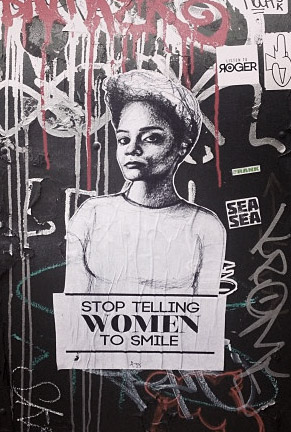
No, I Will Not Smile

Art by Tatyana Fazlalizadeh. More of her awesome work at: http://www.tlynnfaz.com

Art by Tatyana Fazlalizadeh. More of her awesome work at: http://www.tlynnfaz.com

So lots and lots of people who are cooler than I am have written about street harassment. Whenever I post about street harassment on facebook, I get dogpiled with comments– always from men– defending the behavior, or saying things like (and I quote):

“You should take it as a compliment!”

“That doesn’t happen in [city name].”

“That never happens in [type of place, such as subway, mall, universities].”

“I’ve never seen that happen.”

“Only men of certain ethnicities do that.”

“How else are we supposed to meet women? Give us a break!”

…….and the like. I have been told by men, in no uncertain terms, just how wrong I am every single time I’ve ever spoken up about this issue. Every. Single. Time. I see you, men who are limbering up your fingers to tell me I’m just a dumb girl, or a feminazi, or that I just don’t understand, or that I’ve made the entire issue up because duh women do that all the time. Hold up. Read the rest of the article, click on the hyperlinks and read those, and if you still feel like telling me what an asshat I am, I promise you I will read your comment with a serious look on my face THROUGH THE WHOLE THING.
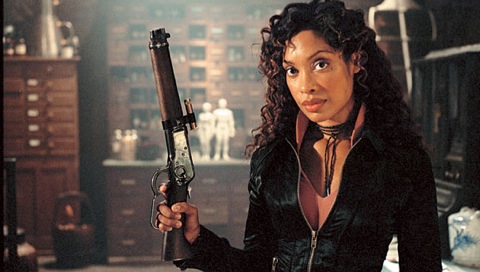
This is what my serious face looks like . . . IN MY IMAGINATION. And please stop telling me I'm Simon, not Zoe. I ALREADY KNOW.

This is what my serious face looks like . . . IN MY IMAGINATION. And please stop telling me I’m Simon, not Zoe. I ALREADY KNOW.

The small area of the Street Harassment Monster I want to tackle right now is the, “Smile, baby! Why don’t you smile? You’d look so much prettier with a smile on your face.”

If you are approaching a stranger with any variation of the above, you are behaving like the human embodiment of painful rectal itch. Here’s why.

Accosting strangers on the street is uncool. In addition to being fucking annoying, it makes women feel unsafe. We have no way of knowing what you’re going to do. I was pushed, HARD, to the ground, at an ATM because I refused to acknowledge a strange guy who was demanding that I smile at him. If our responses to your demands for attention are not to your liking, many of you immediately escalate the encounter to verbal or even physical abuse. We have no way of knowing whether you’re just going to walk away or whether you’re going to follow us down the street yelling, “Fuck you, you stuck-up bitch. Who do you think you are, fat bitch? Don’t you ignore me, bitch,” grab us by the arm, pin us up against a wall, or surround us with jeering companions who threaten to rape us. WE DON’T KNOW WHAT YOU WILL DO. It’s scary. Stop it.

Is it unfair that you, who believe you are a Nice Guy, have to curtail your behavior because other men are behaving like worthless chumpbuckets? Maybe, maybe not, but it’s MUCH more unfair that you’re forcing a woman into an interaction that she knows has a very real chance of ending in verbal or physical abuse.

You have no idea why she’s not smiling. Did she just get the news of a death in her family? Lose her job? Is she having painful menstrual cramps? Did she just kill a strange man who harassed her on the street and is worried about doing it again now that she’s tasted blood? Demanding that a woman construct a cheerful look on her face simply because you demand it is to ignore the fact that she is a person with a life, just like you are. You know NOTHING about that life, and therefore, you know NOTHING about her emotional state. Back off. Actually, back off and read this.

You are not entitled to cheerful interactions with women on demand. Why do you think it’s OK to make random demands of women on the street? You are not our toddlers. Do not demand juice boxes, smiles, or attention from women you do not know. This is what toddlers do. This is why mothers are exhausted: constant demands for attention. Before you demand that the woman you see walking towards you (or are following, ew) force a smile on her face, remember that you are the third man who has demanded her attention in the last 20 minutes. She just wants to walk down the damn street. If she wanted a toddler, she’d have one. If she has a toddler and you harass her with “Smile for me! Don’t forget to smile!” she is now, thanks to Olympia Snowe and her outgoing gift to American women everywhere, The American Patriot Mothers for American Patriotic Heritage Act,  legally entitled to give you a roundhouse kick to the temple.

No, your attention is not flattering. I’m just going to leave this here in case you’re wondering what women think of your commentary and/or demands.
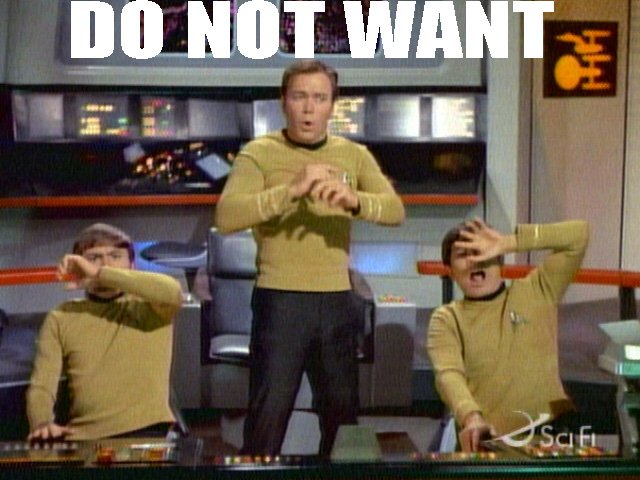
do_not_want2

If you think this behavior is OK, remember that there are quite literally millions of men all over the world who agree with you, and many of them will start harassing your daughter once she hits middle school. They harass your wife. They harass your little sister.

All we’re asking is that you remember that women are people. All we’re asking is that you treat women on the street with the same respect you’d treat your daughter, your mother, or a heavily armed level 20 dwarf fighter.

Did I just hear you demand that I smile? I will smile over your bloody corpse, human.

Did I just hear you demand that I smile? I will smile over your bloody corpse, human.

Tagged , , ,

Skinny White Girls are Exhausting My Eyes

I have nothing against skinny white girls. I really, really do not. I know and love many of them. I cast them all the time, which is not surprising, since the nonunion acting pool anywhere in the US is made up of something like 65% skinny white girls. And even lumping them all together in one group is needlessly reductive– they are as varied as any other group of humans.

But but but.

My eyes are exhausted from looking at skinny white girls and ONLY skinny white girls.

In nearly every representational context, “female” = “skinny white girls.” We, as a culture, are forcing the female experience, in all its variety, to be almost ALWAYS represented by and contained within the body of a skinny white girl. Skinny white girls are not seen as particular; they are seen as general, as “the female.”

In our culture, we posit the stories of straight able-bodied white people, especially of straight able-bodied white men, as universal, and the stories of everyone else as marked by difference. A romantic comedy starring a straight, white, able-bodied couple is just a romcom; but change any one of those characteristics and it becomes a genre film: a Black film, a gay film, a disability “issue” film. You wouldn’t need to change a single word of dialogue to change the perception of the film– just the casting.

What is considered “universal” in representational media is actually reflective of a particular experience– the experience of privilege, usually straight white able-bodied male privilege. Those of us who do not share that experience are always expected to translate– to find and relate to the humanity within the experiences of people unlike us. But those privileged people are rarely expected to do the opposite. Men are rarely expected to relate to plays or films about women, but women are ALWAYS expected to relate to plays or films about men. A film centered around the story of a white man is just a film culturally positioned with the expectation that all will enjoy it in its universality, but a film centered around the story of a Black woman is culturally positioned with the expectation that only Black women will relate to it.

This is a potent issue resulting in a paucity of variation in the portrayal of women. In American mainstream film, TV, and, unfortunately, theatre, what’s positioned as a “normal” and “universal” portrayal of a woman is skinny and white.  All women everywhere are expected to see ourselves, find our humanity, and relate our experiences to the experiences of skinny white girls, most of whom (let’s be realistic) are under the age of 40. AND WE DO. We do it all the time. We do it so well we don’t even think about it most of the time.

I didn’t even realize how exhausted I was by this until I started going to shows at African American Shakespeare Company. As I was watching Merry Wives of Windsor, it slowly dawned on me that I had a level of buy-in to the three lead female characters in the show that I hadn’t had in quite some time. I found myself wondering why. Was it the fantastic acting? Well, sure, but I see fantastic acting all the time. Was it the solid directing or the midcentury costumes (I’m such a sucker for vintage)? I turned it over and over in my mind. And then I realized: Because the three lead women were not all skinny white girls, I felt a level of comfort with them and, by extension, with the narrative, that I hadn’t experienced in a long time. By seeing women who were outside the circle of mainstream privilege, even though they were outside it in a different (and, I would say, more deeply meaningful) way than I am, I felt . . . welcomed. I felt like I could relax. I felt like there was a level of implied judgment that was left outside.

So what does this mean? I’m not saying we should stop casting skinny white girls. Of course not. They’re talented, wonderful human beings who deserve roles and love and cupcakes and all the good things in life, just like anyone else. But clearly we need to step away from the formula “normal = skinny and white.”

I think we all, as a culture, need to look at the ways in which we portray women. While we always portray men in specific ways (the attorney, the action hero, the troubled scoundrel, the cop, the bad guy), we all too often portray women in generalized ways (“the woman”) connected only to their relationship with the men, or to the male-driven narrative. When we step out of that, we fear scaring away potential audience by stepping outside of the “universal” when we step outside the portrayal of privilege.

If you’re a skinny white woman, or a white man, you represent an ever-shrinking segment of the population, but the bulk of representational media still posits you as “normal” and everyone outside of you as marked by difference– the further the difference, the deeper the marking.

Here’s what you can do– here’s what we ALL can do– to have the greatest impact on creating real diversity in our representational media.

If you ever find yourself thinking, “That play/film/show/book isn’t for me,” STOP YOURSELF and ask yourself why you think that. Is it because it has a central female character? A central non-white female character? What is it about her experience or humanity that you find so foreign to your own human experience you feel like her story ISN’T EVEN POSSIBLE TO UNDERSTAND? Yes, you will need to do some work to find YOUR humanity in HER story, but I promise you that you can do it, because SHE does it for YOUR stories every day of her life.

I have heard, dozens and dozens of times, smart, educated, awesome men say about plays with female-driven narratives, “I think this play is well-written, but I don’t get it.” They see the difference and stop there, because they’ve never learned to translate. They’ve never had to.

This is a learned skill. You have to TRY to do it if you don’t already know how. It has to be a conscious choice to step over your privilege and learn to translate the experiences of people who do not share your privilege, finding your own humanity within them. Will you understand every nuance? Of course not. I don’t understand every nuance of every play about the male experience. I’ve never been a closeted boy on a chicken farm, I’ve never been kicked in the balls, I’ve never been on a professional sports team. BUT NEITHER HAVE YOU. Well, maybe the balls part (sorry, that must have sucked), but certainly not the other two. Yet, because the protagonists of Joshua Conkel‘s MilkMilkLemonade and Richard Greenberg’s Take Me Out (both wonderful plays) are male, I’ve seen men relate to those characters and effortlessly see their own humanity in them, even while claiming not to understand plays with female central characters whose stories more closely match their own experience.

I firmly believe that being able to have a theatre community that  stages work with female protagonists– or, hell, even with female supporting characters– who are as diverse in as many ways as women actually are RELIES on having translation buy-in from the resistant members of our potential audiences AND from the resistant members of our own community– two groups, by the way, with significant overlap.

Skinny white girls are cast in almost all our female roles, and have become associated with “normal woman,” because our culture equates whiteness and thinness with beauty (an extremely problematic notion in and of itself), and the body of the actress is there to be looked at– the actress is all too often there to be “the female” in a man’s story rather than there to inhabit a particular story about a particular woman. We can change this in two ways: by expanding the concept of desirable beauty to include more types of women (good) and (even better) we can stop positioning women all the damn time as “desired object,” start staging work that features stories about different kinds of women, and stop pretending that any play that doesn’t conform to “normal woman = skinny white girl as object of desire” is some kind of crazy deviation from the norm.

In order to do this, to achieve diversity, especially a realistic diversity of women on our stages, those who are unused to translating must make a commitment to learn how to translate the experiences of others unlike themselves and see their own humanity therein. But this must be a conscious CHOICE and an ongoing process, or it’s not going to happen.

I know this is not only possible, but happening right now, because I see it myself. Not every white guy is mystified by translation. We’re in a cultural moment where everything is shifting, and our kids are growing up in a world that values diversity in ways never before seen in the history of the world. This is an achievable goal. But we must consciously CHOOSE to achieve it.

Once that choice is made, we’ll start to see more work wherein women aren’t there as decorative objects and events in the lives of men, and we’ll start to see more women on our stages who do not conform to mainstream images of beauty, because their primary function will be telling a story, a story the entire audience will be able to relate to, empathize with, see themselves in because they have chosen to. Our stages will still have room for skinny white girls, but they will also have room for every other kind of woman, and, for that matter, every other kind of man.

We just have to all make the choice, together, to see the humanity in others.

Tagged , , , , ,

Hey, Screenwriters and Playwrights: Create Better Characters

Image

I’ve been teaching at a film school for over five years now, and working with filmmakers has been an eye-opener. I’ve learned a lot, and I hope I’ve helped some filmmakers along the way.

One thing I think screenwriters and playwrights share is the need to create compelling, honest characters, and yet it’s one of the most common areas in which I see scripts fall flat. This can be a real struggle for early career writers.

So: Are your characters boring? Oh, don’t give me that look. You know what I mean. Bland, flavorless characters; characters whose predictability could be spotted by a nine-year-old; characters that are carbon copies of archetypal characters of the past.  They are all too common.

How are memorable, believable, intriguing characters made? While there’s no one right way, I can give you some pointers to help you, early career playwright or screenwriter, find your own process.

1. Imagine your characters as personalities, not as a collection of visuals.

This one is a particular issue for filmmakers. Filmmakers tend to be visual people, and I often see scripts that approach a character from the outside, and stop there. The writer knows what she wants the scene to look like, but hasn’t thought any more deeply about it than that. When you think about your characters, think in more detail about personality traits. Who is this character? Why does he do what he does? What does he want? Which leads me to:

2. Think of your characters as real people with needs and desires.

I often see characters that are treated as nothing but events in the life of the main character. Imagine your characters as real people with goals, hopes, dreams, fears. What does this person want? What does she want from the other character(s) in the scene? What is her opinion about the other character(s) in the scene, what’s happening around them, what might happen, etc? I see this particular “event-in-the-life” type of sloppy writing shine out in its fullest glory when people write women and people of color.

3. Write better women and people of color.

The amount of stereotypical, flat, and unrealistic women and people of color in film and theatre could, if turned into gold, buy every man, woman, and child who ever lived a copy of the latest version of Final Draft. It’s depressing. Even more depressing is the fact that this isn’t the sole province of white male writers. When writing supporting characters that are women or people of color, treat these characters as real people with stories of their own—feelings, opinions, needs, desires—and not just an event in the life of the main character. And here’s a thought: consider writing more pieces with a woman or a person of color AS the main character. I see much more diversity in main characters in theatre than in film, but we could use much more in both. (More stories from more diverse perspectives, please, with extra awesome.) BTW: One more hooker/call girl character and I will scream. Despite what you see in film, 57% of all women between the ages of 18 and 30 are not hookers. Crazy, right? I KNOW. Additionally, I could easily write a 1000-word blog post just about stereotypical writing for people of color. Be better.

4. People are never generic, always specific.

So stop creating generic characters. Stop throwing generic characters into scenes just to advance the narrative and start thinking of characters as essential parts of the equation of storytelling. I promise you that you can, with a little more thought, advance your narrative just as well—actually, better—with an interesting bartender as easily as a generic “bartender.” What’s more, an interesting, complex character can take your narrative in unexpected directions. Allow your characters to be specific people and see where that takes you.

5. The stronger your antagonist, the stronger your protagonist.

This one is more germane to screenwriting than playwriting, but this basic piece of advice should apply to all characters you create, whether they fall into the protagonist/antagonist structure or not. Make sure your antagonist isn’t a total screaming douchebag from the get go. It cheapens your protagonist’s eventual victory (or defeat, if that’s where you’re going). Make your antagonist a worthy opponent and the end will be much more satisfying. At the risk of sounding like a pretentious asshole (SPOILER ALERT: too late) take a tip from Shakespeare—all of his villains have some redeeming qualities, and all of his heroes have some flaws. People are complex, and if you want your characters to be believable, they must reflect that. An antagonist who has a point and makes some sense in his opposition to the protagonist will provide a much more satisfying conclusion.

6. Show, don’t tell.

Yes, I know this is the 100th time you’ve heard this, but it’s really true. Your character doesn’t need to offload sixteen lines of exposition in the first scene. Don’t be afraid of a little ambiguity. Allow the actors some room to create believable characters with your text. Real people are sometimes indirect, are mistaken, lie. People seldom come right out and say precisely what they’re thinking. Show us the character, the relationships, the emotional journey. Don’t feel the need to load it all into the lines.

7. Pay attention to “voice.”

Characters who all sound the same are annoyingly common in scripts. Create specific character voices. Observe the people around you—you’ll encounter interesting character voices every day. Individuals have specific vocabularies, speech patterns, and ways of framing and expressing opinions. Build this in tandem with your characters’ personality traits, as they will inform each other.

My last, and most important word of advice: Follow your heart. Tell the story you need to tell in the way you need to tell it. Only you can tell your stories, so honor those stories by crafting the best scripts you can.

Tagged , , , , , ,

A Common Problem I See In Plays By Women Playwrights. It’s Not What You Think.

Image

Will Hand and Jeanette Penley Marker in Impact Theatre’s Toil and Trouble by Lauren Gunderson, a fantastic play by a brilliant woman with a kickass female character. Check out EVERY WORD LAUREN’S EVER WRITTEN because you will not regret it. Photo by Cheshire Isaacs.

My theatre company is in heavy season planning mode, so I’ve recently read dozens of new plays. I’m always reading new plays, but this time of year, I’m reading a lot of plays, all day long. We’re making an effort to find more plays by women playwrights. We get between 300-400 unsolicited submissions each year, as well as submissions from agents and theatre professionals (playwrights, other ADs or LMs). 75% of those plays are by men, without fail. Unsurprisingly, 75% of the plays we’ve done over our 17 seasons have been by men. So we’re making an extra effort to find women playwrights and ask them to submit.

My company does new plays by “emerging” playwrights (I understand the controversy around that term, but this post isn’t about that, so let’s move on), so I’m reading unpublished plays, many (if not most) by early career, relatively inexperienced playwrights. I noticed a trend in the writing style of these early career women writers, a trend that initially confused me.

I’m seeing a significant amount of plays by women with female characters structurally positioned as the central character. However, that female character isn’t driving the narrative– she is, instead, just reactive to whatever the male characters are doing. It’s a woman sitting around wondering what to do about some man in her life, talking to her friends about some man, interacting with some man about his decisions or actions. It’s still a story with a central male character, just told from the woman’s point of view. If it’s a lesbian play, just change that male character to a female character. The structurally central female character is just as reactive.

Here’s the weird part: I ALMOST NEVER SEE PLAYS LIKE THIS FROM MEN. When I get a play by a man, the central character, male or female, almost always drives the narrative and has an active arc.

Ensemble pieces don’t change anything– they work the same way, just in the plural.

So what the effing eff is going on here? I rarely see this from the more experienced, accomplished women playwrights, but it’s shockingly common from early career women writers.

I thought a lot about this, talked about it with friends, got into a lengthy discussion on facebook (of course) about it. Here’s what I think is going on.

Some playwrights, particularly those who are new to it, are drawing heavily from their own lives and are writing central characters that are reflective of themselves. Sometimes they write plays that are about some perceived injustice they suffered (WHY WON’T HE LOVE ME? WHY WILL NO ONE PRODUCE MY PLAYS?) which can put their central character into a reactive position. But the gender difference, I think, can only be explained one way.

As women, we’re taught to be reactive– to pay careful attention to the needs and opinions of others and react immediately to them. Most women become masters of reading body language and gold medalists at empathy. Not all (of course) but most, because we’re taught that being any other way is unacceptable– at home, in the culture, in plays, films, books, TV shows. Men, however, are taught to be active, and are taught that men who aren’t– who are reactive– are not “real men.” We (unfortunately) re-inscribe this into the culture over and over and over.

Being empathetic and reactive aren’t necessarily bad things, but these received narratives of how to “correctly” perform our genders are having an impact on the way some playwrights are writing, and that impact is working against some women playwrights’ ability to tell their stories.

When you structure a play with a central character, you’re writing someone who occupies the same position in your play that you do in your own life, right? Every person is the central character in his or her personal play/film/video game, because your own life is experienced, of necessity, from your point of view. So when a woman sees herself as inhabiting a reactive position in life, she’s likely going to write a central female character as reactive, because that’s how she perceives what living as a woman IS.

When men write central characters– whether that central character is male or female– those characters are almost always reflective of the active position they’re taught to see as “normal.” Men don’t write reactive female central characters because they see an active self-perception as “normal” in general.

This is, obviously, just a guess, but I don’t know how else to explain what I’m seeing, and I’m seeing it over and over.

Plenty of women writers don’t make their central female characters reactive, but I see enough who do to make me think we should be deliberately and consciously teaching women playwrights to CLAIM THEIR OWN STORIES (the way men are taught to do from the cradle by every corner of the culture). Because a reactive central character isn’t as strong or as interesting as an active one, as women develop their voices as playwrights, I see less and less of this in their work. And of course there are some women writers who never do this. But the ones who do need to be taught to value themselves and their stories. BECAUSE THEY ARE VALUABLE.

So let me tell you now, early career women writers: YOUR STORIES ARE INTERESTING. YOUR STORIES ARE IMPORTANT. YOUR EXPERIENCES ARE IMPORTANT. YOU ARE IMPORTANT. You are important to me, to our work, to the theatre community. YOU ARE MORE THAN YOUR REACTIONS TO SOMEONE ELSE. So write that. And send it to me.

(PS to the men out there writing strong, compelling, active roles for women: Thank you. The women actors of the world also thank you. Don’t let anyone tell you that you don’t have the right to write stories for women because you don’t have “authenticity.” Jesus Timberlake Christ, do they really want there to be FEWER roles for women?)

UPDATE May 2015: For a blog post with only 22K hits, this wins the prize for being the most educational for me as a blogger. One of the most important things I learned from this early post is that the kind of people who will call a stranger an “asshole” or “disgusting” in public for something as small as a relatively unknown blog post are the most likely to be reacting to what they imagine is in the piece rather than what is actually there. I learned that the people who legitimately disagree with the ideas discussed in a post are the least likely to use abusive words. I learned that the people who legitimately disagree with the ideas discussed in a post are awesome, always making me reflect and interrogate my point of view. I learned that engaging with hateful people is always already a lost cause. I learned that I will engage with them anyway. I learned that there are dozens of theatremakers across the country who disagree with some of my ideas and with whom I would dearly love to share a pitcher of beer and an evening of lively discussion.

If you’re here for the first time, I would like to invite you to read some of my newer posts. Click around and see a little more of who I am and what I write. While comments for this one piece are now closed, I approve all comments that are not abusive, so feel free to disagree. Maybe one day we’ll get to share that beer and talk about it in person. Whether you like what you see on Bitter Gertrude or not, I genuinely thank you for being here.

Tagged , , ,

Hey, Guess What? If You Think Women Are People, You’re a Feminist

Image

So facebook, amirite? Facebook. It’s a roiling sea of poorly-thought-out opinions, my own included. In the middle of a discussion about women playwrights (blog post coming soon), someone said that she’s not a feminist because women are “different,” and that we are “not equal” to men.

After I found my eyeballs and put them back into their sockets like a Tex Avery cartoon, I wondered if maybe she and I are just defining the term “equal” differently. What is “equal”? And can difference preclude that? Sure, there are ways in which difference can create inequality. Almost every human on the planet is a better athlete than I am. They are better; I am inferior; there is undeniable inequality there.

When we’re talking about gender equality, though, we’re talking about cultural equality and civil rights, where “equal” means “equal under the law” and “of equal worth.” Of course we’re not fully there yet; I know that. In a world where women still make 81 cents when a man in the same position makes a dollar, where 81% of all male faculty in the US are tenure-track or tenured as opposed to a measly 68% of female faculty (fully 32% of female faculty are lecturers– academic temps), where a woman CEO of a major corporation is as rare as the possibility of successfully navigating an asteroid field (NEVER TELL ME THE ODDS), we clearly have yet to achieve cultural equality. And when everyone down at the courthouse barely had a single fuck to give when my husband and I picked up our marriage license, but would have rung the HOMO ALARM had my betrothed been female, we have some progress to make regarding gender under the law. And pause for a moment to remember just how privileged cisgendered women are, despite our struggles.
But we ARE making progress.

I suppose it’s no surprise that a woman whose mother subscribed to Ms Magazine in the 70s and taught her who Gloria Steinem and Angela Davis were before she could walk has no problem proclaiming herself a feminist. The surprise to me is why YOU DON’T, people.

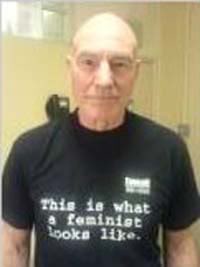
If it's good enough for Captain Picard . . .

If it’s good enough for Captain Picard . . .

Sure, women are different, I guess, in the aggregate. And there are plenty of things about me that conform to the stereotypical woman’s role. I loved being pregnant. I love to bake. I take pride in making seder. I also love to be in charge of shit and, honestly, I’m damn good at it. I don’t usually wear make up, I spend way too much of my free time on the xbox, I swear like 100 sailors, and I would rather listen to five hours of jackhammering than watch fourteen seconds of Sex and the City.

But “different” doesn’t mean “unequal.” When you say “I am a feminist,” what you’re saying is “I believe women should be treated equally, both under the law and culturally: That women should earn as much as men; that women’s stories are as important as men’s; that women should be considered equally for jobs and promotions.”

The tenure thing expressly pisses me off, yes, partly because I’ve been a dramatically underemployed lecturer for eleventy scrotillion years while watching men with less education and experience get tenure, but mostly because the gender breakdown of underpaid, overworked academic temps known as lecturers (who make less than the people working at the campus Starbucks) weighs heavily to WOMEN, while the gender breakdown of the people with tenured positions making twice what we make (to start) weighs heavily to MEN. Bear in mind that women earn 52% of the PhDs awarded each year, corresponding neatly to our percentage of the population. And yet we’re still largely held down into temp positions while the men around us land tenure-track positions in numbers that far outweigh their representation in the population.

But I digress.

YES, women are different than men, sometimes. Maybe most of the time. I’m interested in the neurology about gender. I still find babies miraculous and pregnant women enthralling and special. But women are not BETTER than men, nor are men BETTER than women, and if you think so, it’s a matter of opinion. Also, you are awful.

So what is a “feminist”? I gave it away in the headline, so if you made it this far, I SALUTE YOU. I hope you don’t feel cheated.

“Feminism” is the belief that women are people, and, as people, are as important as men, regardless of any differences, and deserve equal protection under the law. (Recommended reading: The equal protection clause of the 14th Amendment to the US Constitution.)

YOU ARE A FEMINIST. Boom. What? BOOM.

worthyvoice

Tagged , ,