Tag Archives: actors

Why Cold Readings Are Almost Always Useless

My Troilus and Cressida auditions

My Troilus and Cressida auditions

I’ve been steadily working on a post about auditions for directors and producers (what drives actors crazy, what they love, what works, what doesn’t) and I keep getting hung up on specific issues that end up taking on lives of their own. The homogeneity of the women on our stages was the first one, and now this. Eventually I’ll have a post for you (PINKY SWEAR) but I think we all need for it to be less than 38,000 words long, so I’m breaking these larger issues out into posts of their own.

So, cold reads, amirite? They’re almost always completely useless. Let me count the ways.

1. The information a cold read gives you is beside the point. When you hold an audition, especially a callback, you’re attempting to obtain a specific set of answers to a specific set of questions about an actor. Chiefest among them are how the actor makes choices, shapes narrative, engages with scene partners, handles the language, physicalizes choices, and takes direction. You need to know how the actor inhabits the character for which she’s auditioning. You need to see her make emotional and physical choices within that, and make thoughtful adjustments to those choices. You need to see what her style is– does her approach to the material fit with your own well enough to ensure a productive rehearsal process? An actor who has not had adequate time to prepare will be able to show you almost none of that, because that work is complex and takes time– which is why we have a rehearsal process instead of just having actors memorize the script on their own and show up to tech to get their blocking. We expect actors to come into rehearsal prepped, and it’s without a doubt that auditions, as artificial as they are, will provide you with the most accurate information about how your actor will rehearse (and, therefore, perform) if they can replicate as closely as possible the conditions of rehearsal.

A cold read is a completely different experience than either rehearsal or performance in almost all cases. What a cold read shows you is whether an actor can make choices QUICKLY and how adept the actor is at reading aloud. While either of those skills can be useful in some very limited situations (soap opera acting and voice over work spring to mind), they are of limited use in casting your production of, say, Hamlet or Eurydice, where creating a space for the actor to show you her talent, skill, and craft will be of much better use than seeing how good she is at pulling something out of her ass on the spot that will be, of necessity, superficial.

In case you needed any more evidence that cold reading skills are only loosely related (at BEST) to acting skills, I am an EXCELLENT cold reader and LOVE to cold read. Ahem. ‘Nuff said.

OK, I'm not THAT bad.

OK, I’m not THAT bad.

2. An actor who lacks the time to prepare is an actor glued to the script. Of course no one expects an actor to come into callbacks with the sides memorized, but a prepared actor is an actor whose head isn’t constantly buried in his script. If he’s unfamiliar with the lines, the basic narrative of the scene, or the emotional narrative of the character for which he’s auditioning, he’ll be unable to connect with his scene partners as his head will be glued to his script trying to piece together what comes next and what he’s going to do about it. If being able to engage scene partners is an important skill to you (SPOILER ALERT: it is), then you want that kid’s head out of his script as much as possible. Giving him the opportunity to look it over in advance is the way to do that.

3. Dyslexic actors are more common than you think. While many mildly dyslexic actors have found ways to work around a cold read situation, you’d be surprised at how often incredibly talented actors are so severely dyslexic they have to turn down your callback because you can’t be arsed to send sides in advance. When I posted about this on facebook, I was deluged with grateful responses.

“I’m literally crying as I type this. You have no idea how many auditions I have had to turn down because I didn’t want to look like an idiot, stumbling over words, and sounding them out in front of the auditors.”

“Many dyslexics are incredibly expressive and artistic people, which is what makes them such brilliant performers. I am one of these people. Thank you so much for seeing us in a world that often doesn’t.”

“Yes! Thank you. I have this issue so frequently.”

Personally, I learned firsthand how useless cold read auditions were years ago when I worked with an incredibly talented actor who was so severely dyslexic he could not read aloud at all. However, he was almost always the most talented actor in the room. People can succeed if you give them the tools they need to succeed, and all a severely dyslexic person needs is a little time.

If I could just have a few more minutes with the script . . . No?

If I could just have a few more minutes with the script . . . No?

4. When is a cold read audition appropriate? If you’re directing a film or TV show wherein you know the actors will be receiving new pages regularly and will need to be able to prep and perform those pages almost immediately, a cold read audition is a useful tool in addition to an audition that allows for more in-depth work. Similarly, many commercials and music videos require on-the-spot preparation. (Not that you need six hours of rehearsal to prep a 30 second Valtrex ad or the character “Hot Girl Dancing near Lamborghini.”) If you’re directing a play and cold read skills are required as part of the performance, such as an audience engagement piece where the actors perform material the audience has written on the spot, you’ll want information about an actor’s cold reading skills.

"Thank GOD for my RADA training or I'd never be able to get through this"

“Thank GOD for my RADA training or I’d never be able to get through this”

You might be able to get the information you need from a cold reading if you’re not the kind of director who is focused on in-depth work with actors. There are some directors who are more visually-focused, storytelling through visual imagery rather than focused on storytelling through acting and the actors’ emotional narratives, and for those directors, simply seeing an actor talk and move through space may be enough. If you’re not going to do in-depth acting work, there’s no need to see how the actor approaches in-depth acting work, right? So a cold read, which by necessity cannot ever be in-depth, could give you the information you require.

actorprepares


But for the rest of us, the information we get from a cold reading is just beside the point of the information we need to make informed casting choices, and marginalizes severely dyslexic actors (whose numbers are much greater than you think) to boot. So eliminate cold reading auditions unless you really need to test the actor’s cold reading skills specifically. You’ll get better information AND be more inclusive.

Tagged , , , ,

Skinny White Girls are Exhausting My Eyes

I have nothing against skinny white girls. I really, really do not. I know and love many of them. I cast them all the time, which is not surprising, since the nonunion acting pool anywhere in the US is made up of something like 65% skinny white girls. And even lumping them all together in one group is needlessly reductive– they are as varied as any other group of humans.

But but but.

My eyes are exhausted from looking at skinny white girls and ONLY skinny white girls.

In nearly every representational context, “female” = “skinny white girls.” We, as a culture, are forcing the female experience, in all its variety, to be almost ALWAYS represented by and contained within the body of a skinny white girl. Skinny white girls are not seen as particular; they are seen as general, as “the female.”

In our culture, we posit the stories of straight able-bodied white people, especially of straight able-bodied white men, as universal, and the stories of everyone else as marked by difference. A romantic comedy starring a straight, white, able-bodied couple is just a romcom; but change any one of those characteristics and it becomes a genre film: a Black film, a gay film, a disability “issue” film. You wouldn’t need to change a single word of dialogue to change the perception of the film– just the casting.

What is considered “universal” in representational media is actually reflective of a particular experience– the experience of privilege, usually straight white able-bodied male privilege. Those of us who do not share that experience are always expected to translate– to find and relate to the humanity within the experiences of people unlike us. But those privileged people are rarely expected to do the opposite. Men are rarely expected to relate to plays or films about women, but women are ALWAYS expected to relate to plays or films about men. A film centered around the story of a white man is just a film culturally positioned with the expectation that all will enjoy it in its universality, but a film centered around the story of a Black woman is culturally positioned with the expectation that only Black women will relate to it.

This is a potent issue resulting in a paucity of variation in the portrayal of women. In American mainstream film, TV, and, unfortunately, theatre, what’s positioned as a “normal” and “universal” portrayal of a woman is skinny and white.  All women everywhere are expected to see ourselves, find our humanity, and relate our experiences to the experiences of skinny white girls, most of whom (let’s be realistic) are under the age of 40. AND WE DO. We do it all the time. We do it so well we don’t even think about it most of the time.

I didn’t even realize how exhausted I was by this until I started going to shows at African American Shakespeare Company. As I was watching Merry Wives of Windsor, it slowly dawned on me that I had a level of buy-in to the three lead female characters in the show that I hadn’t had in quite some time. I found myself wondering why. Was it the fantastic acting? Well, sure, but I see fantastic acting all the time. Was it the solid directing or the midcentury costumes (I’m such a sucker for vintage)? I turned it over and over in my mind. And then I realized: Because the three lead women were not all skinny white girls, I felt a level of comfort with them and, by extension, with the narrative, that I hadn’t experienced in a long time. By seeing women who were outside the circle of mainstream privilege, even though they were outside it in a different (and, I would say, more deeply meaningful) way than I am, I felt . . . welcomed. I felt like I could relax. I felt like there was a level of implied judgment that was left outside.

So what does this mean? I’m not saying we should stop casting skinny white girls. Of course not. They’re talented, wonderful human beings who deserve roles and love and cupcakes and all the good things in life, just like anyone else. But clearly we need to step away from the formula “normal = skinny and white.”

I think we all, as a culture, need to look at the ways in which we portray women. While we always portray men in specific ways (the attorney, the action hero, the troubled scoundrel, the cop, the bad guy), we all too often portray women in generalized ways (“the woman”) connected only to their relationship with the men, or to the male-driven narrative. When we step out of that, we fear scaring away potential audience by stepping outside of the “universal” when we step outside the portrayal of privilege.

If you’re a skinny white woman, or a white man, you represent an ever-shrinking segment of the population, but the bulk of representational media still posits you as “normal” and everyone outside of you as marked by difference– the further the difference, the deeper the marking.

Here’s what you can do– here’s what we ALL can do– to have the greatest impact on creating real diversity in our representational media.

If you ever find yourself thinking, “That play/film/show/book isn’t for me,” STOP YOURSELF and ask yourself why you think that. Is it because it has a central female character? A central non-white female character? What is it about her experience or humanity that you find so foreign to your own human experience you feel like her story ISN’T EVEN POSSIBLE TO UNDERSTAND? Yes, you will need to do some work to find YOUR humanity in HER story, but I promise you that you can do it, because SHE does it for YOUR stories every day of her life.

I have heard, dozens and dozens of times, smart, educated, awesome men say about plays with female-driven narratives, “I think this play is well-written, but I don’t get it.” They see the difference and stop there, because they’ve never learned to translate. They’ve never had to.

This is a learned skill. You have to TRY to do it if you don’t already know how. It has to be a conscious choice to step over your privilege and learn to translate the experiences of people who do not share your privilege, finding your own humanity within them. Will you understand every nuance? Of course not. I don’t understand every nuance of every play about the male experience. I’ve never been a closeted boy on a chicken farm, I’ve never been kicked in the balls, I’ve never been on a professional sports team. BUT NEITHER HAVE YOU. Well, maybe the balls part (sorry, that must have sucked), but certainly not the other two. Yet, because the protagonists of Joshua Conkel‘s MilkMilkLemonade and Richard Greenberg’s Take Me Out (both wonderful plays) are male, I’ve seen men relate to those characters and effortlessly see their own humanity in them, even while claiming not to understand plays with female central characters whose stories more closely match their own experience.

I firmly believe that being able to have a theatre community that  stages work with female protagonists– or, hell, even with female supporting characters– who are as diverse in as many ways as women actually are RELIES on having translation buy-in from the resistant members of our potential audiences AND from the resistant members of our own community– two groups, by the way, with significant overlap.

Skinny white girls are cast in almost all our female roles, and have become associated with “normal woman,” because our culture equates whiteness and thinness with beauty (an extremely problematic notion in and of itself), and the body of the actress is there to be looked at– the actress is all too often there to be “the female” in a man’s story rather than there to inhabit a particular story about a particular woman. We can change this in two ways: by expanding the concept of desirable beauty to include more types of women (good) and (even better) we can stop positioning women all the damn time as “desired object,” start staging work that features stories about different kinds of women, and stop pretending that any play that doesn’t conform to “normal woman = skinny white girl as object of desire” is some kind of crazy deviation from the norm.

In order to do this, to achieve diversity, especially a realistic diversity of women on our stages, those who are unused to translating must make a commitment to learn how to translate the experiences of others unlike themselves and see their own humanity therein. But this must be a conscious CHOICE and an ongoing process, or it’s not going to happen.

I know this is not only possible, but happening right now, because I see it myself. Not every white guy is mystified by translation. We’re in a cultural moment where everything is shifting, and our kids are growing up in a world that values diversity in ways never before seen in the history of the world. This is an achievable goal. But we must consciously CHOOSE to achieve it.

Once that choice is made, we’ll start to see more work wherein women aren’t there as decorative objects and events in the lives of men, and we’ll start to see more women on our stages who do not conform to mainstream images of beauty, because their primary function will be telling a story, a story the entire audience will be able to relate to, empathize with, see themselves in because they have chosen to. Our stages will still have room for skinny white girls, but they will also have room for every other kind of woman, and, for that matter, every other kind of man.

We just have to all make the choice, together, to see the humanity in others.

Tagged , , , , ,

How to Look Cooler Than You Are

Image

Cheshire’s basic poster image for the world premiere of The Fisherman’s Wife, by Steve Yockey.


You know what I hear ALL the time? “Your posters are amazing.” “Your production shots are incredible.” “Your flyers are gorgeous.” I KNOW. You know why?

Cheshire Isaacs, that’s why.


Image

Another Cheshire poster image. I directed this show, and he captured its feel perfectly with this image.


Apart from being Impact’s Managing Director, my partner in crime, and my theatre husband (you can ask Cheshire and my real life husband about how I can’t keep track of who I told what to. Magical), Cheshire is Impact’s Graphics Overlord. If you’ve ever seen an Impact poster, image, or photograph and loved it, you have Cheshire to thank.


Image


So why am I telling you all this? Because, kittens, Cheshire is leaving his job as Art Director at Berkeley Rep and going freelance. Need an amazing poster? A kickass logo? Exceptional, attention-grabbing PR shots or production photos? New headshots? BAM. He’s your hookup, no question. (He’s San Francisco Bay Area-based, so photography will have to be within a reasonable distance unless you have a TARDIS.)


Image

Cheshire’s basic image for Cameron McNary’s Of Dice and Men. My real life husband painted the mini to match the actor playing the paladin, Jonathon Brooks.


Cheshire has been making me look cooler than I am for years now, and now he can make YOU look cooler than YOU ARE. And if you’re already extremely cool, well, his work will make you EVEN COOLER.


Image

Cheshire’s image for Prince Gomolvilas and Brandon Patton’s last installment of Jukebox Stories


I have a lot of his poster images here, but fewer of his PR and production shots, because I have tons of his shots all over the blog.  Click around and check it out. His shots are incredible.

So check out his stuff and drop him a line when you need some amazing art, OK?


One of Cheshire's PR shots for Impact's Titus Andronicus. Mark McDonald, Reggie White, Anna Ishida, Michael Garrett McDonald, and Joe Loper pictured.

One of Cheshire’s PR shots for Impact’s Titus Andronicus. Mark McDonald, Reggie White, Anna Ishida, Michael Garrett McDonald, and Joe Loper pictured.

One of the PR shots Cheshire took for my Romeo and Juliet. You can see how the poster and PR shot match in tone and feel.

One of the PR shots Cheshire took for my Romeo and Juliet. You can see how the poster and PR shot match in tone and feel. Joseph Mason, Mike Delaney, Reggie White, and Jonah McClellan, with Seth Thygesen as the corpse.

Stacz Sadowski in a production shot from Cameron McNary's Of Dice and Men, of course by Cheshire.

Stacz Sadowski in a production shot from Cameron McNary’s Of Dice and Men, of course by Cheshire.

Image

Cheshire’s art for Impact’s production of Lauren Yee’s Ching Chong Chinaman is now the cover art for the published version, available from Samuel French. This isn’t the only Cheshire Isaacs theatre poster that eventually became the book cover.

Tagged , ,

Get It Together and Hire a Fight Director

As many of you know by now, I’ve been teaching at the Berkeley Digital Film Institute since its founding. Many film directors have passed through my classes, and exactly . . . um, carry the two, OK, FOUR PERCENT of them understand when they start my class that staged violence needs a fight director. And before you start congratulating yourself for being in theatre and therefore knowing better, easily half of all stage violence is blocked without a fight director. Maybe more. Here’s why you need to hire a fight director for your film or theatre violence.

Impact's Romeo and Juliet. Seth Thygesen as Benvolio, Marilet Martinez as Mercutio, Michael Garrett McDonald as Romeo. Photo by Cheshire Isaacs. Fights by Dave Maier.

Impact’s Romeo and Juliet. Seth Thygesen as Benvolio, Marilet Martinez as Mercutio, Michael Garrett McDonald as Romeo. Photo by Cheshire Isaacs. Violence by Dave Maier.

They’re better at it than you are. I know you totally think you can stage that fist fight based on your many viewings of Star Trek TOS, but believe me, you can’t. Or, rather, you CAN; it just won’t be safe or look anywhere near as good as if you had brought in a professional. Here’s the deal: Ideally, you know the look that you want. But the road to get there is not necessarily a straight line. You don’t, for example, set up a stage punch exactly in the same way you’d set up a real punch. It’s not as simple as just not landing your punch. Additionally, every fight has a narrative. Do you know what the story of your fight should be? Do you know how to tell that story clearly? A fight director does. Nothing is more annoying, or pulls you out of a moment faster, than watching badly done violence. It can take a beautifully acted scene and throw it straight down the toilet. You can have all the honesty you want, but if your violence looks cheap and crappy, it’s going to obliterate all that honesty immediately.  So, for the same reason you hire any other designer whose entire job is to know more about their area of design than you do, hire a fight director. It’s the difference between a badass fight and this.

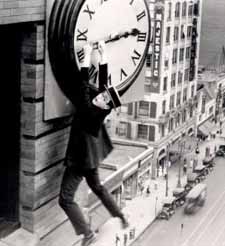
…….or you could just use your phaser. Still: KIRK RULES.

Fight Director Christopher Morrison:

“The fights are integral to the story. A fight happens when the characters run out of language to pursue their objectives and their choices become physical. Block/direct accordingly. Also understand a fight is a DESIGN element. As a director you should understand what KIND of violence you want, how that violence fits into the world of the play/spine of the story, and what tone the violence should be (i.e. cartoon, filmic, epic, comic book, intimate, ‘fake,’ dirty, etc.) and be prepared to speak to your fight lady as you would another designer on the team.”

Christopher Morrison getting thrown by Cara Gilson in Impact's production of Zay Amsbury's The Wake Up Crew. Fights by Christopher Morrison.

Christopher Morrison getting thrown by Cara Gilson in Impact’s production of Zay Amsbury’s The Wake Up Crew. Violence by Christopher Morrison.

They’ll keep you, your actors, and your audience safe. Apart from the obvious first thought– you want the people around you to remain unharmed because you’re not a psychopath– I’m guessing that you, like me, are someone who enjoys staying out of prison and avoiding lawsuits. An excellent way to do that is to hire a professional to stage your fights safely. Fight Director and actor Carla Pantoja:

“I can’t tell you how many stories I have heard or been privy to of actors getting physically injured because someone didn’t use a respectable fight director. Now when I say ‘respectable fight director,’ I mean someone with reasonable and up-to-date training, or even hiring someone in the first place. [Name] shared a story awhile back of a nonunion (sadly, most of these horror stories are peopled with nonunion folk) actor who had her arm broken and dislocated because the director didn’t hire someone and wanted an arm lock that was ‘real’ (ugh, I hate that term used in relationship to theatrical violence– you want ‘real,’ start a fight club). This director demonstrated on her and snapped her arm. She required surgery.

Part of using a respectable and up-to-date fight director is getting the up-to-date knowledge. There are techniques that are outdated. Just like acting, techniques change. “

All fights, no matter how well-choreographed or rehearsed, carry some measure of risk, like everything in life, but the better choreographed and rehearsed they are, the lower that risk is. If you’ve ever lived through an actor getting injured on your stage, knowing you did everything in your power to prevent that is a world of difference from knowing your actor has a puncture wound because you couldn’t be arsed to hire a professional.

And please be prepared to trust that professional and follow his directives. A safe fight will not remain safe if you throw all the fight director’s instructions out the window. Fight Director and actor Andrew Rodgers:

This show is about as bad as it can get for a fight director.  The company called and asked if I’d choreograph the violence and the description of the play didn’t seem so bad.  But then I saw the publicity photos– the sole actress of the production (let’s call her ‘Jenny’) had a knife in her hand in the pictures.  I came to a rehearsal to see what was going on and I discovered that ‘Jenny’ had NO IDEA what safety meant.  The knife she was using was a dulled-down butcher knife, and my heart stopped when she first brought it out.  The blade was dull but it still had a point on it, and she was playing with it like it was a teddy bear– rubbing it on her face, putting it in her mouth, holding it by the blade or with two fingers.  I nearly exploded.  To complicate things, there was no structural, dramatic or narrative reason for the knife to be in the show– the playwright thought it’d be cool and edgy, and he refused to do rewrites until opening week.  I had to explain to ‘Jenny’ that all weapons, dull or not, should be treated as though they are sharp, and that the knife that she was futzing with could actually kill her or another actor.  I thought she had it, then my stage manager called to say she was doing it again.”

I’ve been lucky at my theatre to have worked with many wonderful actors who would never dream of ignoring a fight director’s instructions, but of course we always reinforce that with support from the director, fight captain, and stage manager. Everyone needs to be on board.

Stacz Sadowski and Anna Ishida in Impact's Titus Andronicus. Photo by Cheshire Isaacs. Fights by Dave Maier.

Stacz Sadowski and Anna Ishida in Impact’s Titus Andronicus. Photo by Cheshire Isaacs. Violence by Dave Maier.

Yes, you can afford it. Carla makes an excellent point that nonunion actors bear the brunt of the foolery of the producers and directors who don’t want to hire a fight director. Why is that? Because the small theatres who work with nonunion actors are always looking for ways to keep costs down. I’m right there with you in the trenches. My company is the smallest of the small. No one at my company draws a salary. But we wouldn’t dream of doing a show with fights without hiring a fight director. We build it into the budget from the start along with every other design element. If I can do it with my microbudget, so can you.

Obviously you want a trained, professional, certified fight director, but can you afford one? YES, dammit. A little research will show you who the big theatres in your area are using. While a small theatre is unlikely to be able to afford the kinds of rates paid by a LORT, perhaps that LORT fight director is willing to work with you on a sliding scale. If not, it’s almost certain she has a highly-trained associate or star student who’s qualified and talented but is early in his career and looking to build his professional resume. Is there an organization in your area that trains fight directors and actor combatants? Is there a university in your area that offers stage combat training? A little sleuthing will reveal who teaches those classes. Don’t just assume that these professionals are out of your price range, even if your price range is $100 and a sixer of Pyramid Hef. YOU NEVER KNOW. No asky, no gety. But don’t skimp. Pay your fight director what every other designer is getting, because that’s what a fight director is: part of your design team.

Carla Pantoja:

“For those who believe it is too expensive to hire a fight director, did you know that most of us are willing to talk about prices? Sure, there are price points I can’t go below due to commute, etc., however, I know people and I will point you in the direction of someone who may be in your price point.”

Bring your fight director into the process in preproduction, not during tech week. Again, a fight director is part of your design team. You should be meeting with your fight director before rehearsals even begin. Even if the violence is nothing but a single punch, talk to your fight director in advance, let her know who the actors are and what skills they have, discuss the fight narrative and style with her, and ask her how much rehearsal time she’ll need and where in the process she needs that time to be. Fight director Alaric Toy:

“The sooner you include the fight director in the show the better. If the fight director can be part of the audition process, even better. That way s/he can get a good idea of each actor’s true performing capability then and there. Listing ‘gymnastics’ and not being able to perform a cartwheel is just bad. I speak from personal experience looking at some actors’ supposed resumes and the reality of their movement capability doesn’t match when I have to choreograph the fight.”

Carla Pantoja:

“Producers, please call us in early to the rehearsal process. I can’t tell you how many calls I get to stage something like R & J two weeks before opening and none of the actors have ever held a weapon. I’m not kidding. You are setting us all up for failure. When you call me the first time INTO TECH! to help stage a fall or a hit and the actor can’t do it fluidly and it looks clunky, it isn’t the fight director or the actor’s fault. I am not a miracle worker; I can’t magically give that actor the time it takes to incorporate the moves into their body. BTW, falls are the hardest things to sell, I have found. They are the hardest thing to get right technically while visually looking convincing. I don’t do these last minute calls anymore, they hurt my soul.”

Reggie White and Cassie Rosenbrock in Titus Andronicus. Photo by Cheshire Isaacs. Violence by Dave Maier.

Reggie White and Cassie Rosenbrock in Titus Andronicus. Photo by Cheshire Isaacs. Violence by Dave Maier.

What the hell do you mean by a “fight narrative”? Isn’t it just a fight? Ow, even typing that hurt me. This kind of attitude is all too common, and makes as much sense as asking why you should hire a lighting designer, because can’t you just turn the lights on and off yourself?

Andrew Rodgers:

“That is the key to good choreography– thought. The actors MUST be thinking or the fight turns into empty steps.  The fight MUST have a purpose, just like any other scene in the play, otherwise it’s an uncomfortable dance break (and I’m usually a fan of dance breaks.) The actors MUST be processing what the characters are thinking.  It’s the simple things like this that make good combat– not speed or big shiny weapons– although those have their place.  It’s about thought.”

Carla Pantoja:

“I remember one of my mentors, Richard Lane, tell someone: ‘Would you do Oklahoma and not hire a music director? Or would you hire actors to do a play, just give them a script and have them direct themselves?'”

Don’t avoid hiring a fight director because you think your actors don’t have the training to pull off a professional fight. A trained professional fight director will work with your actors’ capabilities.

Carla Pantoja:

“While actors are amazing, we need direction. We need an outside eye to tell us if what we are doing is working. Safety is also nice. Fear is detrimental to our work as actors, not only fear of ‘is this working?’ but fear of being hurt physically.

As a fight director, I am an actor advocate. My job is to help you portray violence in a convincing way in a safe manner, creating a fight with you and for you. A fight you will enjoy to do and can do well within your own abilities. It doesn’t behoove me to make you do a move you physically cannot do, a move you are fearful of, or hold you back if there is a special move you can do that can be highlighted in the fight.

I have sadly worked with too many actors who have been injured and left distrustful of theatrical violence.”

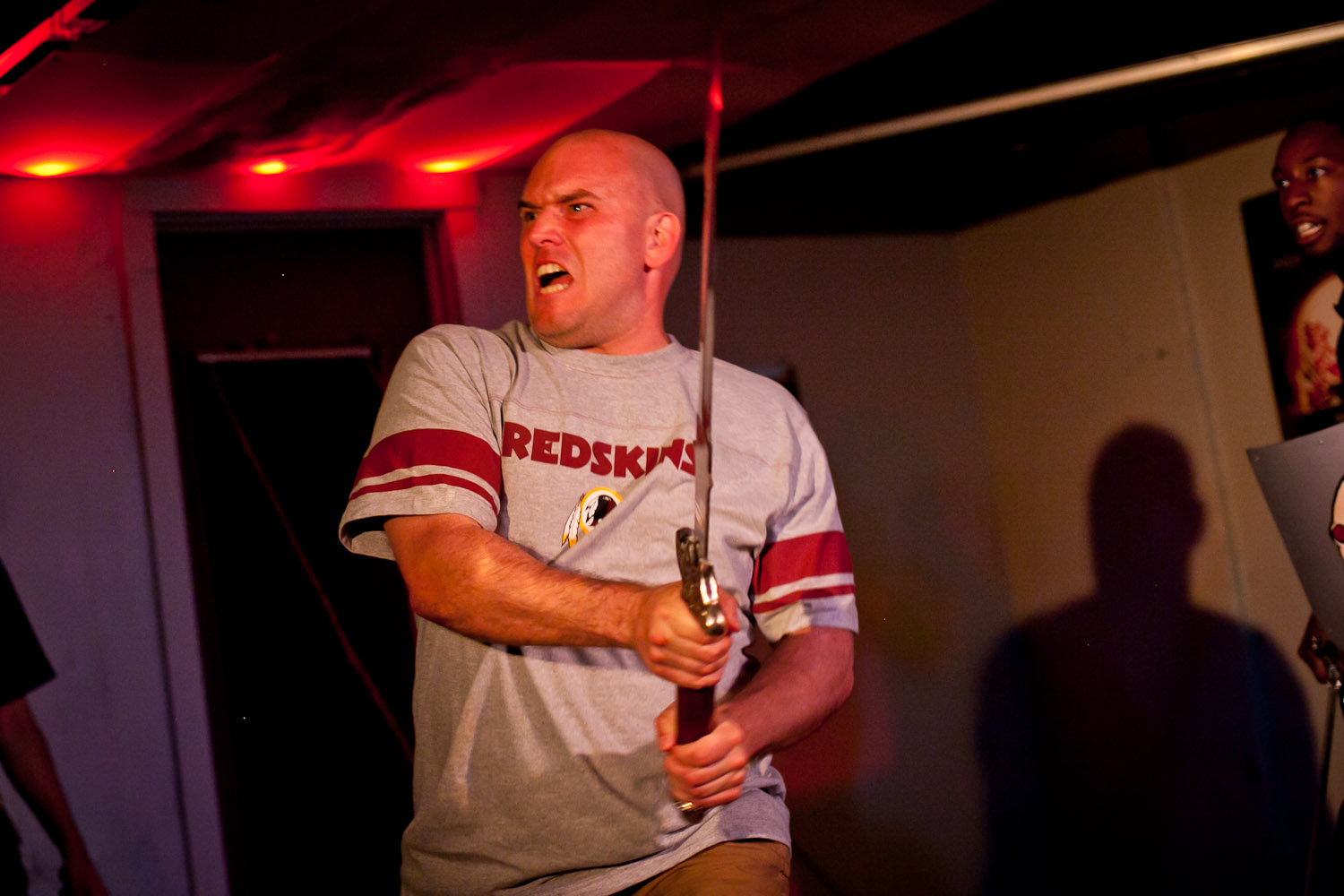
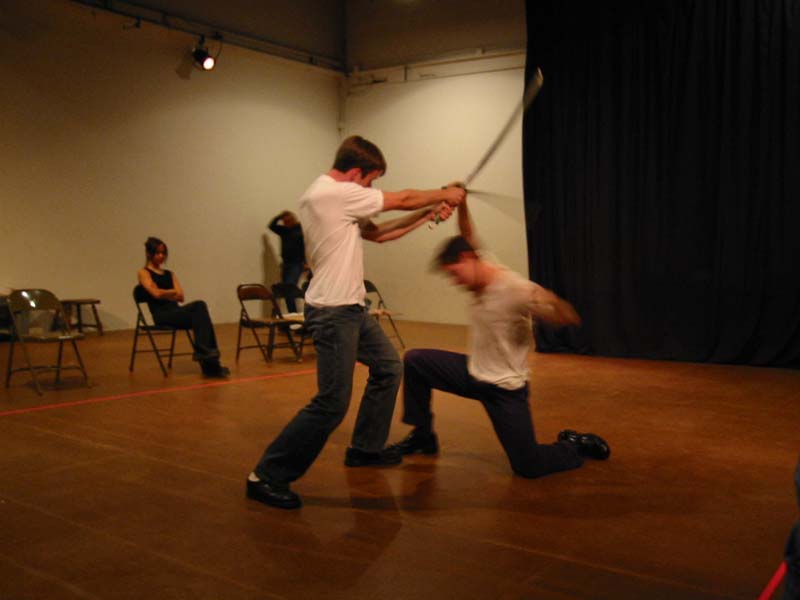
Rehearsing the Hotspur/Hal fight for Impact's Henry IV: The Impact Remix. Violcen by Christopher Morrison.

Rehearsing the Hotspur/Hal fight for Impact’s Henry IV: The Impact Remix. Violence by Christopher Morrison.

FOR THE LOVE OF GOD PLEASE TREAT YOUR WEAPONS LIKE WEAPONS. Never, ever, ever, ever, ever allow an actor to point a gun loaded with blanks at someone, or at himself, and pull the trigger. A blank is not a NOTHING. That noise is made by a violent discharge that can seriously hurt someone. Just because it’s not propelling a bullet through the air does not mean it is a fluffy puppy. (Personally, I use sound cues for gunshots. A sound cue will recreate the sound of the gun in the setting. Is your play set outdoors? In close quarters? Is that gun supposed to be a hunting rifle, a shotgun, a .22? A blank fired in your theatre will always sound like nothing other than a blank fired in your theatre, and yes, all blanks of all sizes and types sound like blanks fired in your theatre, not like a bullet fired in your setting. That is, IF the blank even goes off. I’ve been through far too much “click click click click POP” to rely on blanks. And again, they sound like crap. An excellent sound designer is worth every blank in the world put together.)

A dulled blade is not magically prevented from doing any harm to anyone. It’s still a hunk of metal that can penetrate a squishy human body rather easily.

MORBO LAUGHS AT SQUISHY HUMANS

MORBO LAUGHS AT SQUISHY HUMANS

And NEVER take your weapons out of the theatre unless they’re in some kind of case or containing device. Do you want three uniformed police officers and one plainclothesman charging downstairs into your theatre five minutes before curtain? Then make sure your actor leave his weapon on the prop table when he runs to the bathroom, not shoved down the back of his pants.

(I don’t need to tell you that an actor who plays with the prop weapons backstage is an actor you should NEVER HIRE AGAIN, right? If an actor can’t follow the simple directive of “don’t fuck with dangerous props (or any props, really)” then that lack of concern for professionalism and safety is bound to carry over into other areas of his work.)

All good troopers know to put their weapons back on the prop table when they're off stage, and never touch anyone else's props.

All good troopers know to put their weapons back on the prop table when they’re off stage, and never touch anyone else’s props.

So please hire a fight director. You CAN afford it. A qualified fight director will enormously enhance the quality of your show, keep everyone in your building safe, and open your eyes to new perspectives on work that you may, in many cases, have been turning over in your mind for years. When you finally get your hands on Lear (and by “you,” I mean “me”), a fresh perspective on those scenes you’ve been dreaming about blocking for a decade will not only make the violence better, but will provide fresh insights into the entire piece– narrative, themes, and characters.

Stacz Sadowski and Miyaka Cochrane in Impact's As You Like It. Photo by Cheshire Isaacs. Violence by Dave Maier.

Stacz Sadowski and Miyaka Cochrane in Impact’s As You Like It. Photo by Cheshire Isaacs. Violence by Dave Maier.

This piece wouldn’t be complete without a shout out to the fight director Impact Theatre works with– Dave Maier. Dave is brilliant. He and I see eye-to-eye about violence and tend to exacerbate each other’s love for stage combat when we’re working together as director and fight director.  We’ve been known to turn the simple direction “they fight” into scenes that say as much about the characters as the dialogue, maybe more, and that’s something I would never, ever be able to do on my own. Working with Dave is a joy. I learn something every time I work with him, and his ideas about character and narrative are always fantastic.

So hire a fight director. Be safe. Be a better artist. Be awesome.

Tagged , ,

Actors: This Is Why We Have Auditions

Image

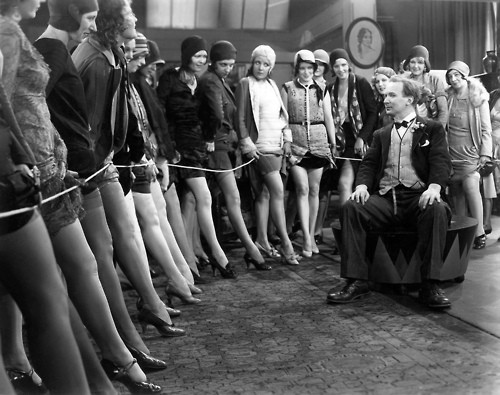
A casting call for showgirls, 1920s. This is exactly how I’m running callbacks for Troilus and Cressida.

I love auditions. I always have and I always will. I will happily sit through day-long auditions. I recognize, however, that auditioning is a deeply flawed process with huge limitations.

For that reason, I also hate auditions. Their artificiality makes it difficult to understand how an actor works in a rehearsal and performance process. There’s also a hierarchical feeling to auditions that makes me uncomfortable. I see actors as co-creators rather than as puppets who execute my vision. I think I’m auditioning for them as much as they’re auditioning for me. But the reality is: I have more actors in front of me than I have roles to fill. Some will hear “yes” and some will hear “no,” and I hate that. The fact remains that I must find a way to make decisions about who will populate the plays I direct or produce.

Taylor Mac wrote a great article about casting a couple of years ago, saying that we should completely do away with auditions and instead cast people we get to know through work in the community or working with them directly. This is, of course, a fantastic way to get to know actors– I’d even say the best way. But it’s not something that can replace auditions outright.

I use a combination of both techniques. I cast people without an audition (or bring them straight to callbacks) if they’re someone I’ve worked with before, or someone whose work I’m familiar with. But I just can’t envision completely giving up auditions, because I think, as flawed as they are, they offer something unique to theatremaking that we can’t do without.

Image

One of the PR shots for my production of Othello at Impact Theatre. Skyler Cooper, my Othello, came in to audition for Macbeth the previous year and blew us away. I had never heard of her as she was new to acting after spending years in the Air Force. Impact’s lesbian Othello was one of the most successful shows we ever did, and I would never have found Skyler were it not for our open auditions. Pictured: Marissa Keltie and Skyler Cooper. Photo by Cheshire Isaacs.

The New Kid on the Block. Over and over again, I’ve had someone I’ve never heard of before walk into an audition and blow me away. They’re new to the area, recently graduated, or new to acting. Often an open audition is the only chance they have to break into a new market. This is especially true for actors who are traditionally marginalized. If you’re not getting cast, I have no way to get to know your work unless I hold an open audition. An open audition allows actors who have no other pathway access to directors, casting directors, and artistic directors. I think preserving that access is crucial.

Growth and development. Yesterday we had our first day of season auditions, and no less than three actors I’ve seen multiple times before gave auditions that almost knocked me out of my seat. Three actors showed up with auditions that were leaps and bounds better than anything I’d ever seen them do before. One did a piece outside of what one of my directors had considered her type, based on the pieces and shows he’d seen her do previously, and changed his entire conception of her abilities. There’s a special kind of joy in watching an actor develop over the years. I’ve seen actors go from green, timid, and wobbly recent graduates to powerhouses in just a few years. I’ve seen powerhouse recent graduates mature into wider and wider ranges and abilities. I’ve seen mid-career actors push through to new levels, mature into new types, discover new approaches. It’s deeply satisfying to see, and it’s something we might not see outside of auditions. If I “know” what your type, range, and abilities are, I might not prioritize coming to see your show in favor of seeing a show stacked with actors I don’t know. I can only see so many shows, so I have to pick and choose. Additionally, you might get cast consistently as a certain type, but have the ability to push out of that range into something new. An audition will give you the opportunity to show us that.

Image

Impact resident actor Mike Delaney in the world premiere of Toil and Trouble by Lauren Gunderson, directed by Josh Costello. Mike auditioned for a show I was directing at CSU East Bay years ago. Now he’s a core member of my company. Photo by Cheshire Isaacs.

Actors as co-creators. When you do an audition monologue, theoretically, at least, this is material you’ve chosen for yourself, performed with choices you’ve made. The choices you make show me something about who you are. I want to work with people who bring something special to the table, who have interesting things to offer as co-creators of the work. When I go to see a show, often I have no way of knowing which choices you’ve made and which choices the director’s made, and that balance is going to differ depending on who the director is, how s/he works, what kind of relationship the director has with that particular actor, what kind of relationship that actor has with the director’s concept, etc. There are a huge number of variables that affect how deeply an actor is directed in any given production.

An actor came in to auditions yesterday doing a piece from a show he had performed, directed by someone I know very well. While he was a skilled performer, his piece looked, smelled, and tasted like the director. All I could see was the director. He came recommended by another actor whose opinion I trust, so I’ll call him back, specifically to see who he is as an actor. His audition just didn’t answer that question for me.

I’m not just looking for actors; I’m looking for collaborators. I don’t want minions; I want accomplices. I’m auditioning people so I can see both what their skills are and what kinds of choices they make.

Change Our Minds. Every so often, I think I know what I want for a certain character, and then an actor shows up who changes my concept completely. I had a short list of actors I was considering for a particular role in the show I’m directing this fall, and an actor I’d never seen before came to auditions yesterday and changed my mind. In the middle of his monologue I suddenly realized that I wanted something completely different for the character. I could see him as the character, and it brought a different context and more depth to the role than I had previously considered. Now he’s my frontrunner for the role. 24 hours ago, I had never heard of him.

Image

Chris Quintos in Impact’s production of The Chalk Boy by Joshua Conkel, directed by Ben Randle. Photo by Cheshire Isaacs.

Despite their drawbacks, auditions are a very useful tool. I have a love/hate relationship with them, but I’ll continue to rely on them.

P.S. I have some articles about audition tips you can check out here and here, and some casting advice for actors here.

Tagged , ,

What Actors Should NOT Be Doing Online

Haha, you thought I was going to say “Get drunk and post naked selfies.” Nope. Go right ahead. Unlike the Cheesecake Factory or the local unified school district, the theatre is forgiving of indiscretions of that sort, don’t you think? Or they damn well should be, I mean, come ON.

Image

A selfie I took hiding behind my desk when one student took the entire two hour final exam period to finish a final everyone else knocked out in an hour. It expressed my soul.

No, I’m talking about how to deal with the fact that your facebook profile and email address are getting in the way of you getting hired. Here are some simple, easy-to-deploy tips you can use to make things easier for me and other people like me, who are looking to cast our plays, films, web series, and industrials as painlessly as possible.

1. DO NOT make your email address impossible to find, use, or tolerate. Create an email address that is at least partially recognizable as yours. Do you have any idea how often I use autocomplete to try to find someone in a hurry? About as many times as I have directors, casting directors, and filmmakers email me asking for suggestions for actors, so a scrotillion times a week at minimum. Evidently I’m the non-union actor fairy. So if I can’t type part (or even all) of your name into the field and have your name pop up, I move on to the next actor. If I really, really want you, specifically, I’ll make the extra effort to find your headshot in my files or swing over to your facebook page (more on that later), but generally I’m burning through a list of the first ten or so people I think might be a good fit for that role while the project I’m working on at the moment is on pause. I can’t allocate an hour to answering an email, so if your email address is “singing4lyf@yahoo.com” and the name you’ve connected to it is “SingerStar DramaLife,” I HAVE NO IDEA WHO THE FUCK YOU ARE . If you simply must make your email address “DramaGrrrrrl47@aol.com” you better make damn sure your actual name is attached to that. But seriously, get a gmail address that is at least partially related to your name.

Also, please don’t share an email address with your husband, wife, parole officer, or dog. You are a GROWN UP. Get your own email address for professional use. No one cares if you share an email address with your spouse for personal use (I mean, we care in that we wonder how you manage to function like that, but we’re not judging you). For professional use, however, we need to be able to find you quickly. When I’m trying to locate an actor in order to recommend her to someone who wants to hire her, again, I can’t find Beth Ishikawa if her email address is “mattandbeth@gmail.com” and the name attached to it is “The Ishikawas.” Make your email address “beth.ishikawa@gmail.com” and make all our lives better.

2. DO NOT make your facebook profile picture the Eiffel Tower, a cat, or a dreamcatcher. Make it a picture of YOU. Should I be using facebook as my personal casting garden? Yeah, maybe, maybe not. But we all do it, all the time. Why? Because often we don’t have your headshots in our files and are trying to track you down, plus we’re already on it all the time, it’s easy as hell to find people that way, and we can tell at a glance if you’re still in the area or if you moved to Chicago like we think we remember you telling us once in an email a few months ago. Sometimes I’ll even just browse my facebook friends if I’m particularly stuck in a casting quandary, hoping for a flash of inspiration. Now, you know I love you all deeply and personally, but sometimes in the heat of the moment, it’s hard for me to remember exactly which Mark or Jessica you are. When your facebook profile picture is of a sandwich, YOU ARE NOT HELPING. It doesn’t have to be your headshot, but it should be YOU.

Image

This should not be your facebook profile picture.

Which leads me to:

3. DO NOT “protect” your email address on facebook. You’re “protecting” yourself from getting hired. Put your professional email address on your facebook “about” page. Create a special email address just for this if you must, but be sure to check it. I can’t tell you how many times I’ve cruised over to a facebook page to find contact info for an actor whose headshot isn’t, for some reason, in my files or in TBA’s talent bank, only to find that their information is “protected.” YOU’RE AN ACTOR. There should be some way to contact you prominently displayed on your every public profile. I will, more often than not, just move onto the next actor rather than leave a facebook message unless we’re already facebook friends because I know you don’t check your “other” folder.

5. DO NOT forget to check your “other” messages folder on facebook. This is where messages go when they’re from companies, or people you don’t know. Chances are you all have a fourteen-month-old message from me in there asking you to come in and read for a role.

6. DO NOT forget to update your TBA Talent Bank info. If you are a Bay Area actor, you should be a member of Theatre Bay Area and you should have current info posted in TBA’s Talent Bank, because we use it all the time.

7. DO NOT forget that everything you post on the internet is ON THE INTERNET. Yes, I know some of you still believe in Santa Claus, the Chupacabra, and Facebook Privacy, but rest assured that if you post it on the internet, at some point, every human on earth will eventually see it. Again, I’m not referring to drunken naked selfies (go on with your bad self). I’m more referring to things like, “I love this show! This is the best director I’ve EVER worked with!” or “This theatre is my favorite place to work!” Now every other director and every other theatre you’ve ever worked for has the sads. Conversely, don’t think you can post “Grrr! I hate this costume! It looks like barf!” without your director, costume designer, and castmates all seeing it within the hour. Every human has been guilty of this at one point or another because humans have EMOTIONS and emotions make us ACT OUT, but this is what the delete function is for.

That’s all I have for now, based on the flurry of casting I’ve been doing over the past few weeks. My usual “Wow, this is a lot of casting” level has been dialed up to “ZOMG I HAVE SO MANY THINGS I HAVE TO CAST RIGHT NOW THIS SECOND AND TEN EMAILS JUST CAME IN ASKING FOR EVEN MORE ACTORS.” So help me find you! Because you know I want to.

Tagged , , ,

Defining “Professional”

It's a question of lust; it's a question of trust; it's a question of-- oh wait, no it's just a question of money

It’s a question of lust; it’s a question of trust; it’s a question of– oh wait, no it’s just a question of money

How we define who is and who is not a “professional” in the theatre community has always been a hot-button topic, especially when you throw companies into the mix. When you start discussing this topic, a lot of people will immediately open their mouths to pour out a response that has something to do with money. This makes no sense whatsoever in the theatre community.

Sure, we could define “professional” as “making enough money at theatremaking to cross a predetermined threshold” (such as hiring AEA actors, or making your living solely as an actor as opposed to a waiter/massage therapist). This is, however, a problematic definition to say the least. Many people who are in love with using this definition for theatre companies do not pass this definition in their own careers as artists. If we’re going to define “professional” for theatre, it needs to have a single definition for us all, not one for producers, one for actors, one for designers, and one for theatre alley hobos.

If an actor lands a role that makes her AEA, and then, as is all too common, sits for two years at home working out every possible ending of Dragon Age but never landing any roles, is she still a “professional”? While the money-based definition above says no, I say YES, and I bet you do, too. She’s still auditioning, maybe taking classes, certainly attending theatre to see others’ work. She’s working at her chosen profession, just not making money at it. Her experience, training, and dedication do not evaporate just because she can’t get hired. That actor is still an actor, and I would call that actor, without question, a “professional actor,” despite the fact that it says “lab assistant” on her 1040.

I really should work on that Rosalind monologue at lunch

I really should work on that Rosalind monologue at lunch

If an actor can retain the label “professional actor” without actually making any money as an actor, then it makes no sense for anyone to be held to a money-based definition, including producers and companies. Either “professional” means meeting specific financial criteria, or it does not.

In an industry where very, very few people are making their living solely as theatremakers, and almost no theatre in the nation is generating enough earned income to pay their bills (most of their budgets coming from donations and grants), what is the point of a financial threshold? What MEANING does money have? Are we honestly going to grant “professional” only to those artists who get hired frequently, and withhold it from those who do not, disproportionately shutting out women and people of color? Are we honestly going to grant “professional” only to those companies that sell lots of tickets or land high-value grants, disproportionately shutting out small companies that do experimental work or serve low-income communities? This is an arts community that purports to have The Art as its primary consideration, and yet so many of us are distressingly willing to make money the most important consideration.  But only for others, amirite? Because while plenty of people condemn other artists and companies with “not professional,” they still consider themselves professionals even though they’ve done nothing but 2 waiver shows and a staged reading since the Bush Administration.

No, we can’t draw financial lines for each other and say, “You must be this wealthy to ride this ride” because it leaves far too many worthy artists and companies out. We need a single definition, and it can’t be money. An artist for whom money is THE most important consideration in the definition of “professional” is an artist who is deliberately shortchanging the worth of other artists and companies. Gross.

So money is out.

What about using quality as the defining factor? “Professional” implies a certain level of quality, does it not? Perhaps, then, we can use excellence as the defining factor. Let’s consider that more deeply. OH WAIT. We already tried to define “excellence” and failed. Remember when the entire national theatre community suddenly started talking about holding each other accountable for “excellence”? It went nowhere because no two people can ever completely agree on what makes a work of art “excellent.” This is ART, and one person’s heartbreaking, brilliant, moving production is another person’s self-important, pretentious dreck. So using “professional” to mean “always high quality” doesn’t work for companies.

It doesn’t work for individuals, either. I know many like to draw the line for actors between AEA (“professional”) and non-AEA (“amateur”). But anyone who has spent more than five minutes in casting knows that union affiliation is no guarantee of quality for an actor. Sure, in the aggregate, AEA actors are “better” than non-AEA actors, because the class of “non-AEA actors” includes those with little or no experience, and those who think they are actors but will shortly discover they are directors or playwrights. Or audience. Or donors! (THINK POSITIVE.) But we can’t cast in the aggregate; we have to cast individuals, and when you compare one individual to another individual for any specific role, union affiliation is not going to indicate anything useful to you about which individual actor is more “excellent,” or more anything else, for that matter. This is why we have auditions. There are stunningly brilliant nonunion actors, no question, just as there are stunningly brilliant AEA actors, and jaw-droppingly mediocre actors both union and non. It’s useless as an indicator of INDIVIDUAL excellence. And of course, even if we wanted to use union affiliation as a marker for excellence and thus “professional,” what about all those people who are directors, designers, playwrights, art directors, and so on, for whom union affiliation is a completely different ball game? Union affiliation is useless as a definer of “excellence” for individuals. In the end, though, it matters little because “excellence” is useless for defining “professional.” We can’t all agree on what “excellence” is.

You may actually believe that all AEA actors are always “better” than all non-AEA actors (because of course all actors automatically go from sucktastic to brilliant the moment they sign, right?), and who would be able to prove your opinion of nonunion actors wrong? It’s your opinion. You may actually believe that a big, expensive set or a full orchestra make a show “excellent,” and who could argue with you? That’s what you enjoy, and therefore it’s “excellence” to you. My point here is: when you can’t pin down a definition for “excellence,” you can’t use excellence to define “professional.”

So money is out and “excellence” is out. Then what the sriracha-flavored fuck CAN we use  to define “professional”?

I'm still trying to work out "sriracha-flavored fuck"

I’m still trying to work out “sriracha-flavored fuck”

I have an idea! I baked it just for you and I hope you like it. I made it out of my lifelong obsession with etymology and my need to accrue respect to theatremakers of all income levels.

So, no surprise, I own a copy of the OED. I cracked it open (any excuse, right?) and looked up “professional,” “profession,” and “profess.” Yes, I know that a dictionary definition is going to have limited applicability on its own in this context, and there is something obnoxious about using a dictionary definition in any argument, but bear with me for a second. The main concepts throughout all the definitions of “professional” in the OED (and Webster, which I also checked for fun) are: professing (self-declaration), depth of commitment (making something your main daily activity; your “profession”), and expertise.

So how about this: “Professionals” in theatre are those people who are openly dedicated primarily to the activity of theatremaking. A “professional” individual in theatre is someone who has made a commitment to the art of theatre, and has made that his or her primary daily activity, or has theatre as a primary daily activity as his or her goal (we don’t want to leave out that AEA lab assistant). A “professional” theatre is one that is staffed with such individuals, regardless of what that theatre pays them.  “Theatre professionals” are people who have made theatremaking their lives, and “professional theatres” are the companies that are staffed with those people.

I believe that resistance to this idea, and assertion that “professional” must have strict financial criteria, comes from a place of elitism. It comes from a place of wanting to protect one’s own privilege, and not have to share it with others one has previously been able to keep out. I don’t think those are useful concepts in theatremaking, so I hope to see the day they’re discarded in favor of becoming more inclusive and diverse.

MAKE ROOM FOR OTHERS. They deserve to be there. Honor the artists and companies around you, no matter how much money they have. Think of looking at the world, and at our art, in ways that do not privilege money over everything else. Yes, we all have to make a living, pay bills, and buy Dragon Age 3, but we do not need to make financial considerations the centerpiece and main defining characteristic of our art. Leave that to Scary Movie 12, porn, and A Doll’s House on Broadway starring Kanye West as Torvald and Kim Kardashian as Nora. (YOU KNOW IT COULD HAPPEN.)

Imma let you finish, but the Tarantella is the BEST DANCE OF ALL TIME

Imma let you finish, but the Tarantella is the BEST DANCE OF ALL TIME

Before I go, I want to say a word about “community theatre.” “Community theatre” is a wonderful, precious resource that exists to allow people who are not professionals to participate in making theatre. My wonderful former father-in-law, a retired chemist, spent the last years of his life acting and building sets at a truly excellent local community theatre. It enriched his life greatly. He had no intention of becoming a professional actor, but he wanted to participate in theatremaking. I truly adored watching him onstage. He was terrible, but he loved to be there, so he was a joy to watch. When he died, they renamed the theatre space after him in honor of the many ways he had contributed to that company. THAT is what “community theatre” is. It’s valuable, and important, and I won’t hear another word about it being somehow “lesser” than professional theatre. When I hear “community theatre,” I see a retired chemist, grinning from ear to ear, on a stage full of people thrilled to be there.

UPDATE: A couple of people have asked me if I’m referring to specific AEA language that appears in some of their documents. Let me explicate: No. I’m discussing how theatremakers talk about each other. If I were discussing specific AEA documents, I would have said so. I’m not really coy about these kinds of things. AEA is one union that represents one segment of theatremakers, and I’m discussing us all.

Comments for this article are now closed. 

Tagged , ,

In the Land of the “Color-Blind”

Jai Sahai as Spango Garnetkiller in Impact Theatre's production of Of Dice and Men, by Cameron McNary

Jai Sahai as Spango Garnetkiller in Impact Theatre’s production of Of Dice and Men, by Cameron McNary. Photo by Cheshire Isaacs.

I wrote an article linked above for Theatre Bay Area Magazine’s Jan/Feb issue, and now that it’s no longer available online, I’ll post it in its entirety here.

I’ve really come to dislike the term “color-blind” casting, because it implies that the highest good is to be “blind” to race and ethnicity, and I just reject that out of hand. The highest good, in my opinion, is to both SEE difference and CELEBRATE it. Not “accept” or “tolerate”– those weak words can take a seat.

While the point of this article is race and ethnicity, I think we also need to start thinking of diversity in terms of body size, age, disability, and gender– and not just gender as in “male/female,” but recognizing the true range of gender, gender expression, and the 1000 ways in which cisgender people enjoy privileges that trans* people do not. As a cisgender woman, this was invisible to me until fairly recently. Over the past ten years (after the death of Gwen Araujo, practically in my childhood backyard), I’ve paid a lot of attention to how trans* people are treated in our culture, and while the cisgender can never truly understand, it’s crucial for us to try.

My own company is in no way perfect. Far from it. We have a long way to go with all of these issues. But it’s something I think about literally every day of my life.

UPDATE 5/20/13: Please read this account of a Filipino American actor who auditioned for a character of color, made it to the second callback, and then discovered the “Big New York Theatre” (his generous psuedonym) cast a white actor instead. It’s a great read for a ton of reasons.

“In the Land of the ‘Color-Blind'”

Theatre Bay Area Magazine, Jan/Feb 2013

As someone who‘s been producing and casting for nearly two decades, I’ve been following the recent casting controversies with keen interest.

The latest occurred at La Jolla Playhouse this past July. Duncan Sheik and Steven Sater’s The Nightingale, an adaptation of the Hans Christian Andersen tale, directed by Moisés Kaufman, was set in China but cast with mostly non-Asian actors, including white actor Bobby Steggert in the lead role of the Emperor of China. The cast of twelve included but two Asian actors in supporting roles. The backlash, led by Asian American theatre artists, was immediate and intense. La Jolla Playhouse’s Artistic Director, Christopher Ashley, eventually apologized, but initially defended the casting as “color blind.” Kaufman defended the “color blind” casting by asserting that the play was never meant to depict a “literal” China, but a “mythological” one.

During this controversy, I saw in several online discussions heated defenses of the casting of The Nightingale as ideally “color blind” and as an example of “artistic freedom.” I was flabbergasted by the initial controversy, by the defense offered by the Nightingale team, and by the arguments in favor of the casting from other theatremakers. I had assumed that the term “color blind casting” was no longer in use, and I had assumed that my own opinions about what it means to cast a white actor as a nonwhite character were nearly universal in the theatre community. I knew I needed to dig deeper, and to that end, I spoke with directors Mark Jackson, Michael Gene Sullivan, Ellen Sebastian Chang, and Alan Quismorio about their approach to this issue.  I began with the term “color blind casting.”

When we cast, we consider many things: type, skill set, approach to the role, chemistry with other actors. Are we not also considering race? Are we ever truly “blind” to race? Would we even want to be?

Michael Gene Sullivan takes issue with the concept of “color blindness”: “Sometimes people will say ‘I don’t see you as Black.’ If you don’t see me as Black, you think you’ve elevated me. Somehow it’s better not to see me as Black. Why? What’s so wrong with being Black? By wiping it away, you’ve made it ‘better,’ but all you’ve done is make yourself more comfortable.”

Ellen Sebastian Chang agrees: “We can’t say ‘I don’t see color.’ Well, why don’t you see color? I see it! What does it mean to you? I see what color I am. I see what color my kid is. I see it, I deal with it all the time. Why can’t you in your casting? Why are you choosing to be blind? Even the term ‘color blind casting’—Why choose blindness? There’s something about it that has the stink of white liberal guilt.”

“I find ‘color blind’ casting to be weirdly naïve,” says Mark Jackson. “Nobody is blind to race, because race matters, and pretending like it doesn’t is no way to deal with it. That makes ‘color blind’ casting an absurd proposition, not to mention kinda racist in a cowardly liberal way.”

“Color blind” casting just doesn’t exist. Of course we see color, and when white directors assert that color doesn’t “matter,” it seems to me that they’re asserting nothing but their own white privilege. In the US, only white people can live in a reality where race “doesn’t matter.”

Race is not invisible, nor should we want it to be. Race– like gender, like size, like age– contains narrative. When we cast, that choice, whatever it is, brings layers of meaning to the production as a whole. “The audience brings a lot of connotations to the event,” says Quismorio. “If you see a white man playing a Chinese man, and we all know that a lot of imperialism happened in the past, you can’t help but look at it from that point of view.”

When a white actor is cast as a non-white character, it contains a very specific cultural meaning, and a different meaning than an actor of color cast in a role written for a white actor.  A white man in the role of the Emperor of China, whether you believe it’s a “mythological China” or not, intertextualizes narratives of cultural appropriation, erasure of difference, colonialism, Asian invisibility, and “yellowface.”

“I always assume that race and gender matter, and try to make choices accordingly,” says Jackson. “The [all white] casting of God’s Plot was deliberate because it was about Puritan characters. They were culturally specific characters in 1665. Doing non-traditional casting made no sense in that context. . . . Salomania and [The Death of] Meyerhold as well—having an Asian Stanislavski or a Black Chekhov would be saying something, but I don’t know what we would be saying.”

Alan Quismorio disagrees. “I would cast a Black actor as Stanislavski, or I would cast a female as Chekhov. I’d have to ask myself why I would do it, because I’d be asked about it. It can’t just be because it was cool. If we were to do a prologue for A Pinoy Midsummer, I would cast a Filipino actor as Shakespeare. It would be saying that Shakespeare, his works, transcend color, transcend nation. It really speaks to the world population.”

Why even consider casting actors of color in roles written for white actors? “We have to be thoughtful about what ‘color blind casting’ is trying to achieve,” says Quismorio. “It’s an attempt to provide actors of color an opportunity to be cast in roles they traditionally haven’t been cast in.” Sullivan says: “Non-traditional casting isn’t about making the audience more comfortable, and that shouldn’t be the reason you came down to the theatre in the first place. The idea is to create the world onstage the way we’d like it to be. Wouldn’t it be nice if this were the way things were and everybody could be cool with it?”

Two of the main ideas behind non-traditional casting are to provide actors of color with opportunities they have traditionally been denied, and to start to approach representing them on our stages in numbers equal to their numbers in the community. There’s a third important idea as well: Casting in a way that’s conscious of color and sensitive to it is a way to frame possibilities for inclusion in the real world. So many of our steps forward as a culture in the areas of race, gender, and sexuality have been led by the arts. An emotionally profound narrative event like a play or a film can have more cultural impact than a protest, article, or lecture.  “There’s a television show called ‘Once Upon a Time,’” says Quismorio, “that cast an African American actor in the part of Lancelot.  When we think of Lancelot, we imagine a ‘white knight.’ Not only are we challenging what’s happening in the real world but also what’s happening in our imaginations. Ten, fifteen, twenty years from now the kids who are growing up today will know of a Black Lancelot. There are other ways of perceiving a character.” Imagining fictional characters in new ways and creating artistic space for the full range of human characteristics people of color possess, not just the stereotypical characteristics we too often see in roles written for people of color, are healthy for us both as artists and as people living in a diverse community.

Casting actors of color in roles written for white actors, however, is not without complications. “Color blind casting too often means that European-based work is reinvented so that people of color are supposed to identify their humanity with that work,” says Sebastian Chang.  “’Color blind casting’ affirms that universality is in the white perspective. Why can’t we just keep developing playwrights of color? Color blind casting too often denies cultural difference.”

Sullivan says, “I would put more pressure on the playwrights. Why do you keep writing plays that deal with four white people on the upper West Side?”

“I don’t have any problem with casting actors of color in European-American plays,” adds Sebastian Chang, “I am so for artistic freedom that way and artistic imagination that way.”

What  about the “artistic freedom” argument? What is the difference between casting an Asian American as Hedda Gabler and a European American as the Emperor of China?  Why is “color blind casting” such a problem and “non-traditional casting” lauded? The reason is because race has meaning. It has an undeniable cultural context that must be considered when we cast. We must consider creating productions that reflect the diversity of our audiences if we want to stay culturally relevant, creating opportunity for underrepresented actors if we want a thriving theatre community, and the effect our casting choices will have on the narrative of the piece if we want to have an understanding of how our work fits into the cultural context and how it will likely be received by audiences.

When I was casting Romeo & Juliet at Impact two seasons ago, our newest resident actor, Reggie White, who is African American, wanted to do the show. I had two open roles at the time: Paris and Tybalt. Reggie is an actor with an abundance of “nice guy” energy, who exudes likeability from every pore, and captures audience sympathy the minute he steps on stage. I didn’t want an unsympathetic Paris—I believe he’s a nice guy caught in a bad situation. Reggie would have been a perfect choice for that role.  Hotheaded Tybalt, on the other hand, is a stretch for an actor whose home base is “the sweetheart.” But given that both my Romeo and Juliet were white (Michael Garrett McDonald and Luisa Frasconi, respectively), how could I cast an African American as Paris? How could I stage a play where the female lead is desperate not to be married off to the Black guy? Reggie’s race would change the Paris narrative to something unpalatable. I cast him as Tybalt, and, of course, he was more than up for the stretch and his talent and versatility made his performance a huge success with both critics and audiences. In making that choice, I also considered that the party scene, wherein Lord Capulet, played by a white actor in our production (Jon Nagel), calls Tybalt “boy” several times, would take on a new, more hard-hitting meaning, and would show even more explicitly why Tybalt’s anger carries over the next day into his challenge of Romeo.  In a play with so much violence from so many characters, I didn’t feel that an African American Tybalt would make a racist statement about Black male violence, but that possibility had to be considered before I could move forward with the choice. Race is always part of the narrative, and it’s our job to be cognizant of that, to consider the cultural context of our choices, and weigh, to the best of our ability, how audiences will read those choices.

Using a white actor as Othello, or as the emperor of China, on the other hand, has a very different impact on the narrative than casting a person of color in a traditionally white role. It erases the physical presence of the person of color, and intertextualizes cultural narratives of imperialism, appropriation, and invisibility. The West has a long history of casting white actors in racist portrayals of people of color, of appropriating the narratives of people of color and reshaping them through a white lens, and of shutting artists of color out of positions of importance. An American audience viewing a white person portraying a person of color will be reminded of all of these, and of blackface, of yellowface, of the history of racism with which we still struggle. These are all present in any production wherein a white actor is cast as a person of color because they are so palpably present within our culture. Again, race is always part of the narrative.

With all this complexity, how do we approach race and ethnicity in casting in the 21st century? I think the answer is that there is no one-size-fits-all solution. Yes, we should be increasing access for actors of color to roles in which they have not been traditionally cast. African American Hamlets and Rosalinds, Asian American Noras and Heddas, Latino Bricks and Estragons: we should continue to encourage these. And, at the same time, we need to actively work to develop voices from across the entire cultural spectrum and ensure that these voices get the kind of attention they deserve. All too often playwrights of color are developed to death: awarded reading after reading, but few mainstage productions at major houses. We need to continue to work towards inclusion of women and people of color in decision-making positions at larger nonprofits and in the commercial theatre.

Finally, we must continue open and honest dialogue across racial, ethnic, and cultural divides. Sebastian Chang says, “Color matters. Class matters. We wish it didn’t, but it does. It does. And it’s the human condition that’s filled with all these contradictions that we struggle with. If we would be willing to get past our fear of racism, which is a real thing, we could sit down and discuss our cultural differences, which isn’t a bad thing. So many things are just missteps of cultural difference.”

Impact's Macbeth. Pictured: Steven Epperson, Skyler Cooper, Pete Caslavka, and Casey Jackson. Photo by Kevin Berne.

Impact’s Macbeth. Pictured: Andy Pelosi, Skyler Cooper, Pete Caslavka, and Casey Jackson. Photo by Kevin Berne.

Tagged , , , ,

The Problem with AEA

Image

What I wish I had been able to do this week

I haven’t posted in awhile because I’ve had a crazy busy week. Among a few other magical surprises, my company lost an actor, and it turned out that, because the show was a commission being built specifically around this actor and his particular talents, we couldn’t, hard as we tried, recast non-AEA, so we had to scramble to fill the slot with something else. We can’t use an AEA actor because we can’t afford the lowest-tier contract right now, and we’ve used up all our waivers.

And I hear all you people outside the Bay Area saying “What?!” Yes, in the Bay Area, a company only gets a few waivers to use in their first few years of existence, and then can never use another waiver ever again for any reason world without end.

Before I go any further, let me lay down a few piles of facts: I’m very pro-union. My grandfather was a forklift driver and my husband is a middle school teacher. I know what unions are for and why they’re important, and union busting is something I cannot abide. I would never cross a picket line. I think unions are vital.

Image

I remember my mother refusing to buy grapes and making sure we knew why.

Secondly, I wouldn’t have any reason to complain about AEA if I didn’t follow its rules. I left an entire job on the table in part because I couldn’t handle willful violations of AEA contracts. I didn’t want to be associated with that, and I didn’t want to have to fight like a cornered wampa over every single contract. I could easily eliminate my problems by just violating contracts and hoping to fly under the radar (“We’ve never been caught,” I was told), but I won’t do that. For one, I think I WOULD get caught, and, much more importantly, it’s not right.

So here’s my problem: In the Bay Area, at least, AEA operates under a fundamental misunderstanding of its own market.

AEA exists in a bizarre context. There are hundreds of actors working in commercial theatre like big Broadway musicals, touring companies, and the like. These commercial enterprises would happily work these actors to death, collect wagonloads of cash from $200 tickets and 45 kinds of merch, and then pay the actors starvation wages (if that) if they could get away with it. AEA is the one thing stopping commercial theatres from using actors like human ATMs.

However, AEA also covers actors working under the nonprofit model. The 501c3 model, as it applies to the arts, exists so that arts organizations can be released from the concerns of the for-profit model– continual growth, market share, and profitability that returns income to investors. It was determined, and rightfully so, that “high art,” new advances in art, and experimental art are not usually big sellers, and that if we are to have vibrant, cutting-edge art being produced in this country, or the preservation of heritage art, we need to protect them from the vagaries of the marketplace. The nonprofit model (ideally) gives companies the freedom to stop worrying about sales, market share, growth, and profitability, and instead use grants and donations to supplement income.

After a perfunctory glance at the AEA documents library, it seems to me that AEA contracts in the Bay Area aren’t much different than anywhere else, apart from being the only place in the country without a functional waiver. (I’d love to hear from some of you folks across the country if I’m wrong about that.) Our agreements are the MBAT, the BAT, and, of course, the LORT. Theatres also use the TYA agreement and the Guest Artist agreement, but primarily, the system is BAPP (our mini-waiver), MBAT, BAT, LORT.  We have 5 LORT theatres in the Bay Area. The other 300 or so of us are BAT and below, so that’s what I’ll address.

This system is, of course, tiered, but not necessarily in the way you’d think. Bay Area companies can only use a BAPP for a few years before that agreement is denied to them forever, regardless of their income. The MBAT is only available to companies that use a 99-and-under theatre, and in the Bay Area, where competition for theatre space rental for a full run of 5 or 6 weeks can be fierce (before we had our own space, we used to start booking our season a year in advance), sometimes the only space available to you shuts you out of the MBAT, again, regardless of income. The BAT is internally tiered– the salaries you must pay the actors increase each year, whether your company’s income increases or not. Once you start working under the BAT, salaries are tied to TIME, not to INCOME.

By limiting the waiver and by tying salaries under the BAT to time rather than income, AEA is forcing Bay Area nonprofit theatres into a for-profit growth model, and it just doesn’t work. A nonprofit theatre’s income is in no way guaranteed to increase year by year– nor should it have to. The point of a nonprofit theatre is the art, not popularity. If we wanted to make a bunch of money, we would all be doing Annie starring Kim Kardashian and Justin Bieber.

Image

Perfect for Miss Hannigan.

Here’s my first example: A theatre I know qualifies for the MBAT in every way except one: The theatres they rent are over 99 seats. They could afford to hire at least 5 or 6 AEA actors a season on the MBAT contract, but they’re not allowed to use it. So they can either make an all-out push to grow much larger in order to be able to afford the BAT contract and its continual increases, or they can stay non-AEA. Of course, in this economy, that kind of growth is not realistic, and why should they be forced to grow to a size that might not be sustainable for them? Solution: they only hire non-AEA actors. So that’s at least 5 or 6 AEA actors who could have been working, who instead sat home while non-AEA actors took those jobs.

I’ll use my own theatre as my next example. We’re no longer allowed to use the waiver, and we can’t afford an MBAT. The MBAT requires a weekly salary for the actor that makes the actor the highest-paid person in the room in almost every MBAT company, including the Artistic Director. We have a tiny, 59-seat theatre and we do a 4-5 show season, primarily new plays by emerging playwrights. In order to hire AEA actors regularly, we’d have to grow by about 50%. This would take years and is by no means guaranteed since we’re dedicated to accessible ticket prices, making our only avenue grants and donations. Solution: we only hire non-AEA actors. FUN FACT: I had a high-profile AEA actor call me and ask for the lead role in a show I was directing. He knew what my approach would be to the show and felt that this would be the only chance he would ever have to perform the role in that way, or perhaps even at all. I called AEA and went to bat for him, and was told no, he could not work on a waiver, and that “AEA actors need to be protected from what they want.”

But hey, now, don’t I want to pay actors? OF COURSE I DO. I would love nothing better than to pay every actor who comes through our theatre each year (about 30 per season) a weekly salary. Hell, I’d love to pay MYSELF a weekly salary. But we don’t have that kind of money.

And here’s the answer I’ve gotten repeatedly: IF YOU’VE BEEN PRODUCING FOR [X] YEARS, AND YOU DON’T MAKE ENOUGH MONEY TO AFFORD THESE CONTRACTS, YOU SHOULD JUST CLOSE YOUR DOORS. YOU DON’T DESERVE TO PRODUCE.

This is a fundamental misunderstanding of the nonprofit model.

Nonprofit theatres are not necessarily interested in a for-profit growth model. We are not necessarily interested in constantly increasing our income or our market share. Many of us are keenly aware that our work, because of its experimental nature, will never sell 500 tickets a night. Many of us do work that is specifically designed for small spaces, limiting our earned income. Many of us are devoted to accessible pricing, which limits our income. Most of us do not wish to produce work specifically designed to be popular and make money, as the commercial theatre does. Again, we do not wish to produce Annie starring Kim Kardashian and Justin Bieber.

So now you’re asking me, “OK, you’re not going to sell 500 tickets a night at $200 each. But what about those grants and donations for which the 501c3 makes you eligible?” Here’s what you need to know: grants and donations do NOT continually increase over time. In a difficult economy, they actually decrease. There are 4 kinds of contributed income: Corporate grants, foundation grants, government grants, and individual donations. Sometimes companies decide to halt all grants to the arts and shift focus to something else, or decide they want to focus on specific geographical areas, or are having a down year and decrease the amount of money they’re granting. Foundations can only grant the amount of money their endowment makes, which, as any investor knows, is not an ever-increasing amount. And don’t even look me in the face and say “government grants.” Government funding has all but evaporated.  Individual donations are directly tied to the economy. You can’t donate to a nonprofit if you’ve just lost your job.

It’s impossible for nonprofit theatre companies to rely on an ever-increasing income. There is NO SUCH THING. Nonprofit theatres are not able to function on a for-profit growth model, despite what AEA thinks, and it’s AEA actors who are suffering for it.

Because nonprofit theatres aren’t growing on a for-profit model, and because our Bay Area AEA contract structure assumes that nonprofits theatres ARE growing on a for-profit model, a huge amount of Bay Area theatres are severely limited in the number of contracts they can afford or are shut out of AEA contracts entirely. Therefore, most AEA actors in the Bay Area work far less than they did when they were non-AEA, and, I would wager, make less at it as well. Sure, the one job they land pays more, but the non-AEA actor is working 7 jobs for every one job the AEA actor works. If you’re an AEA actor who’s a white man who can sing, chances are you’re working a few times a year, but if you’re a woman, forget it. Young white women show up to auditions by the wagonload, so unless you have a particular, hard-to-find skill, you are frequently easily cast around, and the company can save the 1 or 2 AEA contracts they can afford for that show for a role that’s more difficult to cast. If you’re a person of color, just getting considered can be an uphill climb at some theatres or by some directors. Because the pool of jobs available to AEA actors is much, much smaller than the ones available to non-AEA actors, actors of color are especially hard hit when they become AEA.

At the risk of repeating myself: when you’re forcing nonprofit companies into ill-fitting for-profit growth models, most companies (if not all) must limit the number of contracts they can underwrite each season. LORT theatres are favoring shows with small casts, something with which playwrights nationwide have been struggling for years now. In the Bay Area, the lion’s share of BAT and MBAT theatres are only able to hire a few AEA actors per show, casting the rest of the show nonunion, while the AEA actors who could have been playing those roles sit at home perfecting their Covenant abatement strategies.

Image

Not that there’s anything wrong with that.

So what’s my solution?

Tie AEA agreements to INCOME, not to TIME or to SEATS or to anything else. That would make the relationship between AEA and nonprofit theatres realistic, and would result in more AEA actors being hired, which is good for both the theatre companies and the AEA actors. AEA contracts could be tied to a company’s income in the prior fiscal year. If it’s under X, you work under this contract, if it’s over X but under Y, you work under that contract, and so on. Income is REAL. Imagining that money undergoes mitosis and automatically grows over time is not. Imagining that a theatre space with more seats will automatically make a nonprofit theatre more money is not. Use the real income, not the imaginary income. Work out salaries that are fair when compared to the company’s income bracket. You wouldn’t need to reduce the salaries that already exist—just allow companies a more realistic set of criteria for qualifying for contracts.

Bring the Bay Area in line with the rest of the damn country and allow waivers for companies whose financials qualify, regardless of how long they’ve been producing.

Empower your membership to decide for themselves what jobs they will take. The companies who would be using a waiver are currently not using any AEA actors at all. The companies you’ve shut out of the MBAT who can’t grow to BAT are not using any AEA actors at all. Is that better for your membership, really?

And finally, stop imagining that small, nonprofit theatre companies are all sitting atop hoards of gold, arrogantly refusing to give your actors a dime while wiping their asses with hundred-dollar bills. Most of us are barely paying ourselves. Some of us don’t pay ourselves at all. And, apart from a few bad apples, almost all of us are aching to pay AEA actors– who are our friends, people we have worked with for years, people we LOVE– a living wage. Personally, I want to be able to pay ALL actors, AEA or not, a living wage.

What’s best for AEA actors? Because it can’t be struggling year after year to get any work at all while the non-AEA actors around them are working nonstop, right? And the reason that happens isn’t because producers are dicks. It’s because we’re desperately trying to keep the doors open, and we only have so much to allocate for personnel after donations have fallen off and one of our major granting orgs closed their grants for the arts completely, and we did two new plays last year that were critical successes but didn’t sell well, and because we want to keep ticket prices affordable so our audience can stay diverse. And because we’re not working under a profit-driven growth model. And we don’t want to do The Facts of Life: The Musical! with Taylor Swift as Blair, Beyonce as Tootie, and Seth McFarlane as Mrs. Garrett. OK, maybe a little BUT THAT’S NOT MY POINT.

My point is: There has to be a better way, for ALL of us.

UPDATE: There are indeed several other places across the country without a waiver. I feel your pain, Salt Lake City and Las Vegas (and anyone else out there). I feel your pain.

SECOND UPDATE: I’m thrilled with the conversations this has started. I’m even more thrilled that we seem to be thinking of ways to come together to work within the confines of the financial reality of the nonprofit theatre world.

Comments for this article are now closed. I’ll be posting a follow-up article soon!
Tagged , ,

Things Not To Do At TBA Generals Or Really Any Audition Ever

Image

Well, the first day of the annual Theatre Bay Area General Auditions is under our belts, and I’m seeing too many actors sabotage what would otherwise be an excellent audition with easily avoided mistakes. Here’s what NOT to do at TBAs (or at any audition). Strap in.

1. RUSHING. I would *much* rather you get cut off than have you rush through your pieces trying to play Beat the Clock. When you rush your pieces, your shaping, diction, and choices go straight to hell, and all I’m left with is the knowledge that you can say a lot of words very quickly. Your punchlines do not land. Your beautifully crafted emotional moments speed by and make as much impression as a poem written on the side of a runaway freight train. Cut your pieces down to manageable sizes and rehearse them TIMED.

2. BLAND CHOICES. I get that you don’t want to be pigeonholed into one particular “type” and miss opportunities to be called in for other types of roles, but speaking emphatically is not acting. I’ve seen dozens of monologues where the actors made choices I thought were misguided or downright awful, but at least I could see that they were able to make bold choices. That skill is worth a callback. I’d rather have you swing the bat and miss than never pick up the bat at all.

3. SINGING WHEN YOU CAN’T SING. It’s not helpful. Sing if you’re a singer. Sing if you are hoping to be cast in musicals. Do not sing because you’re doing a monologue about a guy who sings all the time. Two minutes of listening to singing done by a guy who can’t sing is not putting me in a callback frame of mind. What’s worse is that the singing in such a case is all too often taking the place of solid acting choices. Do not sing because you can kind of sing and think you might be cast in a “play with music.” Most people can’t sing and that’s FINE. If that’s you, just act. It’s enough, I promise.

4. POOR CHOICE OF MONOLOGUE. Non-linear, experimental, poetic monologues are the very worst choices you can make for audition monologues in a general audition. Almost all of us are casting for linear narrative projects. If there’s no narrative in your monologue, I can’t see how you shape narrative. If there’ s no discrete character, I can’t see how you make character choices. In the end, all I have is you speaking emphatically (again). Monologues that are sexist, racist, or insane are also poor choices. I covered that point in my earlier audition tips post.

5. UNDERREHEARSED. My heart bled for a kid who went up during his Macbeth monologue today. This is not something you want happening to you at TBAs. Only do pieces you know as well as I know the layout of Solitude in Skyrim. Which is to say: PERFECTLY.

6. SONGS WITHOUT RANGE. BLUES SONGS. ROCK SONGS. If you’re singing a song with a four-note range, I have no idea how well you can sing. If you’re taking the trouble to sing at an audition, show me what you can do! Blues songs and rock songs are just beside the point of most musical theatre. While you may be rocking the cast-iron fuck out of that song, we still have no idea how you handle musical theatre songs, which are, let’s face it, the vast majority of musical theatre out there. Even “rock musicals” are (mostly) using musical theatre-style voices, and most musical theatre songs are technically more difficult and demanding, with wider ranges, than most blues and rock songs. They just don’t give me the information I need.

7. WEARING A SHORT SKIRT AND SITTING IN A CHAIR ON A RAISED STAGE. This one needs no explanation. Hello, nurse!

8. TRYING TO CRAM 4+ PIECES INTO YOUR TWO-MINUTE SLOT. This is never a good idea. You’re not showing virtuosity. You’re not giving us enough time to understand why you’ve made the choices you’ve made. It’s unfocused and always ends up being a parade of caricatures. Two pieces are plenty. We don’t need to see everything you’ve ever done.

9. DOING A MONOLOGUE WRITTEN FOR A PERSON OF COLOR WHEN YOU ARE NOT A PERSON OF COLOR. Remember, most of us have no idea who you are and have no way to ascertain if you’re making this choice on purpose (although to what end, I would have to wonder). This will only result in every auditor assuming you haven’t read the play. And if you *are* making this a deliberate choice, bear in mind that this is an incredibly controversial action that would be perceived as naive at best and racist at worst by most of the people in the room capable of giving you a job.

10. YELLING, SHOUTING, OR SCREAMING. Yes, I understand that on occasion volume can be a powerful choice. On the rare occasion. Like, very rare. Easily 99 times out of 100, yelling, shouting, or screaming is the easiest, cheapest, and most boring choice you can make. Pick something more interesting. Any fool can say words loudly. McKayla is not impressed. When you feel the urge to use volume in a monologue, put your thinking cap on and come up with a few different choices to try in that moment. You’ll be glad you did because WE’LL be glad you did.

Auditions are bizarre. WE KNOW THAT. It’s extremely difficult to truly showcase your talent and skill in two minutes. So do yourself a favor and craft that audition to show yourself to your best advantage. We’re all out there rooting for you, honestly.

Tagged , ,